
Jul 5th 2026
Resources
- Facebook Ads for Amazon [Video Course]
- Drive Traffic To Amazon [Ultimate Guide]
- Get More Amazon Reviews [Ultimate Guide]

TL;DR
Which Amazon ad format should a new seller prioritize?
New sellers should prioritize Sponsored Products because these ads capture shoppers who already have a specific product in mind. Even brands with massive budgets use this specific format as their foundation because it consistently drives the most direct sales.
When is the right time to invest in Sponsored Brands?
Sponsored Brands are best utilized when you want shoppers to notice your overall brand rather than just a single item. They are highly effective for sending potential buyers directly to your Amazon Storefront so they can browse your catalog without seeing competitor listings.
Which ad strategy works best for low-priced, impulse products?
For cheap impulse buys, Sponsored Products are the optimal and most efficient choice. Shoppers searching for low-ticket items typically make quick decisions, so your primary goal is simply to ensure your listing appears exactly where they are already looking.
How does advertising change between a product launch and an established item?
During a new product launch, the majority of your budget should go toward Sponsored Products to quickly build sales velocity and gather keyword data. Once a product becomes a steady, established seller, you can shift your strategy to use Sponsored Brands to protect your brand presence and defend your market share.
New sellers launching their first Amazon ad campaign often see their budget disappear faster than expected. With so many options inside the Advertising Console, there is not much guidance on what each campaign type actually does. You create a campaign, set a daily budget, and then watch the spend go somewhere other than where you hoped it would.
That is how many sellers find out they do not fully understand which ad formats drive results. Organic ranking can help, but a new product normally cannot wait around for it. If competitors already own the top spots, you need a way to get seen while the listing is still building traction. This is also where sellers often start looking at Amazon SEO Tools to understand keywords, rankings, and visibility before spending more on ads.
Table of Contents
- The “Big Three” Amazon Ad Formats Explained
- 1. Sponsored Products (The Workhorse)
- 2. Sponsored Brands (The Halo Effect)
- 3. Sponsored Display (The Retargeting Engine)
- The Strategic Matrix: When to Use Which Ad Format
- 1. Your Overall Ad Spend (The Budget Constraint)
- 2. Brand vs. Generic Search Volume
- 3. The Performance of Each Ad Type (ACoS and ROAS Goals)
- 4. The Type of Product You Sell
- 5. Your Price Competitiveness in the Niche
- 6. The Product Lifecycle (Launch vs. Cash Cow)
- The Bottom Line
- FAQ: The Difference on Amazon Sponsored Products & Sponsored Brands
So the next question becomes simple: where should the ad budget go first? Amazon mainly gives you three choices: Sponsored Products, Sponsored Brands, and Sponsored Display. They are all ad formats, but they do not do the same job.
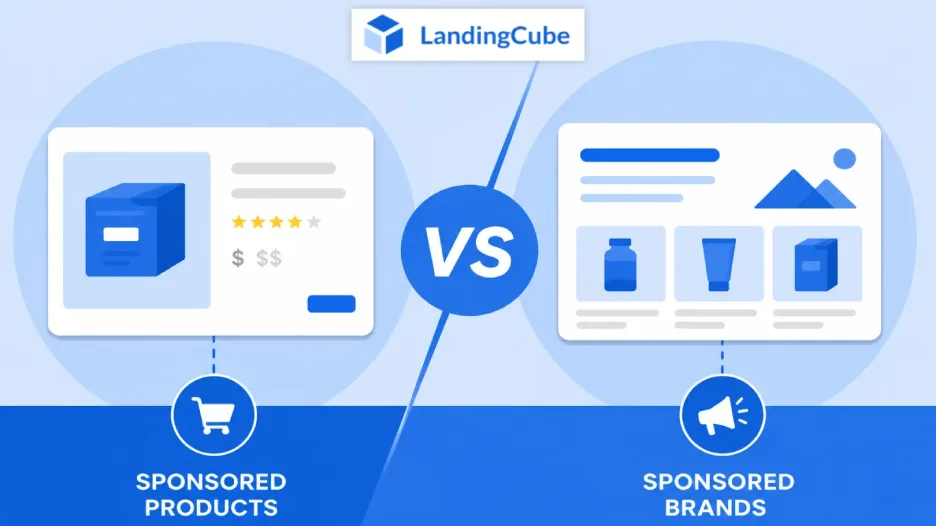
For most new sellers, Sponsored Products are the easiest place to start. They show up when shoppers are already searching for a product like yours, which makes them more direct. Sponsored Brands are better when you want shoppers to notice your brand, see more than one product, or land on your Storefront. Sponsored Display has a different job again, since it can help you reach shoppers who are already at your listing but did not buy. These ad types also fit into a broader Amazon marketing funnel, where each campaign format plays a different role in moving shoppers closer to purchase.
The trouble starts when sellers try to run all three with a small budget. It feels safer because you are “testing everything,” but usually it just spreads the budget too thin. One campaign gets a few impressions, another gets a few clicks, and none of them collect enough data to tell you much.
That is when sellers start blaming Amazon ads. Sometimes the product, pricing, or offer really is the issue. But a lot of time, the bigger problem is that the ad format does not match where the product is in its lifecycle.
In this guide, you’ll walk through Sponsored Products, Sponsored Brands, and Sponsored Display without overcomplicating it. You’ll look at what each format does, when it makes sense, and how to decide where your budget should go first. By the end, you should have a clearer idea of which format to start with and which ones can wait.
The “Big Three” Amazon Ad Formats Explained
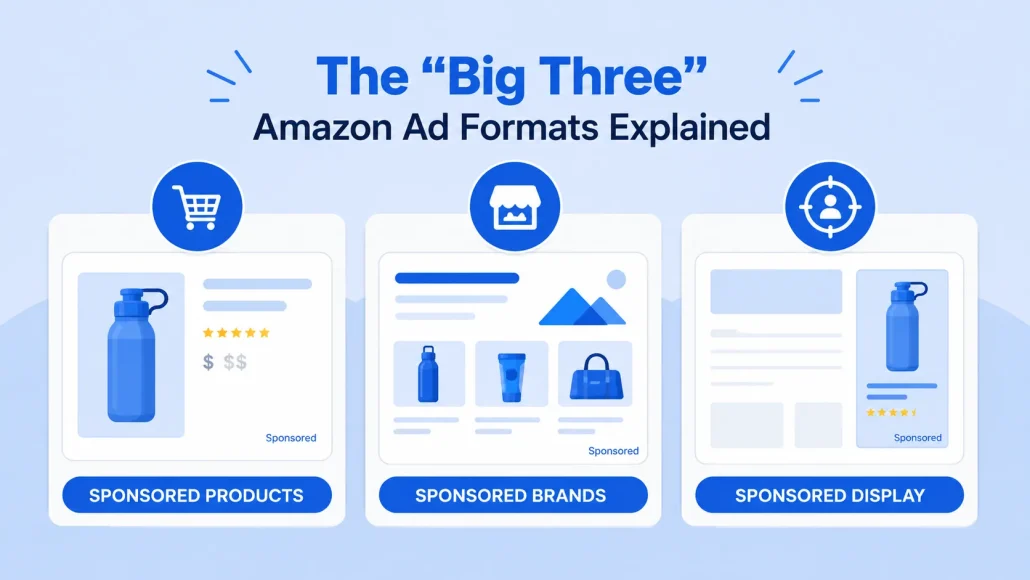
Before deciding where your budget should go, you first need to know what you are actually paying for. Amazo
The trouble starts when sellers try to run all three with a small budget. It feels safer because you are “testing everything,” but usually it just spreads the budget too thin. One campaign gets a few impressions, another gets a few clicks, and none of them collect enough data to tell you much.
That is when sellers start blaming Amazon ads. Sometimes the product, pricing, or offer really is the issue. But a lot of time, the bigger problem is that the ad format does not match where the product is in its lifecycle.n offers three primary advertising formats, and each one was built for a different purpose. Knowing when to use each format can be the difference between campaign success and cash destruction.
1. Sponsored Products (The Workhorse)
Sponsored Products are the foundation of Amazon advertising. Even brands spending millions every year still put most of their budget into Sponsored Products because they consistently deliver the most direct sales.
These are cost-per-click (CPC) ads that promote individual listings. They blend into Amazon’s search results so well that many shoppers do not realize they are clicking on an ad. They can appear at the top of the page, throughout search results, and on competitor listings.
The biggest advantage is buyer intent. Someone searching for “stainless steel garlic press” is not casually browsing. They already have a product in mind. Sponsored Products put your listing in front of shoppers while they are ready to buy, which is why they usually produce stronger conversion rates than the other two formats.
For most sellers, this is where the learning process begins. Sponsored Products help you discover which keywords convert, whether your listing can close the sale, and how your ad budget is returning value. If you track multiple traffic sources, do not confuse Amazon ad conversion data with broader metrics like Amazon affiliate conversion rate, since each one measures a different type of traffic and buyer intent.
2. Sponsored Brands (The Halo Effect)
Sponsored Brands become available after you register your brand with Amazon Brand Registry. Unlike Sponsored Products, these campaigns focus less on selling one item and more on getting your brand in front of shoppers.
You’ll see them above standard search results with your logo, headline, and several products displayed together. Sponsored Brands Video has also become popular because it captures attention before shoppers start comparing listings. This is also where stronger creative assets, including Amazon A+ Premium Content, can help support the brand story shoppers see after they click.
That extra visibility comes with a different objective. While Sponsored Brands can generate sales, they are also designed to introduce shoppers to your brand. Instead of sending someone to one product page, you can send them to your Amazon Store, where they can browse your listings without immediately seeing competing listings. This is why Sponsored Brands often become more useful once you start thinking seriously about how to build a brand on Amazon, not just how to sell one product.
The trade-off is that not every click comes from someone ready to buy. Some shoppers are simply discovering your brand for the first time, which is one reason Sponsored Brands often produce a higher ACoS than Sponsored Products.
3. Sponsored Display (The Retargeting Engine)
Sponsored Display works differently from the other two formats because it was not built on keyword searches alone.
Instead, it focuses on audiences. These ads can appear on Amazon product pages, but they can also follow shoppers after they leave Amazon by showing up on participating websites and apps.
This makes Sponsored Display useful for retargeting. If someone visited your listing yesterday but kept shopping, Sponsored Display gives you another chance to bring them back before they buy from a competitor. This becomes even more useful when paired with an Amazon landing page or external traffic strategy that helps warm up shoppers before they return to Amazon.
Used correctly, this can be effective. Used too broadly, it can quickly become expensive. Targeting large interest groups without enough buyer intent usually results in many clicks and few sales.
RANK LIKE THE PROS
Discover a better way to rank products from external traffic, like Facebook, Google and TikTok, with LandingCube promo pages.
Try it free for 21 days.
For that reason, Sponsored Display is generally better suited for established campaigns than new product launches. Once you have traffic, customer data, and a healthy ad budget, it becomes much easier to use effectively.
The Strategic Matrix: When to Use Which Ad Format
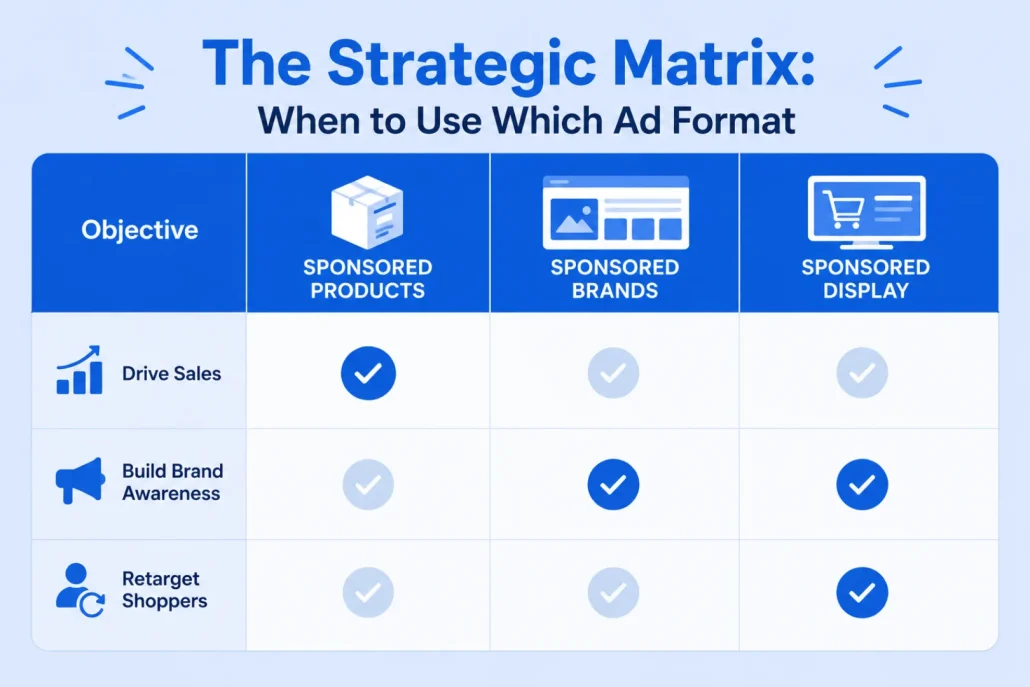
This is where most sellers get stuck. Knowing what each ad format does is one thing, but deciding where your budget should actually go is another.
Your best option depends on a few practical things: how much you can spend, what kind of product you sell, how competitive your price is, and whether the product is brand new or already selling well.
1. Your Overall Ad Spend (The Budget Constraint)
Your ad budget usually decides the strategy before anything else. You cannot run a full Amazon funnel strategy on $40 a day and expect every campaign type to get enough data.
If your monthly ad spend is under $3,000, keep it simple. Put your budget into Sponsored Products first. At that level, you do not have much room to test brand awareness campaigns. Every dollar needs to work as close to the sale as possible. It will give you the most efficient Cost Per Acquisition (CPA).
If you are spending between $3,000 and $10,000 per month, you can start to test a little. Sponsored Products should still take most of the budget, but Sponsored Brands Video may be worth a small test. That way, you keep direct sales coming in while seeing whether premium search placement helps.
If you are spending more than $10,000+ per month, you have more room to build a proper funnel. Sponsored Display retargeting can start to make sense here because you already have enough traffic to bring shoppers back after they click and leave without buying. At this stage, tools like Amazon PPC Tools and Amazon Analytics Tools can help you track performance more clearly before adding more campaign types. Some sellers also use ChatGPT for Amazon Sellers to organize campaign ideas, review keyword data, and plan tests before increasing spend.
2. Brand vs. Generic Search Volume
Next, look at how shoppers are finding you. Are they searching for your product type, or are they already searching your brand?
High Generic Search Volume (No Brand Recognition): If you just launch a silicone baking mat, almost nobody is searching for your brand name yet. You need Sponsored Products to show up for non-branded terms like “non-stick baking mat.” That is where the existing demand already is.
High Brand Search Volume: If people are already searching for your brand, the strategy changes. Competitors may bid on your brand name and try to steal the traffic you worked to build. Sponsored Brands help defend that space by putting your logo and products at the top of the results. If that brand demand came from outside Amazon, tools like LandingCube can help you understand how to drive external traffic to Amazon without losing track of attribution and conversion quality.
3. The Performance of Each Ad Type (ACoS and ROAS Goals)
Your target ACoS and ROAS also matter. If you need strict efficiency and cannot afford to waste much cash, Sponsored Products are usually the safer choice.
Optimizing for strict profitability (Low ACoS): Exact match and long-tail keyword campaigns help you focus on shoppers who already know what they want. That makes them useful when cash flow is tight and you need your ad spend to stay close to breakeven.
Optimizing for Market Share (Higher ACoS tolerance): Sponsored Brands make more sense when you can tolerate a higher ACoS for the sake of reach. A Sponsored Brands Video campaign may cost more per click, but it can introduce shoppers to your brand and help you win customers beyond the first sale.
4. The Type of Product You Sell
The product itself changes the way people shop. A cheap impulse product does not need the same strategy as an expensive product that takes days of comparison.
Impulse Buys & Low-Ticket Items: If you sell a $12 phone case, shoppers may decide quickly. They search, scan a few options, click what looks good, and buy. Sponsored Products are usually the best fit because you just need to appear where the shopper is already looking.
High-Ticket & Consideration Items: If you sell a $400 espresso machine, the sale is different. Shoppers may compare reviews, check features, leave the page, watch videos, and come back later. Sponsored Display can help in that situation because it keeps your product in front of people who already showed interest. For products with longer buying journeys, channels like Facebook ads for Amazon products and TikTok Ads for Amazon can also support awareness before the shopper comes back to buy. If TikTok is one of your primary marketing channels, learning How to promote Amazon Products on TikTok can help you create content that reaches the right audience while supporting your Amazon advertising strategy.
5. Your Price Competitiveness in the Niche
Price matters more than sellers like to admit. If your product is clearly cheaper than similar competitors, Sponsored Products can work well on competitor detail pages.
If you are the cheapest option: When your ad appears on a competitor’s product detail page through ASIN targeting, shoppers immediately have a price comparison in front of them. If your product offers similar quality at a lower price, there is a clear reason for them to click your listing instead.
If you are the premium (expensive) option: If your product is more expensive, the strategy needs to change. Competing only on price will be hard. Sponsored Brands Video can help because it gives you space to show why the product costs more, whether that is better build quality, better packaging, stronger features, or a more premium use case. Before pushing more budget into ads, it also helps to run an Amazon listing audit so you know whether your product page can justify the higher price.
6. The Product Lifecycle (Launch vs. Cash Cow)
A product launch and an established best seller should not use the same ad strategy. They have different jobs to do.
The New Product Launch (“The Honeymoon Phase”): If you are launching a new product, Sponsored Products should usually carry most of the budget. Early on, you need sales velocity, keyword data, and a better chance of gaining traction in search results. Profit still matters, but the first job is often getting the product seen and bought. This is also where Amazon Product Research Tools can help sellers confirm whether the product has enough demand before scaling ad spend.
RANK LIKE THE PROS
Discover a better way to rank products from external traffic, like Facebook, Google and TikTok, with LandingCube promo pages.
Try it free for 21 days.
The Cash Cow Product: Once the product becomes a steady seller, the strategy changes. You can pull back on some aggressive generic Sponsored Products spend and use Sponsored Brands to protect your brand presence. Sponsored Display can also help retarget shoppers or cross-sell related products to shoppers who are already engaging with your catalog. Over time, this kind of strategy supports the Amazon flywheel, where traffic, sales, reviews, and ranking begin to reinforce each other.
The Bottom Line
At the end of the day, new Amazon sellers should not walk into Amazon Ads blind and expect the numbers to work out. There is more math behind a good campaign than a dashboard makes it seem. Amazon may make it look like you just pick a campaign type, add a daily budget, and wait for sales, but that is not how it usually plays out.
The common mistake is spreading a small budget across Sponsored Products, Sponsored Brands, and Sponsored Display at the same time. It feels like you are covering all your bases, but really, each campaign ends up with too little money and too little data. That is how sellers end up with weak campaigns and a lot of frustration.
Start with Sponsored Products first. Use them to test whether your listing converts, which keywords are worth paying for, and whether your product can start gaining organic traction. Once the product is converting and the numbers are not fighting against you, then Sponsored Brands become more useful for taking up visual space and protecting your brand.
When the ad format matches your budget, product lifecycle, and market position, Amazon Ads stop feeling like random spend. They become a more controlled way to grow the business. If your goal is learning how to increase sales on Amazon, the key is not using every ad type at once. It is choosing the format that matches your product stage and budget.
Once the right ad format is working, the next step is learning how to increase traffic to your Amazon listing without sending low-intent clicks that waste budget.
FAQ: The Difference on Amazon Sponsored Products & Sponsored Brands
There is no perfect number that works for every seller. If you only have around $20 per day, do not split that budget across several campaign types.
Put it into Sponsored Products first. With a small budget, your priority is getting enough clicks and sales data to learn what is working. If you spread the money across Sponsored Products, Sponsored Brands, and Sponsored Display, none of the campaigns will get enough data to tell you much.
Think of Sponsored Products as ads for individual listings. They look similar to regular Amazon search results and are built to reach shoppers who are already looking for a specific product.
Sponsored Brands are more about brand visibility. They can show your logo, headline, video, and several products together. They are usually a better fit once you have Amazon Brand Registry and want shoppers to notice your brand, not just one listing.
No. You do not need Amazon Brand Registry to run Sponsored Products ads. Most sellers with an active Professional Seller account can start there.
You will need Brand Registry if you want to run Sponsored Brands and access other brand-focused ad features, including Sponsored Display.
If Sponsored Display is spending without sales, the first thing you would check is the targeting. Many sellers accidentally go too broad and end up paying for clicks from people who are not close to buying.
Sponsored Display usually works better when it is used for retargeting. That means showing ads to shoppers who already viewed your product but left without purchasing. Cold audiences can work in some cases, but they are much easier to waste money on. If you are testing outside traffic, make sure you also understand Amazon Attribution so you can see which channels actually contribute to sales.
An ASIN targeting campaign lets you place your ad on specific product detail pages instead of bidding only on a keyword. In simple terms, you can show your product directly on a competitor’s listing.
This works best when your product has a clear reason to win the click. Maybe it is cheaper, has better reviews, stronger images, or a better offer. If there is no obvious advantage, ASIN targeting can still get clicks, but those clicks may not turn into sales.
Sponsored Products usually produce the best ACoS, especially exact match keyword campaigns. They catch shoppers who are already searching for a specific product, so the buying intent is stronger.
Sponsored Brands and Sponsored Display can still be useful, but they often sit earlier in the buying journey. That is why they may show a higher ACoS, especially when you use them for awareness, retargeting, or brand-building.
No. Sponsored Brands videos may auto-play in the search results, but they are muted by default.
This is why your video needs to work without audio. Use clear visuals, captions, or text overlays so the shopper can understand the message even if they never turn the sound on.
Yes. Ranking #1 organically is great, but it does not mean you should automatically turn ads off.
The top of the Amazon search page is competitive. If you stop running Sponsored Products or Sponsored Brands, competitors can buy the ad placements above or around your organic result. Running ads can help protect your visibility and make it harder for competitors to pull shoppers away.
In most cases, no. Sponsored Products, Sponsored Brands, and Sponsored Display are designed to send shoppers to Amazon product detail pages or Amazon Storefronts.
If your goal is to send people to Shopify, you would usually use external ad platforms instead. Amazon ads are mainly built to keep shoppers inside the Amazon ecosystem.
New-to-Brand tells you whether a shopper who bought from your ad has not purchased from your brand in the last 12 months. It helps you see whether your ads are bringing in new customers or mainly driving repeat purchases.
Sponsored Brands and Sponsored Display track New-to-Brand metrics. Sponsored Products do not give the same level of brand acquisition reporting.
RANK LIKE THE PROS
Discover a better way to rank products from external traffic, like Facebook, Google and TikTok, with LandingCube promo pages.
Try it free for 21 days.