Best Amazon Product Research Tools for Sellers (2026 Update)
Choosing what to sell is one of the most consequential decisions an Amazon seller makes. A weak product idea can tie up thousands of dollars in inventory, freight, photography, packaging, advertising and storage before the first meaningful sales data arrives. A strong opportunity does not guarantee success, but it gives every later decision (from sourcing to launch) a better foundation.
Amazon product research tools are designed to reduce that uncertainty. They help sellers uncover possible product opportunities, estimate customer demand, measure competition, examine sales-rank and price history, identify gaps in existing products and calculate whether the economics could work before placing a large inventory order.
In this guide, we compare the leading Amazon product research tools specifically for pre-launch product discovery and validation. We focus on whether each platform can help answer practical questions:
Is there sustained customer demand?
Is the niche accessible to a new seller?
Can the product be differentiated in a meaningful way?
Is the expected contribution margin large enough to absorb mistakes?
Does the opportunity fit your business model, capital and operational capabilities?
We also explain which tools are most appropriate for private-label, wholesale, online-arbitrage and retail-arbitrage sellers. A disciplined seller with two complementary tools will usually make better decisions than a seller who buys an expensive software suite and treats its sales estimate as a prediction.
Last reviewed: August 2026. We checked pricing, plan names, trial conditions and product-research features against current information published by each provider. Software companies frequently change their plans, usage limits and promotional offers, so confirm final terms before subscribing.
TL;DR: The Best Amazon Product Research Tools at a Glance
The table below provides a quick comparison of each tool’s best use case, current access conditions, core research features and principal limitation. The table summarizes each platform’s best use case, current access conditions, principal product-research features and main limitation.
Access conditions vary considerably. SellerSprite and AMZScout currently offer limited free access or trial access, while Keepa provides basic functionality for free. Jungle Scout and Viral Launch do not advertise conventional free trials; instead, they offer short money-back-guarantee periods. Because providers frequently change free limits and promotional terms, verify current access before subscribing.
Comparison of the nine best Amazon product research tools for US sellers in 2026
Rank
Tool
Best For
Current Price and Access
Key Product Research Features
Main Limitation
1
Jungle Scout Catalyst
New and growing private-label sellers who want a guided, all-in-one
research workflow
From $49/month
Entry-level access is equivalent to approximately $29/month when
billed annually. No conventional free trial; a seven-day
money-back guarantee is available.
Product Database and Opportunity Finder
Browser Extension with sales estimates
Product Tracker and historical trends
Category Trends
Keyword and supplier research
Search limits, historical-data access and exports vary by plan.
Sellers requiring deeper research capabilities may need a more
expensive Catalyst tier.
2
Helium 10
Serious private-label sellers who want product and keyword research
in one broader Amazon seller suite
Platinum: $129/month
Platinum is equivalent to $99/month with annual billing. Diamond
costs $359/month or the equivalent of $279/month when billed
annually. A limited free plan is available.
Black Box product and niche discovery
Xray Chrome Extension
Product Launchpad and viability analysis
Cerebro and Magnet keyword research
Listing Review Insights
It is one of the more expensive options. Sellers who only require
product discovery may pay for operational, listing and marketing
features they do not need.
3
SellerSprite
Detailed product, category, competitor and keyword research at a
comparatively accessible price
Paid plans from $39/month
Higher plans currently extend to $189/month. Limited free access
and a no-credit-card trial are available.
Product and competitor research
Category and market insights
Keyword mining and reverse-ASIN research
Browser Extension
Product, keyword and new-listing tracking
The volume of filters, datasets and reports creates a steeper
learning curve than more guided platforms. Tracking and export
capacity also varies substantially between plans.
4
Amazon Product Opportunity Explorer
Amazon-native demand, customer-behavior, review and return insights
No separate software fee
Included with an Amazon Professional selling account, which costs
$39.99/month plus selling fees.
Amazon search and purchasing behavior
Niche demand and saturation information
Search-volume and sales trends
Customer review themes
Return activity and unmet-demand opportunities
It does not replace a complete profitability model, supplier
database or detailed ASIN price-history tool. Access also requires
an Amazon Professional seller account.
5
SmartScout
Wholesale, online arbitrage, brand, seller and category research
Basic: $29/month
Essentials costs $97/month and Business costs $187/month.
Annual billing discounts and a seven-day money-back guarantee are
available.
Brand, product and seller databases
Research across more than 40,000 subcategories
Product Opportunity Finder
Price List and UPC Scanner
Sales Estimator and FBA profitability calculator
Its brand, seller and category approach is especially strong for
wholesale and resale research, but it is less guided than Jungle
Scout for a seller launching a first private-label product.
6
ZonGuru
Combining product discovery with keyword and supplier research
Researcher: $49/month
Researcher is equivalent to $29/month when billed annually.
Seller plans begin at $79/month. A seven-day free trial is
available.
Niche Finder
Chrome Extension
Sales Spy
Easy Source supplier matching
Keywords on Fire and Listing Optimizer
Data freshness can vary between its niche-discovery tools and its
Chrome Extension. Sellers needing broader operational and
monitoring features require a higher-priced Seller plan.
7
Keepa
Historical price, sales-rank, offer and competition validation
Free basic functionality
Advanced product-research, export and data-access functions
require a paid subscription. Confirm the current paid price
directly in Keepa before subscribing.
Historical price and Buy Box charts
Sales-rank history
Offer, seller-count and stock history
Product Finder and category data
Alerts, exports and seasonality validation
Keepa is a powerful historical-validation tool rather than a
complete all-in-one research platform. It does not replace keyword,
supplier or product-differentiation research.
8
AMZScout
Beginners who prefer browser-based product research and
straightforward profitability estimates
AI Bundle: $59.99 for one month
Current main-page offers also include $169.99 for three months
and $399.99 for 12 months. A no-credit-card PRO AI Extension
trial is available.
PRO AI Extension
Product Database and Product Tracker
Sales history and FBA profit estimates
Keyword and competitor research
AI Review Analyzer and supplier matching
AMZScout operates several packages and promotional pricing pages,
which can make direct price comparisons confusing. Confirm exactly
which tools and usage limits are included before purchasing.
9
Viral Launch
Straightforward product discovery and market validation
Core: $49/month
Core costs $539 annually. Growth costs $79/month and Scaler
costs $249/month. A seven-day money-back guarantee is available.
Product Discovery
Market Intelligence
Sales, revenue and competition estimates
Chrome Extension with FBA calculator
Seasonality and keyword-demand research
The Core plan is narrower than the leading all-in-one suites.
Advanced competitor, keyword and listing tools require the Growth
plan, while PPC automation is reserved for Scaler.
Pricing and features checked August 6, 2026. Prices are in US dollars unless otherwise stated and exclude taxes, Amazon selling fees and optional add-ons. Providers frequently change plans, usage limits and promotional offers, so verify final terms before subscribing. Rankings reflect LandingCube’s editorial assessment of each platform’s usefulness for pre-launch product research; they are not a measure of independently verified sales-estimate accuracy.
What is an Amazon Product Research Tool?
An Amazon product research tool helps sellers discover and evaluate possible products before committing to inventory. Depending on the platform, it may provide estimated sales, keyword demand, competition data, sales-rank history, price history, review insights, supplier information and preliminary profitability calculations.
The purpose of these tools is not to guarantee that a product will succeed. Most sales, revenue and search-volume figures produced by third-party platforms are estimates rather than complete records of competitor performance. They are best used to compare opportunities, identify potential risks and determine which product ideas deserve deeper investigation.
Different tools also serve different sourcing models. A private-label seller may need niche discovery, keyword research, customer-review analysis and supplier matching. A wholesale or arbitrage seller may place more value on price history, seller count, Buy Box behavior, product restrictions and expected sell-through.
The best Amazon product research tool is therefore not necessarily the platform with the longest feature list. It is the one that supplies the evidence required for the type of sourcing decision you are trying to make.
Amazon Product Research Tools vs. Amazon Analytics Tools
Amazon product research platforms and Amazon analytics platforms often display similar metrics, but they serve different stages of the seller journey.
A product research tool is primarily used before a seller commits to sourcing or launching an item. It helps uncover possible products, estimate demand, evaluate competition, study historical trends and determine whether a market appears commercially viable.
Its central question is:
Should I sell this product?
An Amazon analytics tool is primarily used after a listing is live and generating business data. It brings together actual revenue, fees, advertising spend, refunds, inventory, sessions, conversion and profitability information.
Its central question is:
What is happening in my Amazon business, why is it happening and what should I do next?
Some Amazon software suites cover both functions, but this guide evaluates them specifically for finding and validating new selling opportunities. It does not rank them according to their advertising dashboards, profit reporting or operational analytics for existing products. For those use cases, see our separate comparison of the best Amazon analytics tools.
What Should an Amazon Product Research Tool Help You Decide?
An Amazon product research tool should do more than display estimated monthly sales or assign an opportunity score. Its purpose is to help you decide whether a product idea deserves deeper investigation—or whether you should reject it before committing money to samples, inventory, freight, packaging and advertising.
No single metric can answer that question. A product may generate substantial estimated revenue but be dominated by one established brand. Another niche may have relatively few reviews but insufficient customer demand. A promising selling price may also become unattractive once Amazon fees, freight, returns and advertising costs are included.
A useful product research platform should therefore help you evaluate six connected areas.
Is There Real Customer Demand?
The first question is whether the broader market contains enough demand to support another relevant product—not simply whether one successful listing generates substantial sales.
Useful signals include estimated unit sales, keyword search volume, sales rank, revenue estimates, “bought in past month” data and the number of listings receiving meaningful orders.
Look across several related keywords and competing products. A niche can appear attractive because one dominant ASIN controls most of the revenue while the remaining listings sell very little. In that situation, the total market size may overstate the opportunity available to a new seller.
Healthy demand is generally distributed across several products, showing that customers are willing to consider more than one brand or product configuration.
Is the Demand Durable?
Current sales figures provide only a snapshot. Before ordering inventory, examine whether demand is stable, growing, declining or driven by a temporary event.
Historical sales-rank, pricing and keyword data can reveal seasonal peaks, short-lived trends, promotional spikes and competitor stockouts.
Seasonality is not automatically a problem. A seasonal product can be profitable when purchasing, production and inventory are planned correctly. The danger is treating peak-season sales as a normal monthly forecast.
A strong research tool should help distinguish sustained customer demand from a brief increase caused by a holiday, viral trend or temporary reduction in competition.
Can a New Seller Realistically Compete?
Competition cannot be measured by review count alone.
A market with thousands of reviews may still contain room for a clearly differentiated premium product. Conversely, a niche with fewer reviews may be difficult to enter if one recognizable brand controls most clicks, advertising placements and purchases.
Evaluate factors such as:
How concentrated sales are among the leading listings
The strength of established brands
Average ratings and review counts
Listing quality
Price stability and discounting
The presence of Amazon as a seller
Whether newer listings have gained traction
The amount of sponsored placement activity
The question is not whether competitors exist. Profitable markets almost always attract competition. The question is whether the market leaves a realistic opening for a new product with a clear advantage.
Is There a Meaningful Differentiation Opportunity?
Product research should help explain why customers choose existing products and where those products fail to meet expectations.
Review and return analysis can reveal recurring complaints involving:
Material quality
Durability
Sizing or compatibility
Packaging
Assembly
Missing accessories
Confusing instructions
Cleaning or maintenance
Frequently requested features
The strongest opportunities solve a specific, recurring customer problem. Adding another color, including a cheap accessory or claiming “better quality” without evidence rarely creates a durable competitive advantage.
Focus on patterns that appear across several listings rather than isolated complaints. The proposed improvement must also be commercially realistic. A desirable feature may require expensive materials, complex engineering or a protected design that makes the product unviable.
Research software can identify possible gaps. Supplier discussions, samples and product-development judgment are still needed to determine whether those gaps can be solved profitably.
Do the Unit Economics Work?
Estimated revenue can make an unattractive product look promising. What matters is the contribution remaining after all relevant costs have been included.
A preliminary profitability calculation should account for:
Manufacturing and packaging
Inspection
Freight and duties
Prep and labeling
Amazon referral and fulfillment fees
Storage
Expected returns
Discounts and promotions
Advertising
A contingency allowance
Run conservative, expected and optimistic scenarios. The conservative case should assume a lower selling price and higher product, advertising and return costs.
Do not evaluate margin only as a percentage. A product may show an attractive percentage while generating too little profit per unit to absorb rising advertising costs, returns or an unexpected fee increase.
A product that only works when every assumption is favorable is not a strong opportunity.
Does the Opportunity Fit Your Business?
A product can look attractive in the data and still be wrong for your business.
A new private-label seller may struggle with a product requiring specialist certifications, expensive molds or a large minimum order. A wholesale seller may accept a thinner margin when demand is established and inventory turns quickly. An arbitrage seller may care more about Buy Box eligibility, restrictions and sell-through than product differentiation.
Before proceeding, consider whether the opportunity fits:
Your available capital
Your acceptable inventory risk
Your supplier network
Your marketplace experience
Your compliance capabilities
Your launch budget
Your desired inventory turnover
Your tolerance for seasonality and returns
The best product research tool is therefore not necessarily the platform with the most features. It is the one that provides the evidence required by your sourcing model and resources.
Do the Signals Support the Same Conclusion?
Opportunity scores can help narrow a long list of ideas, but they should not make the final sourcing decision.
Each platform uses different data sources and assumptions. Two tools may evaluate the same niche differently, and neither knows your exact supplier cost, freight terms, advertising plan or tolerance for risk.
The strongest opportunities are those where several independent signals agree:
Customers are actively searching and purchasing
Demand has remained reasonably stable
Sales are not controlled by one inaccessible competitor
Reviews reveal a meaningful product gap
Conservative financial assumptions still produce an acceptable margin
The product fits your business capabilities
When the signals conflict, investigate further rather than relying on the most optimistic estimate.
A product research tool should reduce uncertainty and expose risks. It should not create false certainty about a product that has not yet been sourced, launched or tested.
How We Evaluated the Amazon Product Research Tools
We compared the tools according to their usefulness for discovering and evaluating new Amazon product opportunities—not according to the total number of features advertised on their websites.
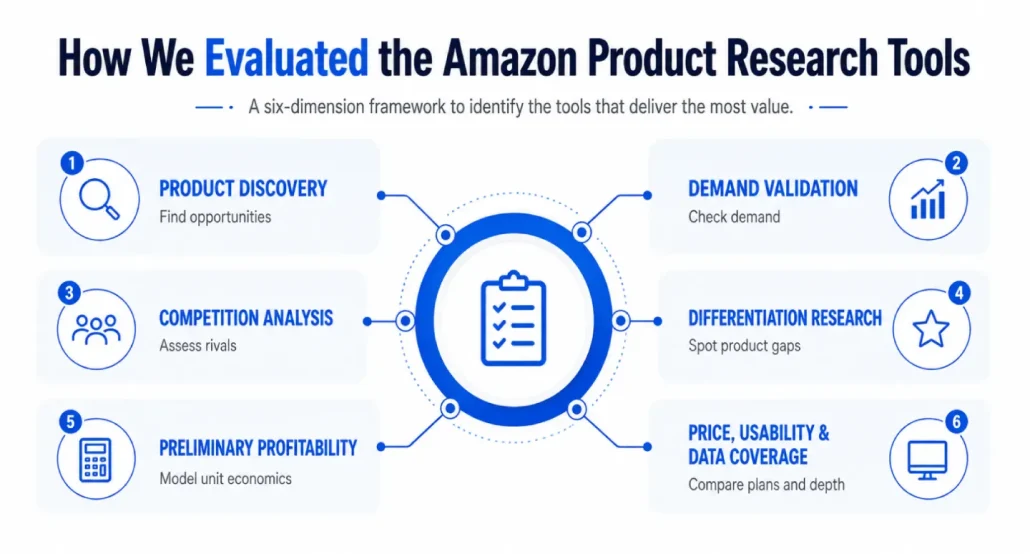
Our review considered six core areas.
We examined product and niche discovery. A useful discovery platform should help sellers move from a broad category, keyword or supplier list to a manageable shortlist of products. Relevant filters may include estimated sales, price, review count, rating, seller count, product size, fulfillment method, search growth and seasonality.
We considered demand validation. We looked for information that goes beyond a single monthly sales estimate, including sales-rank history, price movement, search trends, seasonality, purchasing signals and the distribution of demand across competing listings.
We reviewed competition analysis. This includes the strength of established listings, sales concentration, review barriers, seller count, brand dominance, advertising activity and evidence that recently launched products have been able to enter the market.
We assessed differentiation research. Review analysis, return insights, listing comparisons and product-attribute information can help sellers understand why customers choose one product over another and where existing options fail to meet expectations.
We considered preliminary profitability research. A useful platform should make it easier to estimate Amazon fees and incorporate seller-supplied costs. We gave less weight to tools designed primarily to report the actual profitability of products that are already selling, because those belong in our separate Amazon analytics comparison.
Finally, we considered historical-data depth, marketplace coverage, browser-extension usability, export options, learning curve, free access, pricing and the transparency of each tool’s limitations.
Pricing, plan names and publicly documented features were checked against official provider information in August 2026. Unless explicitly stated otherwise, LandingCube has not independently verified each platform’s sales estimates against the private sales records of competing Amazon sellers. All modeled figures should therefore be treated as directional rather than exact.
In-Depth Reviews of the Best Amazon Product Research Tools
There is no single product research platform that is best for every Amazon seller.
Some tools are designed around the needs of private-label sellers developing entirely new products. Others are more useful for wholesalers and arbitrage sellers evaluating existing ASINs, brands or supplier price lists. Amazon’s own Product Opportunity Explorer provides valuable Amazon-native marketplace insights, while Keepa specializes in the historical evidence needed to validate current estimates.
The following reviews focus on the product-research capabilities of each platform. We examine what each tool does well, which sellers it suits, where its limitations become relevant and how its current pricing compares with the alternatives.
Jungle Scout: Best Overall for Private-Label Sellers
Jungle Scout has been one of the most recognizable Amazon product-research platforms for more than a decade. Its current Catalyst platform combines product discovery, historical tracking, keyword research, supplier research and listing tools in a relatively guided interface.
That makes Jungle Scout particularly suitable for new and growing private-label sellers who want to move from an initial product idea to market validation without assembling several unrelated applications.
Jungle Scout Product Database
Product Database allows sellers to filter a large catalog of Amazon products by category, estimated demand, price, reviews, competition, product size, fulfillment method and other criteria.
It is most useful at the beginning of the research process, when a seller needs to transform a broad category or business idea into a smaller group of possible products. Products uncovered in the database can then be sent to Product Tracker for closer monitoring.
Jungle Scout Product Tracker
Product Tracker lets sellers follow selected products over time instead of making a decision from a one-day estimate.
This is particularly useful when assessing seasonality, sales consistency and movement within a niche. Tracking several competing products can also show whether demand is distributed across the market or concentrated among one or two dominant listings.
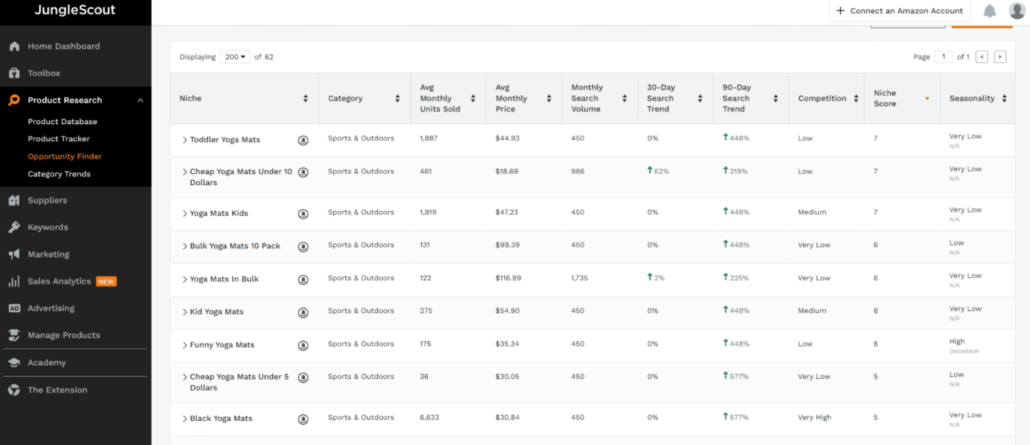
Jungle Scout Opportunity Finder
Opportunity Finder approaches discovery from the keyword and niche level. Sellers can investigate search demand, average units sold, average prices, reviews, seasonality and competitive conditions surrounding a group of related searches.
Jungle Scout assigns niches a summarized score, but that score should be treated as a screening aid rather than a final recommendation. A promising score does not account for every supplier cost, regulatory concern, intellectual-property risk or launch expense.
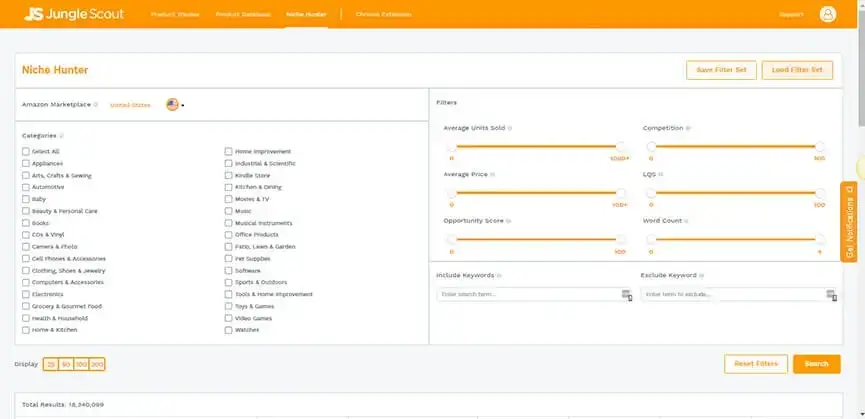
Jungle Scout Opportunity Hunter
Opportunity Finder approaches discovery from the keyword and niche level. Sellers can investigate search demand, average units sold, average prices, reviews, seasonality and competitive conditions surrounding a group of related searches.
Jungle Scout assigns niches a summarized score, but that score should be treated as a screening aid rather than a final recommendation. A promising score does not account for every supplier cost, regulatory concern, intellectual-property risk or launch expense.
Jungle Scout Category Trends
Category Trends tracks the leading products in Amazon categories and subcategories. Sellers can use it to observe changes in demand, identify rising product types and see which listings are gaining or losing prominence.
Jungle Scout currently describes Category Trends as a product-research feature that follows the top 100 products within a selected category or subcategory.
Jungle Scout Browser Extension
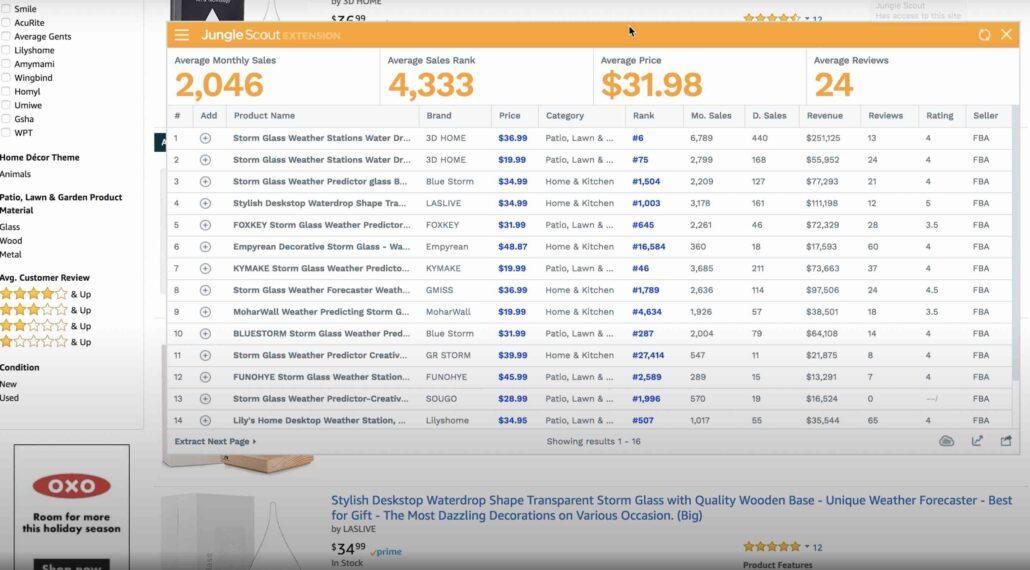
The Browser Extension adds estimated sales, revenue, reviews, fees and other product information to Amazon search-result and product pages. This makes it useful for quickly investigating the listings customers actually encounter for a keyword.
The extension is most valuable when used after broader database research. Product Database can generate ideas, while the extension can help sellers examine the live competitive landscape surrounding those ideas.
Supplier and keyword research
Catalyst also includes tools for keyword discovery, listing optimization and supplier research. Jungle Scout’s Supplier Database can be used to find manufacturers and review shipment relationships, while Keyword Scout helps sellers investigate search terms connected to an opportunity.
Main limitation
Jungle Scout’s entry-level plan may be restrictive for sellers conducting a high volume of research. Search allowances, tracking capacity, historical-data access and competitive-intelligence features increase on the higher-priced tiers.
Catalyst is also primarily designed for sellers operating through Amazon Seller Central. Established brands, agencies and Vendor Central teams that require category-wide market-share intelligence may be better suited to Jungle Scout Cobalt rather than Catalyst.
Jungle Scout pricing
Catalyst plans currently start at $49 with month-to-month billing or $348 annually, equivalent to $29 per month. Higher tiers increase research limits and add more advanced functions. Jungle Scout does not offer a conventional free trial, but it provides a seven-day money-back guarantee.
Jungle Scout verdict
Jungle Scout is the strongest overall option for a new or growing private-label seller who wants a structured research process. Its main advantage is not that any single feature is irreplaceable, but that discovery, tracking, keyword research and supplier investigation can be completed in one connected platform.
SellerSprite: Best Value for Detailed Product Research
SellerSprite offers a dense collection of product, category, keyword, competitor and advertising-research tools at a lower entry price than several of the best-known Amazon seller suites.
It is especially useful for sellers who want access to extensive filters and granular marketplace information without paying for a large set of operational tools they may not use.
Product and market research
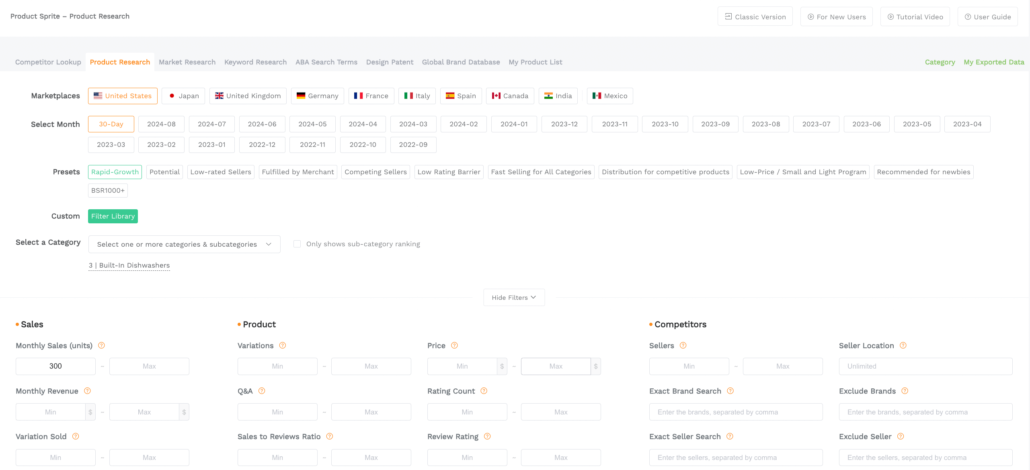
SellerSprite’s product-research interface lets users filter opportunities according to estimated sales, revenue, ratings, reviews, seller count, fulfillment type, price and growth.
Preset filters can help sellers investigate specific opportunity types, such as rapidly growing listings, lower-rated products or products fulfilled by merchants. These presets may be useful for beginners, while experienced users can create more customized searches.
Its market-research tools provide a broader view of a niche, including leading products, competitive concentration, pricing, review distribution and historical changes.
Keyword and competitor research
SellerSprite also offers keyword mining, reverse-ASIN research, keyword tracking and competitor analysis. These tools help sellers examine the search terms associated with competing products and assess whether demand is concentrated around a few dominant keywords or spread across a wider set of searches.
Review-analysis tools can supplement this research by identifying recurring customer complaints and buying motivations.
Marketplace coverage
SellerSprite currently states that its seller plans support ten Amazon marketplaces: the United States, Japan, the United Kingdom, Germany, France, Italy, Spain, Canada, India and Mexico. Sellers operating internationally should still check whether every individual feature is available with the same data depth in their target marketplace.
Main limitation
SellerSprite’s greatest weakness is complexity. The volume of filters, datasets and reports can make the interface less immediately approachable than a more guided platform such as Jungle Scout.
Plan limits also matter. Tracking capacity, sub-accounts and data allowances vary considerably, and the entry-level monthly plan has more restricted tracking functionality than the higher tiers.
SellerSprite pricing
Monthly plans currently include:
Basic: $39 per month
Standard: $79 per month
Advanced: $129 per month
VIP: $189 per month
SellerSprite also advertises limited free access and a free trial that does not require a credit card. Annual plans provide a discount compared with monthly billing.
SellerSprite verdict
SellerSprite offers strong value for sellers who are comfortable working with a large amount of product and keyword data. It is particularly appealing when detailed research matters more than polished onboarding or an extensive set of post-launch operational tools.
Amazon Product Opportunity Explorer: Best Amazon-Native Research Tool
Amazon Product Opportunity Explorer gives sellers access to aggregated information based on activity within Amazon’s own marketplace.
Rather than relying exclusively on third-party estimates, it analyzes how customers search, browse and purchase products. Amazon groups related searches and products into “niches” representing specific customer needs.
Where Product Opportunity Explorer Is Most Useful
Sellers can use Product Opportunity Explorer to examine:
Search volume and demand trends
Purchasing behavior
Competitive pricing
Niche saturation
Customer-review themes
Return activity
Product features associated with sales
Areas where customer demand may not be fully served
The ability to connect search behavior with purchases is particularly useful. A keyword may generate substantial interest without converting into consistent sales, while another niche may contain a smaller but more commercially valuable audience.
Review and return information can also reveal why customers are dissatisfied with existing products. This may help sellers identify a realistic product improvement rather than launching another nearly identical offer.
Amazon states that Product Opportunity Explorer analyzes search, browsing, purchasing, pricing, review and return behavior to identify potential gaps in the marketplace.
Main limitation
Product Opportunity Explorer is not a complete product-research stack.
It does not know your supplier quotation, freight costs, inspection fees, duties, advertising plan or acceptable return on capital. Historical specialists may also provide more detailed ASIN-level price and sales-rank charts, while third-party suites offer wider product filtering, browser extensions and supplier tools.
Amazon itself warns that the information is guidance rather than a guarantee. Sellers remain responsible for independently deciding which products to develop or source.
Access and cost
Product Opportunity Explorer does not carry a separate advertised software fee, but access requires an Amazon Professional selling account. Amazon currently charges $39.99 per month plus applicable selling fees for that account.
Product Opportunity Explorer verdict
Product Opportunity Explorer is a valuable source of Amazon-native demand and customer information. It works best as a validation layer alongside historical data, supplier research and a transparent profitability model.
Helium 10: Best Comprehensive Amazon Seller Suite
Helium 10 is a broad Amazon seller platform that combines product research with keyword research, listing optimization, operational reporting, advertising and educational resources.
For product discovery, its main advantage is the connection between Black Box, the Xray Chrome Extension, Cerebro, Magnet and customer-review insights. Sellers can move from broad opportunity discovery to keyword analysis and competitor investigation without leaving the platform.
Helium 10 Black Box
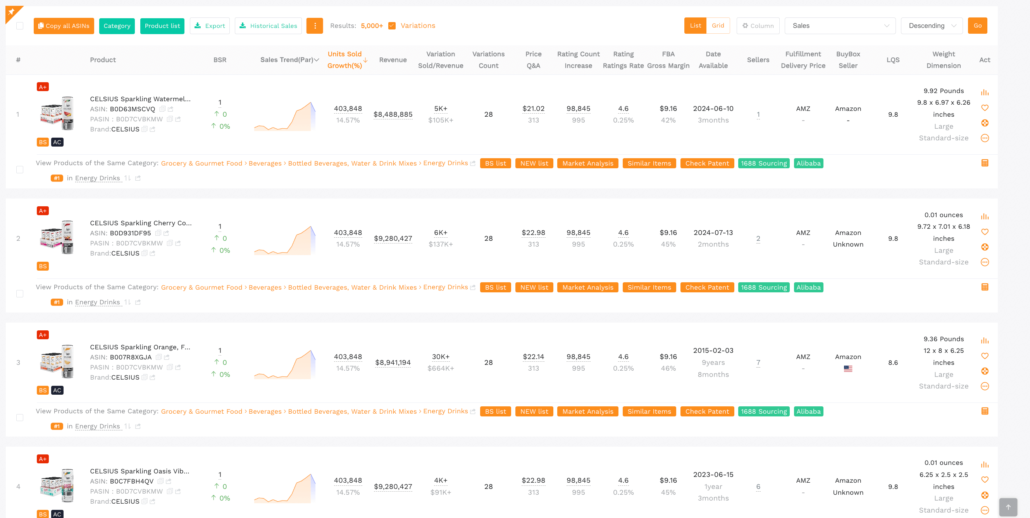
Black Box lets sellers filter Amazon products and keywords according to criteria such as category, estimated sales, revenue, price, reviews, competition and product characteristics.
It can be used to generate initial product ideas, search for products that match a predefined business model or investigate niches connected to particular keywords. As with every third-party product database, the sales and revenue figures should be treated as modeled estimates.
Helium 10 Xray
Xray is Helium 10’s browser-based research tool. It adds estimated sales, revenue, reviews, fees, seller information and competitive data to Amazon search-result and product pages.
Its customizable Two-Factor Success Score shows how many of the top ten organic products meet seller-defined revenue and review thresholds. It does not simply calculate a revenue-to-review ratio, and it should be used as a quick screening device rather than a prediction of success.
Cerebro and Magnet
Cerebro supports reverse-ASIN research, allowing sellers to investigate the search terms associated with competing products. Magnet starts with a seed keyword and generates related terms and demand estimates.
Together, these tools help sellers determine whether an opportunity is supported by several commercially relevant searches or relies heavily on one narrow keyword.
Listing Review Insights
Listing Review Insights extracts themes from customer reviews. Sellers can use it to identify frequently mentioned benefits, complaints and product attributes across competing listings.
This can help turn marketplace research into a more specific product concept. However, recurring complaints should still be read in context rather than treated as automatic feature recommendations.
Supplier matching
Helium 10’s Xray extension can connect Amazon product research with similar products available through Alibaba. This can reduce the time required to identify possible manufacturers, but it does not verify product quality, legal compliance or supplier reliability.
Every shortlisted supplier still requires independent due diligence, sampling, certification checks and quality-control planning.
Main limitation
Helium 10 is relatively expensive when product discovery is the seller’s only requirement.
Its subscription includes listing, analytics, operations, education and advertising functionality. That creates value for sellers who will use the broader suite, but it can result in unnecessary cost for someone who only needs occasional product research.
Helium 10 pricing
Platinum currently costs $129 with monthly billing or the equivalent of $99 per month when billed annually. Diamond costs $359 monthly or the equivalent of $279 per month with annual billing.
A limited free plan is available, but full Chrome Extension access and broader research limits require a paid plan.
Helium 10 verdict
Helium 10 is best for serious private-label sellers who want product discovery, keyword research and post-launch tools in one ecosystem. Jungle Scout may feel more guided for a first product, while Helium 10 provides a wider suite for sellers who expect to use its keyword, listing and operational features as the business grows.
Its Researcher plan is designed specifically for sellers who are still deciding what to launch, while its Seller plans add broader monitoring and business-management features for live products.
ZonGuru Niche Finder
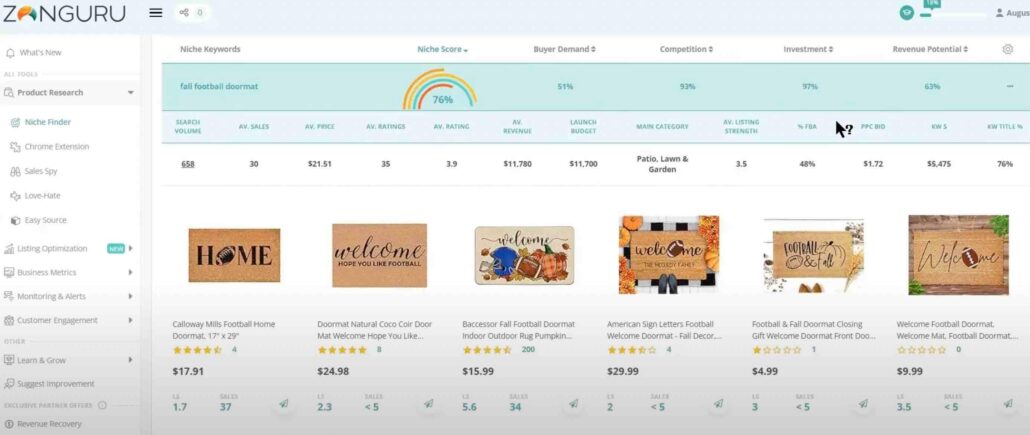
Niche Finder helps sellers generate product ideas by applying filters such as estimated revenue, sales, review count, competition and search demand. It also provides a summarized Niche Score that can help narrow an initial list of ideas.
ZonGuru Sales Spy
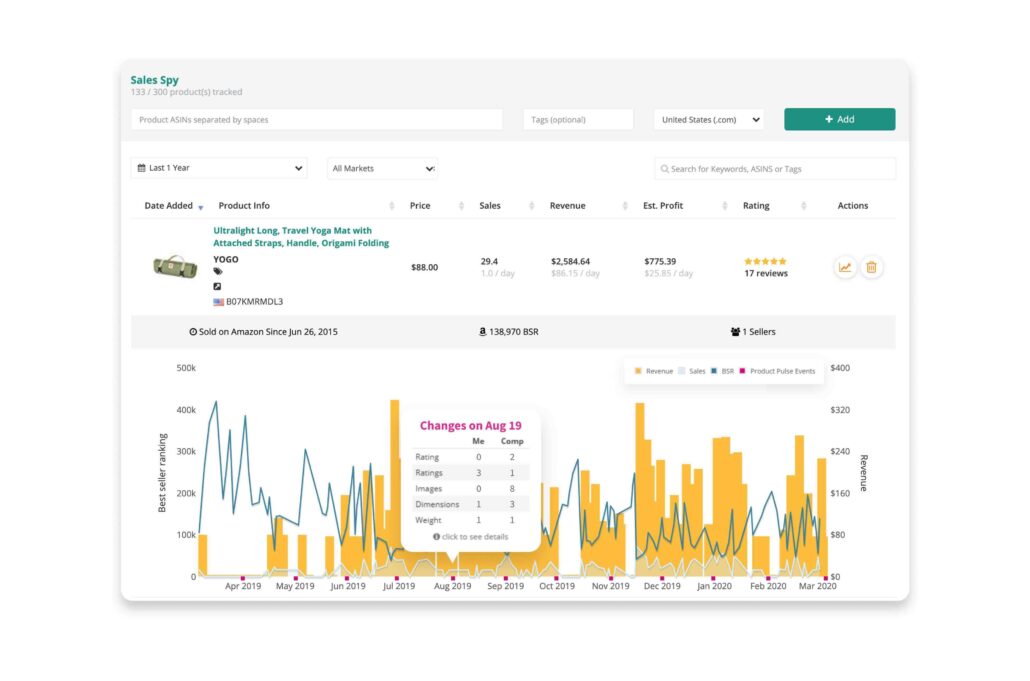
Sales Spy lets sellers follow selected products over time. It can help show whether demand is consistent, seasonal or affected by temporary changes in pricing and availability.
This is more useful than relying on a single daily estimate, particularly in markets where sales fluctuate around holidays or promotional events.
ZonGuru Easy Source
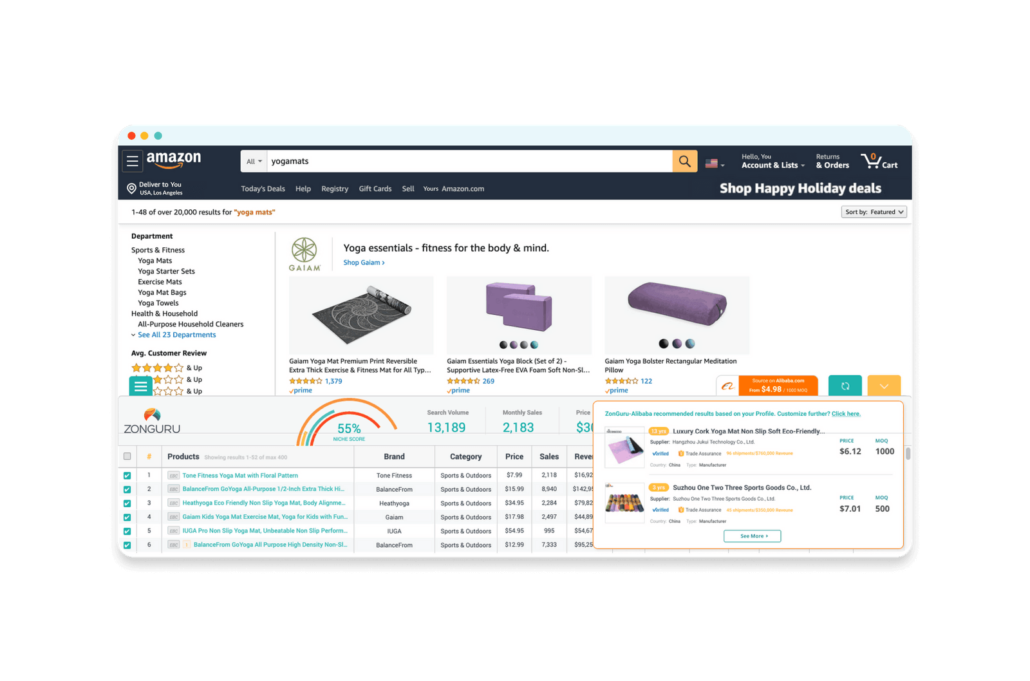
Easy Source connects Amazon product research with possible Alibaba supplier matches.
These matches should be treated as initial leads rather than approved manufacturing partners. Sellers must still verify supplier credentials, production capacity, samples, certifications, quality-control procedures and intellectual-property risks.
ZonGuru describes Easy Source as a collaboration with Alibaba designed to connect product ideas with potential suppliers.
ZonGuru Chrome Extension
The ZonGuru Chrome Extension adds estimated sales, revenue, reviews, fees, competition and profitability information to Amazon search pages. It is most useful for checking the current competitive environment after a seller has identified a possible niche through Niche Finder.
ZonGuru notes that its Chrome Extension retrieves current marketplace information when a search is run, while the broader Niche Finder dataset is updated periodically. Sellers should therefore use Niche Finder for broad discovery and the extension for more current validation.
ZonGuru Chrome Extension
ZonGuru’s integrated features for product research and optimization make it well-suited for scaling FBA businesses. Each tool offers unique advantages in data accuracy, ease of use, and features like keyword tracking and listing optimization, empowering sellers to confidently identify profitable products.
Keyword and listing research
The Researcher plan also includes Keywords on Fire and Listing Optimizer. These tools can help sellers understand the search terms associated with competing products and determine how a future listing might be positioned.
Main limitation
ZonGuru is a capable research platform, but its data cadence varies between tools, and its interface contains both pre-launch and post-launch functionality.
The Researcher plan is appropriate for discovery. Sellers who need business dashboards, monitoring, alerts and broader account-management functions must move to a Seller plan.
ZonGuru pricing
The Researcher plan costs $49 with monthly billing or $348 annually, equivalent to $29 per month.
Seller plans begin at $79 with monthly billing or the equivalent of $49 per month when billed annually.
ZonGuru currently offers a seven-day free trial.
ZonGuru verdict
ZonGuru is a strong choice for private-label sellers who want to connect product discovery with keyword and supplier research. It is less extensive than Helium 10 as an overall seller suite, but its Researcher plan remains closely aligned with the task of deciding what to launch.
Viral Launch: Best for Straightforward Market Validation
Viral Launch offers a focused set of product-discovery and market-validation tools for sellers researching possible Amazon opportunities.
Its Core plan is designed primarily for sellers who do not yet have active products and need foundational discovery, demand and competition information.
Viral Launch Product Discovery
Product Discovery lets sellers filter possible products according to category, estimated sales, price, reviews, competition and other market characteristics.
It is intended to generate an initial list of opportunities rather than prove that a particular product will succeed.
Viral Launch Market Intelligence
Market Intelligence provides a closer view of the products ranking for a keyword or competing within a selected market.
It includes estimated sales, revenue, pricing, review trends, competition and historical information. Sellers can use it to compare several opportunities and investigate whether a market appears stable, seasonal or unusually dependent on a small number of dominant listings.
Viral Launch Chrome Extension
The Market Intelligence Chrome Extension brings product and market information into Amazon search pages. It includes demand and competition estimates, sales trends, keyword insights and an integrated FBA calculator.
Main limitation
Viral Launch’s Core plan is deliberately narrower than the larger all-in-one platforms.
More advanced competitor research, expanded keyword tools and listing optimization require the Growth plan. PPC automation is reserved for the considerably more expensive Scaler plan.
This makes Core reasonably focused for product research, but sellers may need to upgrade or use another platform as their operational requirements expand.
Viral Launch pricing
Current plans are:
Core: $49 per month or $539 annually
Growth: $79 per month or $790 annually
Scaler: $249 per month or $2,739 annually
Viral Launch does not offer a conventional free trial. It currently provides a seven-day money-back guarantee.
Viral Launch verdict
Viral Launch is a practical option for sellers who want straightforward product discovery and validation without immediately purchasing a larger operational suite. Its Core plan is appropriately aligned with pre-launch research, although Jungle Scout, SellerSprite and Helium 10 provide broader research ecosystems.
AMZScout: Best for Browser-Based Product Research
AMZScout focuses heavily on browser-based product analysis through its PRO AI Extension, supported by a product database, trackers, sales estimates and additional research resources.
It is particularly approachable for sellers who prefer to begin on Amazon search pages rather than inside a complex market-intelligence dashboard.