

Aug 29th 2026
Resources
- Facebook Ads for Amazon [Video Course]
- Drive Traffic To Amazon [Ultimate Guide]
- Get More Amazon Reviews [Ultimate Guide]

TL;DR
How much can A+ Content improve sales?
Amazon says Basic A+ Content can increase sales by up to 8%, while well-executed Premium A+ can increase sales by up to 20%. However, simply filling every available module will not guarantee better performance; results depend on how clearly the content answers customer questions and communicates product value.
What should effective A+ Content actually do?
Strong A+ Content should answer important questions that the title, bullets and main image stack leave unresolved, such as compatibility, use cases, benefits or differences between models. The content should then guide shoppers from understanding the product to seeing its value, proof points and the right purchase option.
How should you design A+ Content for mobile shoppers?
Each module should communicate one obvious idea, with important claims immediately visible and copy large enough to read comfortably on a smaller screen. Avoid relying heavily on text embedded in images and always review both the desktop and mobile versions before publishing.
Which ASINs should you optimize first?
Start with high-traffic, high-margin or strategically important ASINs where better content has the greatest potential commercial impact. Products with confusing variants, complex features or repeated customer misunderstandings are especially strong candidates for A+ optimization.
Amazon A+ Content is no longer just an upgraded product description. Used properly, it answers the questions that stop shoppers from buying: Will this work for me? How is it different? Which model should I choose? What does that feature actually do in real life?
Amazon currently says Basic A+ Content can increase sales by up to 8%, while well-implemented Premium A+ can increase sales by up to 20%. But the words well implemented matter. Filling all five or seven available modules does not automatically improve conversion. The result depends on which questions you answer, how clearly you communicate the value proposition, how the page works on mobile and whether you test your assumptions against real customer behavior.
Table of Contents
- Amazon A+ Content Types in 2026: Basic, Premium and Brand Story
- Requirements Amazon Sellers Need to Meet to Create A+ Content
- Which ASINs Should You Optimize First?
- Does Amazon A+ Content Improve SEO?
- How Much Does Amazon A+ Content Cost in 2026?
- What Are the Differences Between Standard A+ and Premium A+ Content?
- Who Is Eligible for Amazon Premium A+ Content in 2026?
- Creating Amazon A+ Content With AI in 2026
- Amazon A+ Content Best Practices Start Before You Pick a Module
- Why Amazon Rejects A+ Content
- Check Amazon’s A+ Content Quality Analysis
- Design Amazon A+ Content for Mobile First
- Amazon Premium A+ Content Best Practices: Which Modules to Use for Maximum Sales Lift
- Premium A+ Modules to Use Selectively
- Common Mistakes when Creating Amazon A+ Content
- Additional Examples of Premium A+ Content in Use
- How to A/B Test Amazon A+ Content With Manage Your Experiments
- Conclusion: Getting More From Amazon A+ Content
- FAQ: Amazon A+ Content Best Practices
This guide explains how Amazon sellers should approach A+ Content in 2026. We’ll cover Basic A+, Premium A+ and Brand Story, current eligibility requirements, the modules worth using for different situations, mobile-first design, AI-assisted creation, Amazon’s content rules and a practical approach to A/B testing with Manage Your Experiments.
If you’re already using A+ Content, you’ll also learn how to identify the modules that are merely filling space and replace them with content that actually helps a customer choose your product.
Amazon A+ Content Types in 2026: Basic, Premium and Brand Story
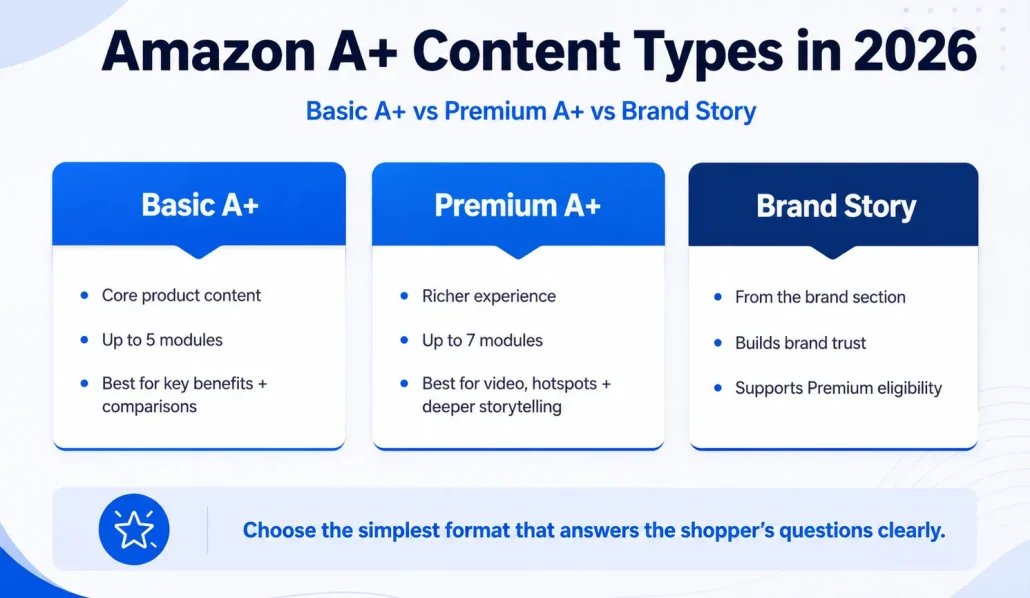
When sellers talk about “Amazon A+ Content,” they are sometimes referring to three related but different tools. Understanding the distinction matters because each one solves a different part of the product-detail-page problem.
Basic A+ Content
Basic A+ is the foundation. It lets eligible sellers expand the product description with structured combinations of images and text, technical information and product-comparison content.
Amazon currently allows up to five Basic A+ modules per ASIN. The format is particularly useful when a shopper needs more context than the main image stack and bullet points can reasonably provide.
For a straightforward product, Basic A+ may be all you need. A clear visual explanation of three or four key benefits, a use-case section and a comparison chart can often do more for the shopper than a visually elaborate page that simply repeats information already shown above the fold.
Premium A+ Content
Premium A+ gives brands considerably more creative flexibility. Current Premium options include larger imagery, video, interactive hotspots, clickable image and video carousels, Q&A sections and enhanced comparison formats.
Amazon allows up to seven Premium modules and positions Premium A+ as its more immersive product-detail-page experience. Amazon’s own current figures say Basic A+ can increase sales by up to 8%, while well-implemented Premium A+ can increase sales by up to 20%. Those are Amazon internal benchmarks rather than a guarantee for an individual ASIN.
The important phrase there is well implemented. Premium gives you more options; it does not remove the need to prioritize information.
Brand Story
Brand Story sits under the “From the brand” section and has a different job. It gives you space to explain who the brand is, what it stands for and how products in the wider catalog relate to each other.
This is valuable for brands that have a genuine story or a product family shoppers may want to explore. It is less useful when it becomes a corporate biography that makes the customer scroll through several screens before learning anything relevant to the product.
A useful rule is:
Basic or Premium A+ should primarily sell the product. Brand Story should primarily sell the reason to remember and trust the brand.
Brand Story is also strategically important because publishing it across your brand-owned ASINs is one of the current requirements for unlocking Premium A+.
Which A+ format should you use?
Don’t choose Premium simply because it is available.
Choose the simplest format that allows you to answer the shopper’s outstanding questions convincingly. A product with a complicated mechanism may benefit enormously from video or hotspots. A range with several similar models may benefit from an enhanced comparison table. A straightforward consumable product may not need either.
Start with the purchase decision. Then choose the modules. That produces better A+ Content than starting with a list of available templates and asking how to fill all of them.
Requirements Amazon Sellers Need to Meet to Create A+ Content
RANK LIKE THE PROS
Discover a better way to rank products from external traffic, like Facebook, Google and TikTok, with LandingCube promo pages.
Try it free for 21 days.
To use Amazon A+ Content, you need a Professional selling account. You must also have a Brand Representative or Reseller role assigned to a brand enrolled in Amazon Brand Registry, or have eligible generic products in your catalog.
Basic A+ Content is available at no additional Amazon content fee for eligible sellers. Premium A+ has additional eligibility requirements, which we’ll cover below.
Which ASINs Should You Optimize First?
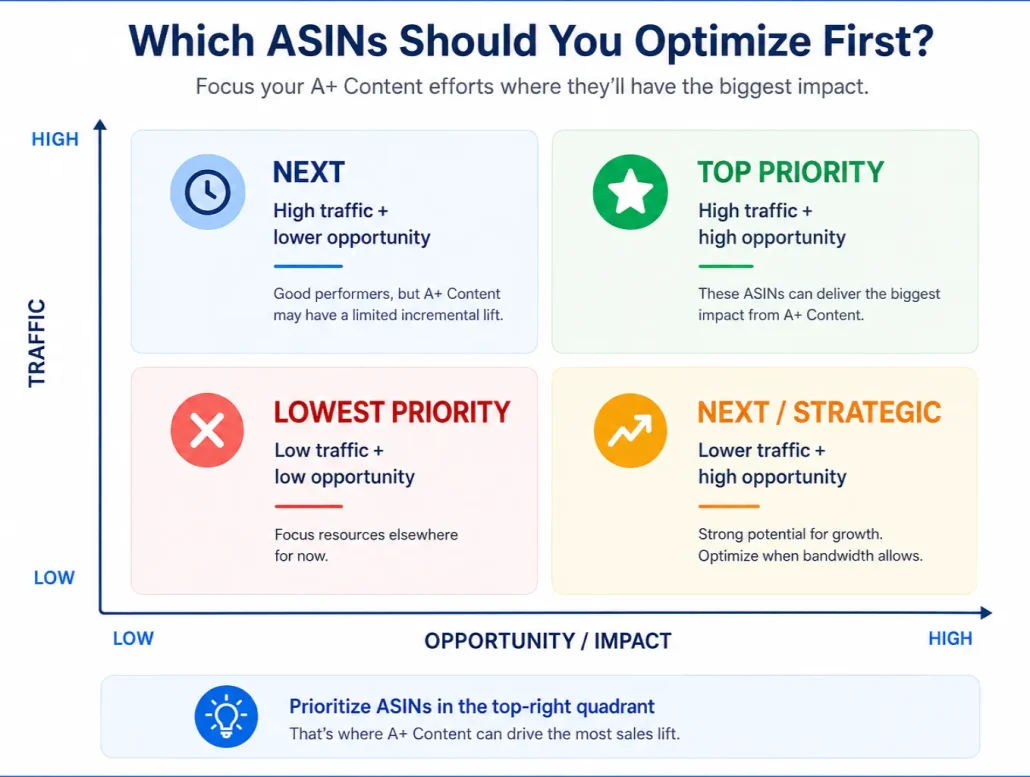
If you have five products, adding A+ Content everywhere may be straightforward. If you have 500, prioritization matters.
The best starting point is usually not your weakest ASIN. It is the ASIN where better conversion would have the greatest commercial impact and where the product has enough traffic for improvements to matter.
Start with products that already attract meaningful traffic but have clear opportunities to improve the buying decision. These are often your hero products, high-margin ASINs, products that require explanation, ranges with confusing variants, or listings where reviews and return reasons reveal repeated customer misunderstandings.
Imagine two ASINs.
ASIN A gets 30,000 detail-page visits per month and has a 9% conversion rate. ASIN B gets 500 visits and converts at 5%.
Even if A+ Content improved both by the same relative amount, ASIN A would generally create much more incremental revenue. It would also generate enough traffic to test different versions more reliably.
The same principle applies to Premium A+.
Video, custom photography and sophisticated comparison content take more resources to produce. Put those resources where a better buying experience has enough scale to repay the investment.
There are exceptions. A strategically important new product may deserve Premium A+ before it has accumulated traffic, particularly if it is central to a launch or brand repositioning. But that should be a conscious business decision, not the default rollout order.
A useful question for every proposed A+ project is:
What customer uncertainty are we trying to remove, and what is the commercial value of removing it?
If the team cannot answer that, don’t start designing modules yet.
Does Amazon A+ Content Improve SEO?
A+ Content can support the overall performance of a product listing, but sellers should be careful about treating it as simply another place to stuff keywords.
The primary job of A+ Content is to help a shopper understand the product and make a confident purchase decision. That means explaining benefits, demonstrating use cases, answering common questions, differentiating models and removing objections that the title, bullets and main images could not address fully.
For search visibility, continue treating your title, bullet points, product attributes and other core listing data as your primary SEO foundation. In A+ Content, use descriptive language naturally where it improves the customer’s understanding of the product. Don’t distort copy simply to force additional keyword variants into the page.
There is also an indirect commercial relationship worth considering. If stronger A+ Content helps more shoppers convert, select the correct product and avoid returns, the listing itself becomes commercially stronger. But that is different from claiming that putting a keyword into an A+ module automatically pushes the ASIN higher in Amazon Search.
The practical rule is simple: write A+ Content for product understanding first and search engines second.
How Much Does Amazon A+ Content Cost in 2026?
There is no additional Amazon fee for Basic A+ Content for eligible sellers. Premium A+ is also currently available at no additional charge.
But there is an important qualification: Amazon still describes this as a promotional period rather than a permanent commitment to keep Premium A+ free forever.
Amazon says that if it introduces a Premium A+ fee in the future, sellers will be given the opportunity to opt in and will not be charged without their consent. Premium content already published during the promotional period will remain on the detail page without a retroactive charge.
That distinction matters because the real cost of A+ Content today is usually not an Amazon platform fee. It is the cost of producing the content itself: photography, video, design, copywriting, localization and the internal time required to plan and test it.
RANK LIKE THE PROS
Discover a better way to rank products from external traffic, like Facebook, Google and TikTok, with LandingCube promo pages.
Try it free for 21 days.
For that reason, don’t ask only, “Is Premium A+ free?” Ask whether the ASIN has enough traffic, margin and strategic importance to justify producing Premium-quality creative. A sophisticated seven-module layout is not automatically a better investment than a focused Basic A+ implementation on an ASIN that only needs three customer objections answered clearly.
Sellers looking to maximize ROI often partner with an Amazon PPC Agency to align their Amazon SEO and PPC advertising and A+ Content strategies. To further enhance your strategy and leverage the value of your A+ content, consider driving traffic through Google Ads for Amazon Listings and building an Amazon marketing funnel that supports your product listings.
What Are the Differences Between Standard A+ and Premium A+ Content?
| Feature | Standard A+ Content | Premium A+ Content |
| Image Modules | Yes | Yes |
| Interactive Features | No | Yes |
| Video & Hotspot | No | Yes |
| Navigation Carousel | No | Yes |
| Advanced Comparison Tables | Limited | Yes |
| Allowable Modules on Detail Page | 5 | 7 |
| Module Selection | 14 | 19 |
| Amazon platform fee | Free for eligible sellers | Currently free during promotional period |
Premium A+ Content offers more dynamic and engaging options, making it ideal for brands looking to stand out.
Who Is Eligible for Amazon Premium A+ Content in 2026?
Premium A+ Content is more widely accessible than it once was, but it is not automatically available to every Amazon seller.
Amazon’s current eligibility rules are straightforward. To qualify, your brand must have a published A+ Brand Story on all of the ASINs you own within your catalog, and you must have had at least five A+ Content projects approved and published during the previous 12 months.
Once your brand meets those requirements, Amazon can grant Premium A+ access through A+ Content Manager. You do not need to demonstrate a particular review score, return rate or A+ engagement benchmark as an additional Premium eligibility condition.
There is also an important distinction between being eligible to create A+ Content in general and qualifying for Premium A+ Content. Basic A+ is available to eligible Professional sellers using Amazon Brand Registry, while Premium adds the Brand Story and recent-project requirements described above.
If you are working toward Premium eligibility, start by auditing A+ Content Manager. Make sure every applicable brand-owned ASIN has a published Brand Story, then check that you have at least five qualifying A+ projects with an approved and published date inside the previous 12 months.
Amazon’s current Premium A+ criteria apply across the countries where you sell and publish A+ Content. Amazon says that when eligibility is achieved in one country, Premium access can be provided worldwide.
To work toward Premium A+ eligibility, We will walk you through the creation process:
- On your menu, go to Advertising > A+ Content Manager

- Click on the Start creating A+ content button.

- Choose “Create Brand Story A+” to create a Brand Story project and apply it to all applicable brand-owned ASINs.

- Add Your Brand Story Modules

- Apply to ASIN

- Review and Submit for approval. Once approved, it can take 24 hours for content to be published to the product detail page.
Tip: Use the bulk upload feature to publish Brand Story content to all the ASINs in your catalog. You can have up to 20 pending submissions in review at one time.
Once Premium access is enabled, start a new A+ Content project, select Premium A+, add your desired Premium modules, apply the relevant ASINs, review the content and submit it for approval.
Amazon reviews eligibility every week. Keep an eye for the Premium A+ access notification banner when you log on to A+ Content Manager. You will be able to create Premium A+ content by clicking on the Creating Premium A+ button.
Creating Amazon A+ Content With AI in 2026
Amazon now provides AI-assisted creation directly inside A+ Content Manager. In eligible modules marked “AI Ready,” sellers can use generative AI to create or enhance text and imagery, helping teams move from a blank module to a workable first draft much faster.
The important thing is to treat AI as a production accelerator rather than your product strategist. Before generating content, decide which customer question the module needs to answer, what benefit you want to communicate and which facts support that message. AI can then help explore different ways of presenting it, but every claim, image detail and product specification should still be checked by a human before publication.
AI is particularly valuable when you need to scale a proven A+ framework across a large catalog. Once you have learned that a particular narrative works. For example:
Hero benefit → use case → technical proof → compatibility → comparison.
You can reuse the structure while tailoring the actual value proposition to each ASIN.
What you should not do is produce 200 nearly interchangeable pages in which the product name changes but the message doesn’t.
The efficiency comes from standardizing the workflow, not standardizing away the customer’s reason to buy.
Amazon A+ Content Best Practices Start Before You Pick a Module
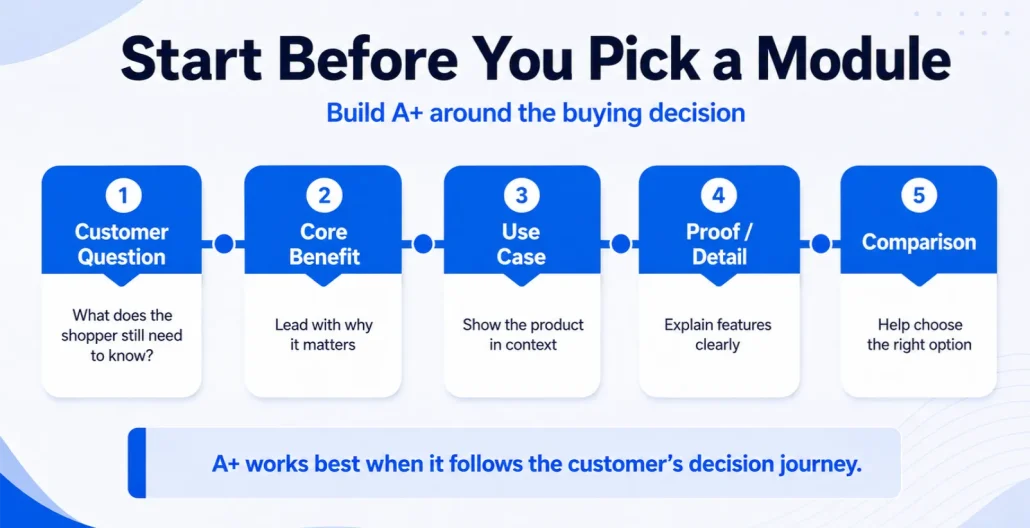
A common way to build A+ Content is to open A+ Content Manager, look through the available modules and begin filling empty spaces.
It’s backwards.
Start by asking what a customer still doesn’t know after seeing your title, main images, price, rating and bullet points.
For a kitchen appliance, that could be: How large is it on the countertop? How difficult is it to clean? What can I actually make with it? Which model should I buy?
For a skincare product, the questions might be: Where does this fit into my routine? What skin type is it designed for? What does the texture feel like? What is the difference between this product and the other product from the same line?
For an electronics accessory: Will it fit my device? What is included? Does it require an adapter? How is it installed?
Those unanswered questions should determine the A+ structure.
A strong sequence usually moves from orientation to persuasion to proof.
The first module makes the value proposition immediately understandable. The next one or two turn product features into customer outcomes. Subsequent modules demonstrate use cases, clarify technical details or answer objections. Finally, a comparison module can help a customer select the right item within your range rather than returning to Amazon Search and potentially buying from a competitor.
That flow is much more useful than treating seven Premium modules as seven independent advertisements.
Lead with the customer’s reason to care
The first A+ screen shouldn’t be a generic brand manifesto.
A headline such as “Engineered for Everyday Performance” might sound polished, but it tells the customer almost nothing. Compare that with a headline that communicates an actual outcome: faster preparation, easier cleaning, more precise control, longer battery life, better fit or whatever genuinely differentiates the product.
A shopper should be able to glance at the first module and understand why the product deserves further consideration.
Translate features into consequences
Technical features matter. But features are rarely persuasive in isolation.
“5,000 mAh battery” is a specification. “Power for a full workday without reaching for the charger” explains why that specification matters.
“Double-wall stainless steel” is a construction detail. “Keeps the outside comfortable to hold while helping drinks stay hot” turns the feature into a real-world benefit.
That does not mean replacing every specification with marketing language. It means pairing the fact with the practical consequence.
Show the product in the situation where the benefit matters
Lifestyle imagery is most useful when it provides information.
A beautiful image of a person holding your product can support branding. A photograph showing exactly where, how or for whom the product is used can answer a purchase question.
Think about the objections hidden inside your reviews, customer questions, return reasons and support tickets. If shoppers repeatedly misunderstand size, compatibility, assembly, fit, ingredients or care instructions, A+ Content gives you additional space to fix the problem before the order is placed.
Don’t repeat the image stack
A+ Content sits further down the page. A customer who reaches it has already seen your main listing assets.
Don’t reward that extra attention by showing the exact same information again. Use A+ to go one level deeper.
If the image stack says what the product does, A+ can explain how and why. If the bullets list five features, A+ can show those features in context. If the main listing introduces the hero product, A+ can explain the wider range and help customers choose between variants.
That’s how A+ adds information rather than simply adding page length.
Why Amazon Rejects A+ Content
You can create outstanding A+ creative and still lose a week because one claim, graphic or external reference fails moderation.
Amazon’s current A+ guidance prohibits or restricts a number of common marketing tactics. Sellers should avoid pricing and promotional statements, shipping information, QR codes, links or directions to external web pages, contact details and direct comparisons with competing brands. Amazon also warns against unsubstantiated superlatives such as “best-selling” or “top-rated,” warranty or guarantee language in restricted placements, low-resolution or animated imagery, and assets for which the seller does not hold the necessary rights.
Awards and third-party endorsements need particular care. If you refer to one, Amazon expects enough supporting context (such as the awarding organization and year) to substantiate the statement.
This is why compliance should happen during the copywriting and design stage rather than five minutes before submission.
A designer who has already placed “The #1 choice for professionals” across a hero banner cannot solve the problem by changing the alt text. A copywriter who has structured a whole comparison module around a named competitor may need to rebuild the module.
Create a compliance review before final export:
Does every objective claim have support? Are we comparing products within our own brand rather than attacking competitors? Have prices, discounts, contact details and external CTAs stayed out of the creative? Do we own the rights to every image, icon, testimonial and video element?
Then use Amazon’s preview before submission.
That ten-minute check is much cheaper than sending an entire launch schedule back through moderation.
Check Amazon’s A+ Content Quality Analysis
Before considering an A+ page finished, check the Content quality analysis tab in A+ Content Manager. Amazon now evaluates A+ Content for factors including readability, information completeness, visual presentation and conversion effectiveness, and provides recommendations for individual projects.
Treat those recommendations as another diagnostic rather than blindly implementing every suggestion. Combine them with customer feedback and, where possible, results from Manage Your Experiments to decide what actually improves the listing.
Design Amazon A+ Content for Mobile First
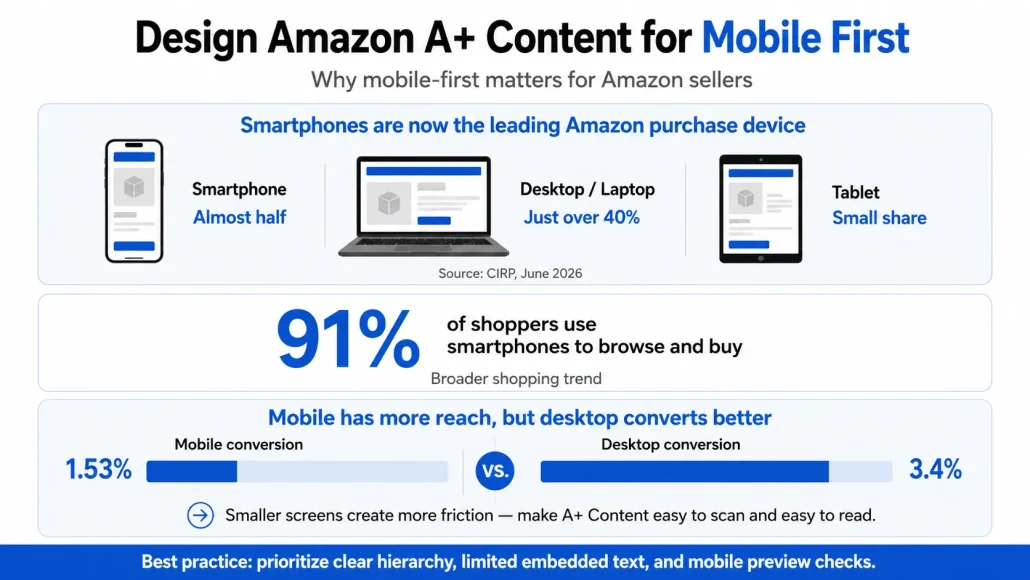
Most sellers still design A+ Content on a desktop because that’s where Seller Central and creative software are easiest to use. Your customers, however, increasingly experience Amazon very differently.
Recent research from Consumer Intelligence Research Partners (CIRP) shows that smartphones are now the most common device used by US Amazon customers to make purchases. In its June 2026 research, CIRP found that almost half of US Amazon customers made their most recent Amazon purchase on a smartphone, compared with just over 40% who used a desktop or laptop computer. Tablets accounted for only a relatively small share of purchases. CIRP says smartphones overtook computers as the leading Amazon purchasing device around five years ago.
That makes mobile optimization much more than a design preference.
Amazon itself highlighted the same issue in August 2026, reporting that 91% of shoppers now use smartphones to browse and buy. Yet Amazon also noted a significant conversion gap: mobile shopping converts at around 1.53%, compared with 3.4% on desktop. In other words, mobile gives sellers enormous reach, but a smaller screen and greater friction make it much easier to lose the sale.
That should directly influence how you build A+ Content.
A section that looks impressive at 1,400 pixels wide can become a dense strip of tiny copy when squeezed onto a phone. Amazon therefore recommends balancing photography with readable text and specifically advises sellers to avoid relying heavily on text embedded inside images. The information may look perfectly legible on a designer’s desktop monitor while becoming almost useless on a six-inch screen.
Mobile-first A+ Content does not mean making everything simplistic. It means prioritizing information much more aggressively.
Your most important product benefit should not require the shopper to swipe through several carousel slides before finding it. Critical specifications should not be buried inside an infographic that becomes unreadable when scaled down. Headlines should communicate useful information even when the customer does not stop to read every line of supporting copy.
There are three particularly useful checks to make before publishing.
- First, open the mobile preview and ask whether each module communicates one obvious idea within a few seconds. If your eye does not immediately know where to go, the shopper probably will not either.
- Second, check the order in which your information appears once Amazon’s responsive layout has rearranged the assets. A composition that makes perfect sense from left to right on desktop can become image-copy-image-copy vertically on mobile. Read the entire mobile version from top to bottom as though you have never seen the desktop creative.
- Third, inspect every piece of text embedded inside an image. If a customer cannot comfortably read it without zooming, either shorten it substantially or move the information into Amazon’s live text fields.
The commercial implication is simple: designing A+ Content desktop-first means optimizing around the minority device experience while potentially making the buying decision harder for Amazon’s largest group of shoppers.
Amazon Premium A+ Content Best Practices: Which Modules to Use for Maximum Sales Lift
Not all modules are created equal. Consider these for maximum impact:
Premium Comparison Tables
Premium Comparison tables are great to cross-sell products. They come with clickable products, where prices, reviews and Add To Cart buttons are included in the comparison table. The difference between A+ Premium and Standard A+ Comparison tables is that Premium tables allow users to “add to cart” right away, without having to navigate to the Amazon listing.

Premium Full Video
Premium videos are ideal for showcasing complex products and demonstrating how features work.

Premium Full Image
Premium images give you the freedom to bring out your brand identity. Don’t feel limited creating generic product images, but be creative. The example from NYX below shows this. While the branding is successfully incorporated, the image also communicates the availability of multiple product colors, thereby adding tangible value for shoppers.

Interactive Hotspots
Interactive hotspots work well for products with several physical features that benefit from closer explanation, allowing shoppers to explore individual details without overcrowding a single image. Use accurate, descriptive alt text for each image to support accessibility and search relevance, but write it naturally rather than stuffing it with keywords.


Clickable Q&As
Answer frequently asked questions and clear up uncertainties that could otherwise lead to poor purchase decisions or negative reviews. They can also help eliminate common purchase barriers by answering predictable questions before the customer orders. If you are aware of common questions that users may have prior to buying your products, make sure to answer these questions so that nothing gets in their way buying your products! Naturally, for products that are self-explanatory, the need to incorporate a Q&A is less pressing than it is if you sell products with many (complicated) features.

Premium A+ Modules to Use Selectively
We have covered some of the more effective modules. There are however a couple of Amazon Premium A+ Modules that we would discourage you to use. They are either overly complex, require too many user actions, or there are just better options. Let’s dive right in.
Use Text and Images Together. Don’t Turn Every Module Into a Banner Ad
One of the easiest A+ Content mistakes to make is designing every module as a finished advertising graphic and baking all of the headline and supporting copy into the image itself.
It gives designers complete control on a desktop canvas. It can also produce a much worse customer experience once that same graphic is squeezed onto a phone.
Amazon’s current guidance recommends balancing text with photography and specifically advises sellers to avoid embedding text in images so customers can read the information on smaller screens. That should be the default.
Use imagery for the information that is naturally visual: product scale, materials, use cases, component relationships, before-and-after situations where permitted, installation, fit and lifestyle context. Use Amazon’s live text fields for explanations, supporting claims and details that need to remain comfortably readable.
There will still be cases where a short callout belongs inside an image. If you do use one, make it brief, large and legible. Don’t create an infographic containing two paragraphs of eight-point copy and assume a customer will pinch-and-zoom to read it.
The goal is not to maximize the amount of creative packed into every module. The goal is to reduce the amount of work required for the shopper to understand the product.
Amazon also lets you preview A+ Content on desktop and mobile before submission. Use both previews every time. A design isn’t finished simply because it looks good on the designer’s 27-inch monitor.
Premium A+ Navigation Carousel
This module allows customers to swipe or click through multiple content panels. While this seems like a great option to communicate product information and product benefits it comes at a great cost: it requires the user to swipe through. If at this point, you still need an image carousel to explain product features (bear in mind that this is what the Amazon Listing Main Images are for), you are clearly missing the mark and are failing to prioritize important information.
Navigation carousels work well when shoppers benefit from exploring additional depth, such as multiple use cases, product angles or a sequence of secondary features. The mistake is hiding information that is essential to the purchase decision several swipes into the carousel.
Keep your primary value proposition and most important product information visible without requiring interaction. Use carousels for optional depth rather than information every shopper needs to understand the product.