
Jul 20th 2026
Resources
- Facebook Ads for Amazon [Video Course]
- Drive Traffic To Amazon [Ultimate Guide]
- Get More Amazon Reviews [Ultimate Guide]

TL;DR
What is the core mechanism of the Amazon Conquest Strategy?
Instead of overspending on hyper-inflated search keyword auctions, this strategy uses Amazon Product Attribute Targeting (PAT) to bypass the search bar and place your digital billboards directly onto your competitors’ Product Detail Pages (PDPs). This effectively intercepts high-intent shoppers during the evaluation phase right as they are preparing to buy a rival’s product.
How can sellers weaponize AI-generated review summaries against market rivals?
Under the “Social Proof Arbitrage” framework, you isolate competitor ASINs where AI-generated review summaries prominently highlight customer complaints or lower ratings. By targeting these specific listings, your highly-rated product appears as a safe, high-quality alternative, capturing shoppers who are experiencing immediate purchase hesitation.
What specific data anomaly indicates a competitor listing is highly vulnerable?
When analyzing the Amazon Search Terms and Search Query Performance (SQP) reports, look for competitor ASINs that maintain a high Click Share but yield a disproportionately low Conversion Share. This distinct statistical gap highlights a severe conversion weakness, marking them as prime targets for aggressive, exact-match manual conquest campaigns.
What is the critical financial risk of driving external traffic (TikTok/Facebook) to an undefended listing?
If you pay to drive external traffic to your Amazon listing before building a closed-loop defensive ad moat on your own pages, you risk directly subsidizing your competitors’ marketing budgets. Unsecured ad slots on your detail page allow rival conquest ads to intercept and steal the high-intent traffic you paid to acquire.
If you have been selling on the US Amazon marketplace for more than a few years, you already know the grim reality: the traditional search engine results page (SERP) is a bloodbath. Relying only on broad and exact match keyword targeting can increase Cost-Per-Click (CPC) pressure and reduce campaign efficiency. Competition for top-of-search placements can raise CPCs and reduce margins for brands that target high-volume terms.
Table of Contents
- The Psychology of the PDP Intercept
- The Conquest Framework: Exploiting Competitor Weaknesses
- Harvesting Targets: Search Terms Report and SQP
- Category Targeting Refinements: The Scalable Net
- Defensive Product Targeting: Building the Impenetrable Moat
- Weaponizing Ad Formats for ASIN Targeting
- Data-Driven Optimization: Knowing When to Kill a Target
- The Bottom Line
- Frequently Asked Questions (FAQ)
However, the competition for a customer does not end on the search results page. In fact, it barely begins there.
Keyword targeting simply gets the shopper into the correct aisle. Amazon Product Targeting (PAT) is how you intercept them exactly as their hand reaches for the competitor’s box on the shelf.
Amazon gives shoppers several ways to compare products. Consumers are conditioned to click a product, scroll past the bullet points, and immediately scan the “Products related to this item” carousels. Shoppers can compare several Product Detail Pages (PDPs) before they decide to make a purchase.
If your entire advertising budget is tethered to the search bar, you are missing the most critical, high-intent touchpoint in the e-commerce funnel. Amazon Product Targeting allows you to bypass the keyword auction entirely and place your digital billboard directly inside your rival’s retail store.
In this masterclass, we are skipping the beginner-level definitions. We are going to explain practical conquest strategies, defensive targeting methods, and data-based ASIN research for 2026.
The Psychology of the PDP Intercept
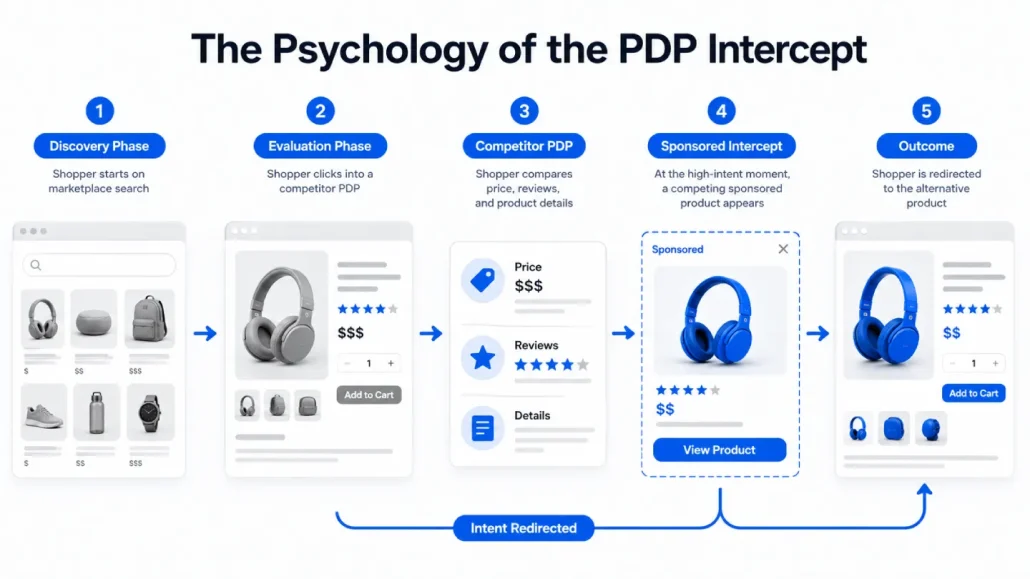
To execute Product Targeting effectively, you must understand the psychology of the placement. When you bid on a keyword like “stainless steel garlic press,” you are capturing a shopper in the discovery phase. They know what they want generally, but they haven’t committed to a specific solution.
When a shopper clicks through to a specific product detail page, they have transitioned into the evaluation phase. Their purchase intent is significantly higher. They are comparing the price, reading reviews and AI-generated summaries, and deciding whether the product meets their needs.
Intercepting a shopper at this exact micro-moment is incredibly lucrative, but only if your offer is objectively superior. If a competitor has far stronger reviews and a much lower price, your ad may struggle to earn clicks. You will bleed impressions and destroy your Click-Through Rate (CTR).
Product Targeting requires a predatory mindset. You are actively hunting for vulnerabilities.
The Conquest Framework: Exploiting Competitor Weaknesses
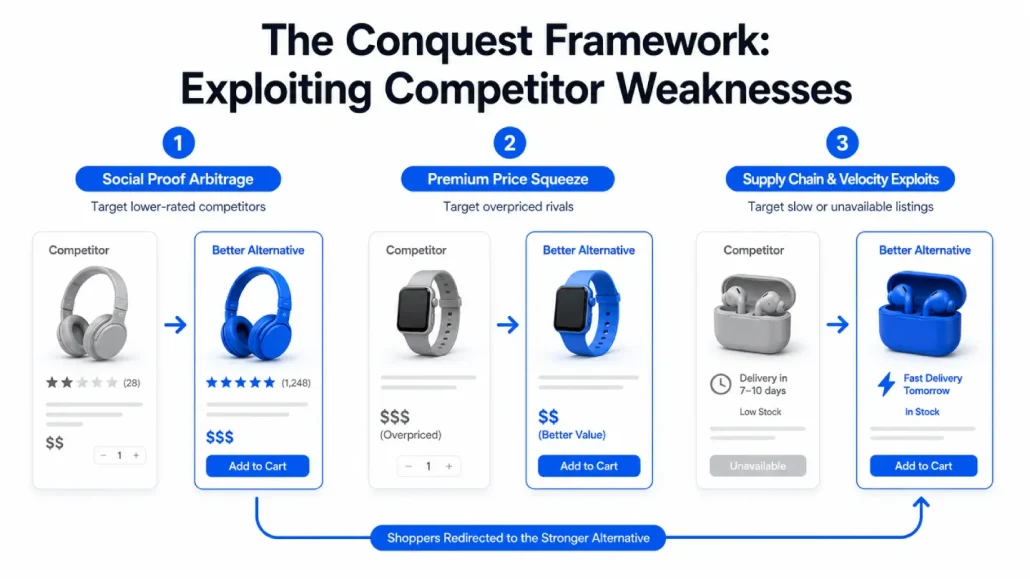
Successful ASIN targeting is not a shotgun approach; it is a sniper rifle. Identify competitor products with clear conversion weaknesses, then position your product as a relevant alternative. We call this the Conquest Framework, and it relies on three primary pillars of exploitation.
1. The Social Proof Arbitrage (Targeting Low Ratings)
In 2026, social proof is the ultimate currency. AI-generated review summaries can surface common customer concerns near the top of a listing. This is your greatest offensive weapon.
If your product has a clear rating advantage, test competitor ASINs with lower ratings in a separate campaign. When a shopper lands on that competitor’s page, the negative reviews instantly trigger purchase hesitation. Your highly rated product may appear in an eligible sponsored placement on the competitor’s detail page.
The psychological relief for the shopper is immediate. They transition from a risky purchase to a safe haven. A clear rating advantage may improve conversion, but results will vary by product, price, review count, and category.
2. The Premium Price Squeeze
Amazon shoppers are notoriously price-sensitive. If you have engineered a product that offers comparable quality to the premium market leaders but at a more accessible price point, you can siphon their traffic effortlessly.
You must utilize tools like Helium 10, DataHawk, or Jungle Scout to scrape your sub-category for ASINs priced 20% to 30% higher than your listing. If a shopper is currently viewing a $60 insulated water bottle, and your ad appears offering a virtually identical, well-reviewed alternative for $38, the value proposition is undeniable. The shopper may click your ad if the price difference and offer are clear enough. You may reach the same shopper through an ASIN target at a lower CPC, but the actual cost will depend on the auction and category.
3. Supply Chain and Velocity Exploits
Amazon shoppers may consider delivery speed alongside price, reviews, availability, and product relevance. If a major competitor runs out of stock, or if their supply chain breaks down and their delivery window slips from one-day Prime to a five-day delay, they are bleeding blood in the water.
You should continuously monitor the top 10 organic ranking competitors for your main keywords. When a competitor loses the Prime badge or shows extended shipping times, consider testing higher bids on that ASIN. A faster delivery offer may give the shopper a reason to consider your product instead.
RANK LIKE THE PROS
Discover a better way to rank products from external traffic, like Facebook, Google and TikTok, with LandingCube promo pages.
Try it free for 21 days.
Harvesting Targets: Search Terms Report and SQP
You cannot rely on guessing which ASINs to target. You must leverage Amazon’s own first-party data.
Use the Amazon Search Terms report to identify competitor ASINs, and use Search Query Performance (SQP) to assess search-funnel data for your own brand or ASINs. Look at the top search queries for your category. The Amazon Search Terms report can show leading clicked products for a query, while Search Query Performance reports show search-funnel data for your own brand or ASINs.
You are looking for a specific anomaly: ASINs that have a high Click Share but a disproportionately low Conversion Share. This pattern may signal a conversion weakness, but it does not prove why shoppers did not buy. The competitor’s listing may have a conversion weakness that requires further review. That is your target. Extract those ASINs and load them directly into an aggressive Exact ASIN manual campaign.
Category Targeting Refinements: The Scalable Net
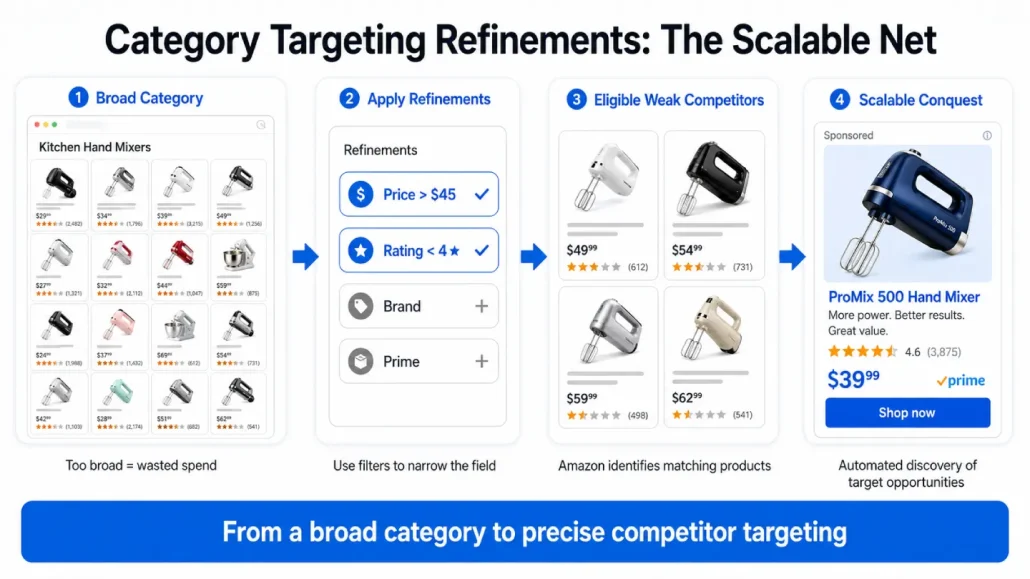
Manually inputting hundreds of ASINs is highly effective for sniper campaigns, but it is difficult to scale. To cast a wider net without wasting budget, Amazon offers Category Targeting.
Left unchecked, targeting an entire broad category (e.g., “Kitchen Hand Mixers”) is financial suicide. Amazon will show your ad on thousands of irrelevant pages. However, Category Targeting becomes an automated conquesting machine when you utilize Refinements.
Instead of targeting the raw category, you apply algorithmic filters. You instruct Amazon: “Only show my ad in the ‘Kitchen Hand Mixers’ category IF the competitor’s price is greater than $45 AND their review rating is less than 4 stars.”
By layering these refinements, you essentially automate the Conquest Framework. Amazon can use your category refinements to identify eligible products that match the selected price, rating, brand, or Prime criteria. This allows you to discover and exploit weak competitors that you never would have found during manual research.
Defensive Product Targeting: Building the Impenetrable Moat
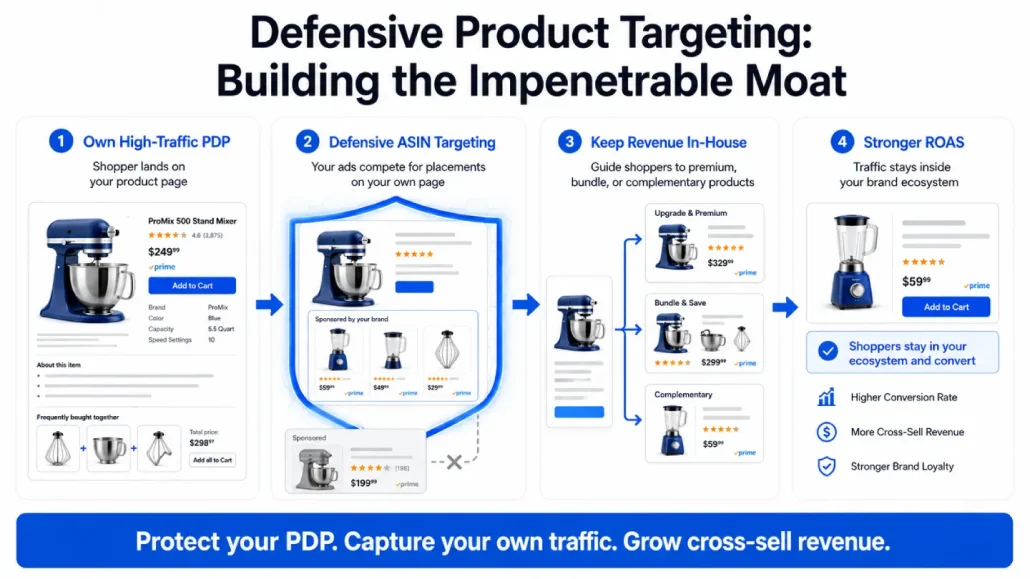
Offense is useless if you leave your own back door open. If your product is generating significant sales velocity and ranking on page one, you are currently being targeted by competitors using the exact strategies outlined above.
To prevent rivals from siphoning your hard-earned traffic, you must build a defensive moat around your digital real estate. This is achieved through Defensive ASIN Targeting—bidding on your own products.
If you have several related products, consider creating a defensive campaign for the ASINs that receive meaningful traffic or support cross-selling. Your defensive ads can promote premium models, bundles, or complementary products on your own detail pages, but they cannot prevent all competitor ads.
Bidding aggressively on your own ASINs achieves three critical objectives:
- It helps your products compete for eligible ad placements on your own detail pages.
- It creates a closed-loop shopping environment. If a customer decides the specific item they are viewing isn’t right, your ads guide them to another product within your own brand ecosystem, keeping the revenue in-house.
- It can support Return on Ad Spend (ROAS) when shoppers respond to related products in your catalog. Traffic that is already on your product page and clicks another one of your products converts at remarkably high rates.
Note: Before you invest heavily in driving external traffic to Amazon using tools like LandingCube to build email lists and boost rankings, you absolutely MUST build this defensive moat. If you pay for Facebook traffic to land on your Amazon listing, and a competitor’s ad steals them on your page, you just subsidized your competitor’s marketing budget.
Weaponizing Ad Formats for ASIN Targeting
Product Targeting is not limited to a single ad type. To achieve total domination of a competitor’s page, you must deploy a multi-format assault using Sponsored Products, Sponsored Brands, and Sponsored Display.
Sponsored Products PAT: This is your workhorse. Set the budget allocation based on each ad format’s performance rather than using a fixed percentage. These ads can appear in shopping results and eligible product detail page placements. Their placement within the Amazon shopping experience can help them attract relevant clicks, but conversion rates will vary.
Sponsored Brands PAT: Sponsored Brands can use product targeting to show a custom headline and multiple products in eligible placements. This format is devastating when used for comparative positioning. If you know a competitor’s product is notorious for breaking after a month, you can run a Sponsored Brand ad on their page with the headline: “Heavy-Duty Construction. Backed by a Lifetime Warranty.” You do not need to name the competitor; you just need to loudly solve the exact problem their negative reviews are complaining about.
Sponsored Display PAT (The Ultimate Intercept): Sponsored Display takes ASIN targeting to its most predatory extreme. These ads may appear on product detail pages, but Amazon does not guarantee a position beside the price or “Add to Cart” button.
A Sponsored Display ad may reach shoppers in eligible placements while they compare products. Furthermore, Sponsored Display allows for view-remarketing. Views remarketing can re-engage audiences who viewed your products or similar products but did not complete a purchase.
Data-Driven Optimization: Knowing When to Kill a Target
Setting up the campaigns is just the mechanical execution; the actual profit is generated through ruthless, data-driven optimization.
RANK LIKE THE PROS
Discover a better way to rank products from external traffic, like Facebook, Google and TikTok, with LandingCube promo pages.
Try it free for 21 days.
Unlike keyword campaigns where you are evaluating broad search intent, ASIN targeting is a binary evaluation of a direct, head-to-head matchup. You must routinely download your Search Term Reports and isolate the ASINs (which appear starting with “b0”).
Evaluate these ASIN targets with zero emotion. Consider pausing or negating the ASIN after it reaches your agreed spend or target CPA threshold without a sale. The result shows that the target has not met your campaign goal.
Conversely, when an ASIN target converts well, scale the campaign gradually. Increase product-page Placement Modifiers gradually and review the results, since a higher bid cannot guarantee every impression.
The Bottom Line
Shifting a portion of your budget away from the saturated, highly inflated keyword auctions and directly attacking the product detail pages of vulnerable competitors is no longer an “optional” advanced tactic. In 2026, it can form an important part of a broader Amazon Ads strategy.
Whether you use Category Refinements, target overpriced rivals, or promote your own top sellers, Amazon Product Targeting can help you compete for more category sales. Stop fighting for the aisle; start owning the shelf.
Frequently Asked Questions (FAQ)
Keyword targeting triggers your ad when a shopper types a specific phrase into the search bar, attempting to capture them during discovery. Product Targeting (PAT) triggers your ad when a shopper is actively viewing a specific competitor’s Product Detail Page (PDP) or browsing a specific category, intercepting them during the evaluation phase.
Use the Amazon Search Terms report to review leading clicked products and their click and conversion shares. You can also use Search Query Performance to assess your own brand or ASIN performance and compare relevant products. Confirm each target by reviewing its price, rating, reviews, delivery terms, and relevance to your offer.
Several factors can cause impressions without clicks, including weak target relevance, low placement visibility, an uncompetitive price, a weaker main image, or limited review strength. Review the target, bid, placement, image, price, ratings, and reviews before changing the campaign.
Usually, prioritize equal- or higher-priced competitor products because a large price gap can reduce click potential. However, a premium product may still compete with a cheaper item if its image, bundle, features, or warranty clearly explains the added value.
You must use Negative Product Targeting. Just like negative keywords, you can input specific ASINs into your campaign and tell Amazon never to show your ad on those pages. This is crucial for stopping wasted spend on competitor pages where your conversion rate is zero.
Category Targeting can waste budget if the category is too broad. Refinements such as price range, ratings, brand, and Prime eligibility can help narrow your targeting, but you should still review performance before scaling.
Yes, this is highly recommended. If you sell high-end coffee makers, you should use Product Targeting to place ads for your proprietary coffee filters or branded coffee beans directly on your own coffee maker’s product page. This can support Average Order Value (AOV) and increase the visibility of your own catalog, but it cannot keep all competitors off your listing.
Defensive targeting can promote your catalog on your own product pages and reduce opportunities for competitors to capture interested shoppers. However, it does not block all competitor ads or guarantee exclusive placement.
Sponsored Display ads can support product-page targeting because they may appear on relevant detail pages and other eligible placements. Amazon does not guarantee that they will appear directly below the price or beside the “Add to Cart” button.
Use a spend-based rule instead of a fixed click count. Consider negating the ASIN after it spends your target Cost Per Acquisition (CPA) without a sale, while accounting for its CPC and expected conversion rate.
RANK LIKE THE PROS
Discover a better way to rank products from external traffic, like Facebook, Google and TikTok, with LandingCube promo pages.
Try it free for 21 days.