
Aug 29th 2026
Resources
- Facebook Ads for Amazon [Video Course]
- Drive Traffic To Amazon [Ultimate Guide]
- Get More Amazon Reviews [Ultimate Guide]

TL;DR
What does “passive income” on Amazon really mean in 2026?
It usually means front-loading the work, capital or creative effort and then reducing the amount of ongoing involvement needed to keep earning. No Amazon model is completely hands-off, but several can become meaningfully lower-maintenance over time.
How do the main Amazon passive-income models differ?
Some rely on physical products, others on publishing, designs, content or acquiring an existing business. The biggest differences are how much cash, upfront work, ongoing management and inventory risk each model requires.
Which Amazon income models require the least inventory investment?
KDP, Merch on Demand, Amazon Associates and the Influencer Program do not require you to buy conventional inventory upfront. Print on demand can also reduce inventory exposure substantially compared with traditional FBA.
What makes an Amazon income stream become more passive over time?
The key is separating future revenue from future hours worked through fulfillment, automation, documented processes and delegation. The more repeatable work that can be handled by Amazon, software or other people, the less dependent the income stream becomes on the owner.
Making passive income on Amazon is still possible in 2026, but probably not in the way it is advertised on social media.
There is no Amazon business model where you create an account on Monday, switch everything to autopilot on Friday and collect effortless income indefinitely. The models that come closest to passive income are front-loaded: you put in the money, creative work or operational effort first, then build systems that reduce the amount of work required to keep earning.
Amazon can take a significant part of that workload off your hands. Fulfillment by Amazon can store inventory, ship orders and handle many customer-service tasks. Kindle Direct Publishing can distribute ebooks and print books without you carrying inventory. Merch on Demand can manufacture merchandise after a customer orders it. Amazon Associates and the Influencer Program let you monetize content without operating a traditional ecommerce business.
Table of Contents
- Can You Really Make Passive Income on Amazon in 2026?
- Which Amazon Passive Income Model Is Right for You?
- 7 Ways to Make Passive Income on Amazon in 2026
- How Much Does It Cost to Build Passive Income on Amazon?
- How to Make an Existing Amazon FBA Business More Passive
- The Risks of Passive Income on Amazon
- Conclusion: Is Amazon Passive Income Worth It in 2026?
- Frequently Asked Questions About Amazon Passive Income
The trade-off is that Amazon never eliminates the work entirely. Someone still has to choose good products, create worthwhile content, monitor margins, replenish inventory, manage advertising, protect account health or keep a catalog relevant.
So the better question isn’t “Can Amazon generate completely passive income?”
It’s:
“Which Amazon business models can produce income without requiring me to trade another hour of work for every additional dollar I earn?”
There are several good answers. And we are going to cover it below.
Can You Really Make Passive Income on Amazon in 2026?
Yes, but “low-maintenance income” is a more accurate description than “passive income.”
Every Amazon model requires one of three things upfront: capital, work or an existing audience. FBA requires money for inventory and considerable operating work. KDP requires something worth publishing. Merch on Demand requires designs people actually want. Affiliate and Influencer income require content and attention. Buying an established business replaces much of the setup work with a much larger capital requirement.
What makes Amazon different from many traditional businesses is that several pieces of the operating chain can be handed off once you’ve built the asset.
With FBA, Amazon can store products, pick and pack orders, ship them and deal with many customer-service and return activities. Amazon describes FBA as a way to outsource fulfillment, including pick, pack, shipping, customer service and returns.
With KDP, a manuscript can continue to generate ebook or print sales without you personally fulfilling each order. With Merch on Demand, a design can remain available while Amazon manufactures products when customers buy. With affiliate and influencer content, an article or video created today can potentially keep sending shoppers to Amazon months later.
That’s the economic characteristic you’re looking for: the ability to separate future revenue from future hours worked.
But none of these models should be treated as “set it and forget it.” Products lose rank. Ad costs change. Competitors enter the market. Inventory runs out. Designs get copied. Policies change. Content gets old. Account issues arise.
A successful passive-income strategy therefore has two phases.
- First, you create or acquire the asset.
- Then you systemize the maintenance.
The second phase is where Amazon becomes particularly powerful.
Which Amazon Passive Income Model Is Right for You?
| Amazon income model | Best for | Upfront cash | Upfront work | Ongoing work | Inventory risk |
|---|---|---|---|---|---|
| Amazon FBA | Sellers who want to build a scalable physical-product business | Medium–High | High | Medium | High |
| Kindle Direct Publishing | Writers, experts and content creators | Low | High | Low–Medium | None |
| Merch on Demand | Designers and niche creators | Low | Medium | Low–Medium | None |
| Amazon Associates | Publishers and audience owners | Low | High | Medium | None |
| Amazon Influencer Program | Social/video creators | Low | High | Medium | None |
| Third-party print on demand | Brand builders who want more product control | Low–Medium | Medium | Medium | Low |
| Acquire an Amazon business | Capital-rich buyers who prefer existing cash flow | High | Medium | Medium | Varies |
7 Ways to Make Passive Income on Amazon in 2026
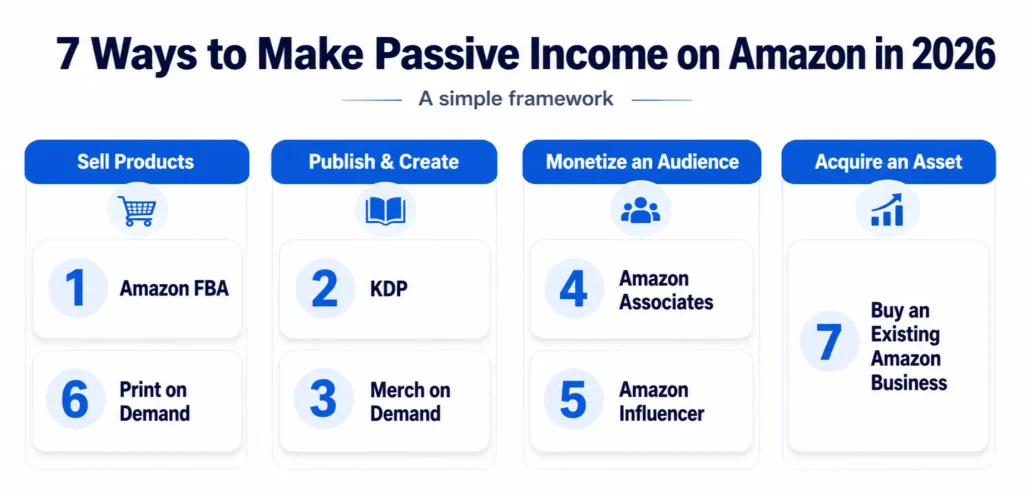
The seven models below work in very different ways. Some use Amazon as a marketplace, some as a fulfillment company, and others as a publishing or affiliate platform.
What they share is scalability: once the underlying asset has been built, an additional sale does not necessarily require an equivalent amount of additional work from you.
RANK LIKE THE PROS
Discover a better way to rank products from external traffic, like Facebook, Google and TikTok, with LandingCube promo pages.
Try it free for 21 days.
1. Amazon FBA: Build a Business That Doesn’t Require You to Ship Every Order
For sellers who want to build a scalable physical-product business, Fulfillment by Amazon is one of the most established routes.
FBA isn’t a passive-income business model by itself. It is an infrastructure layer that can make a product business considerably less labor-intensive.
You send inventory into Amazon’s fulfillment network. When a customer orders, Amazon can pick, pack and ship the product, provide Prime delivery and handle customer service and returns associated with fulfillment.
That eliminates one of the biggest barriers to scaling a traditional ecommerce operation: physically processing more orders every time sales increase.
What it does not eliminate is the work involved in operating the business.
You are still responsible for choosing products, negotiating with suppliers, monitoring demand, keeping the right amount of stock available, maintaining listings and Amazon SEO, defending margins, running advertising, responding to competitive changes and protecting the health of your seller account.
That’s why FBA should be thought of as semi-passive rather than passive.
The goal is to gradually turn the seller from the person completing every task into the person managing the system.
What FBA costs in 2026
There is no universal “Amazon FBA fee” because costs depend on the product, dimensions, weight, inventory levels and services used.
Amazon’s US selling plans currently cost $0.99 per item sold for the Individual plan or $39.99 per month for the Professional plan, before applicable referral fees and optional services such as FBA and Amazon Ads.
FBA itself can add fulfillment and storage costs, along with costs associated with aged inventory, some returns, inventory removal/disposal and inbound placement. Inventory that remains in fulfillment center, it begins the aged-inventory surcharge at 181–210 days
For 2026, Amazon said US FBA fees would increase by an average of approximately $0.08 per unit, following no increase in US referral and FBA fees during 2025.
That is why a passive FBA business cannot simply be measured by revenue. The important number is contribution margin after product cost, Amazon fees, advertising, returns, storage and operating overhead.
What makes FBA increasingly passive?
Once the product-market fit exists, much of the repetitive work can be systemized.
Effective Amazon inventory management can increasingly be driven by inventory thresholds and forecasts rather than by manually checking Seller Central every morning.PPC campaigns can use rules and ad optimization tools for repetitive bidding and budget decisions while a human continues to review strategy. Purchase orders, supplier communication and shipment preparation can follow SOPs. Reporting can surface only the ASINs or campaigns that need attention.
External traffic can also be systemized. Instead of repeatedly launching one-off promotions, sellers can build evergreen traffic funnels that move potential customers from channels such as Google, Meta or creator partnerships toward optimized Amazon listings.
At that stage, the owner is no longer fulfilling every transaction. The owner’s job becomes managing exceptions and improving the system. That’s a realistic form of Amazon passive income.
2. Amazon Kindle Direct Publishing: Turn Intellectual Property Into a Long-Term Asset
Kindle Direct Publishing is one of Amazon’s genuinely asset-based income models.
You create the book once. Amazon provides the infrastructure through which the ebook or print version can continue to be discovered, purchased and delivered.
The hard part is not fulfillment. It’s creating something people want to buy.
That could be fiction, practical nonfiction, specialist reference material, journals, workbooks or other eligible publishing formats. The strongest approach is generally to solve a clearly defined reader need rather than flooding Amazon with generic low-value titles.
A niche tax guide written by an accountant, for example, has a fundamentally different value proposition from another generic “success journal.” The first contains expertise that is difficult to reproduce. The second competes primarily on cover design, keywords and price.
This distinction matters even more in 2026 because AI has lowered the cost of producing generic content.
Amazon now requires KDP publishers to disclose AI-generated text, images and translations when publishing or republishing a book. AI-assisted content (where the author creates the material but uses AI to brainstorm, edit or refine it) does not require the same disclosure.
RANK LIKE THE PROS
Discover a better way to rank products from external traffic, like Facebook, Google and TikTok, with LandingCube promo pages.
Try it free for 21 days.
The lesson is straightforward: use technology to improve your workflow, not as an excuse to publish material that offers no reason for a reader to choose your book.
KDP royalties in 2026
KDP offers 35% and 70% ebook royalty options.
One important change occurred on July 7, 2026: Amazon expanded the eligible Amazon.com price band for the 70% royalty option from $2.99–$9.99 to $2.99–$12.99.
That doesn’t mean a $9.99 ebook automatically produces a $6.99 royalty every time. Under the 70% option, Amazon’s calculation can deduct applicable delivery costs, and the royalty also depends on territory and eligibility requirements.
Once a useful title is published and ranking, however, ongoing work can be relatively light. You may still need to update the book, optimize its detail page, run promotions or advertising, respond to policy changes and build additional titles.
The real leverage comes from a catalog. One book is a product. Ten complementary books can become an asset portfolio in which older titles continue selling while new titles expand your reach.
3. Amazon Merch on Demand: Sell Designs Without Holding Inventory
Amazon Merch on Demand is one of the closest Amazon models to traditional passive income because Amazon removes both the inventory purchase and fulfillment requirement.
You create an eligible design, choose the products on which it will appear, set the list price and submit the product. When a customer buys, Amazon manufactures and fulfills the order.
Amazon currently describes the program as having no out-of-pocket account cost. Your royalty is based on the product’s offer price after applicable taxes and Amazon’s costs.
That means the economics are very different from private-label FBA.
You don’t have thousands of dollars sitting in inventory. You don’t pay to warehouse unsold shirts. You don’t need to forecast how many units of a design will sell before Christmas.
The asset is the design and the listing. But the absence of inventory risk does not mean the absence of work.
Most designs do not magically attract buyers. You need to understand niches, search behavior and the types of visual ideas that work at thumbnail size. You need original artwork that doesn’t violate intellectual-property rights. You may need to test different designs and descriptions, and successful niches attract competition.
What makes Merch on Demand passive?
Once a design has been approved, ranked and proven to sell, Amazon takes over much of the transactional workload.
You aren’t manufacturing another shirt each time someone purchases. You aren’t packaging the order. You aren’t buying another size medium because you just sold one.
A portfolio of evergreen designs can therefore continue producing royalties with comparatively little operational intervention.
The non-passive work is research, creative production, listing optimization, compliance and maintaining the portfolio.
That makes Merch on Demand an attractive option for people who have more creativity than startup capital.
4. Amazon Associates: Monetize Content Instead of Inventory
You don’t need to sell your own products to make money through Amazon.
Amazon Associates lets publishers and creators earn commission income from qualifying purchases generated through approved affiliate links.
This model is attractive because you are building a content asset rather than an inventory asset.
A useful product comparison, tutorial, newsletter or video can continue attracting people after it has been published. If the content generates search, social, referral or direct traffic over time, the same piece of work can potentially produce repeated commission income.
The challenge is that the content itself must be good enough to attract and influence an audience.
In 2026, Amazon explicitly strengthened its Associates policies around original content, defining it as material that adds value through commentary, analysis or transformation.
That makes the old model of publishing hundreds of thin “best X products” pages increasingly unattractive anyway.
Useful affiliate content has an advantage precisely because it contains something Amazon’s own product page doesn’t: expertise, comparison, testing, context or a point of view.
How long is the Amazon Associates cookie in 2026?
Amazon Associates does not generally give you a 30-day attribution window.
A standard Associates session lasts up to 24 hours after the shopper reaches Amazon through your Special Link, and can end sooner if the customer orders or follows another Associate’s link. If an eligible product is placed into the customer’s cart within that window, commission can still qualify if the order is completed before the cart expires, normally within 90 days, subject to Amazon’s rules.
Commission rates also vary substantially by category. Amazon’s current standard US schedule, for example, ranges from 0% in some categories to materially higher rates in selected categories.
This is why the best Associates businesses aren’t built around blindly maximizing clicks. They’re built around high-intent audiences and content that genuinely assists the buying decision.
5. Amazon Influencer Program: Build Content That Can Earn On and Off Amazon
The Amazon Influencer Program deserves a separate place on this list because it adds a different distribution model to traditional affiliate marketing.
The program is an extension of Amazon Associates for qualifying creators. Participants can get an Amazon storefront where they curate products and direct followers using a dedicated Amazon URL.
For creators, the particularly interesting part is Amazon’s onsite earnings system.
Eligible shoppable content uploaded to an Influencer storefront can be selected by Amazon to appear while customers browse Amazon. If a shopper interacts with that content and completes a qualifying purchase, the creator may earn an onsite commission.
That gives the content two potential jobs:
- First, you can send your own audience to Amazon.
- Second, qualifying content can potentially influence shoppers who were already on Amazon.
A detailed video comparing two camping stoves, for example, could continue helping buyers after you finish making it. The marginal work required when the 101st person watches that video is essentially zero.
That is exactly the type of asset-based economics we’re looking for.
But don’t confuse this with effortless income. You first need to qualify for the program, produce useful content, build credibility and continue publishing enough quality material to create a meaningful content library. Think of the Influencer Program as content compounding, not free money.
6. Print on Demand Through an Amazon Seller Account
Merch on Demand isn’t the only way to sell made-to-order products on Amazon. Another option is to run products through your own Amazon seller account while connecting orders to a compatible print-on-demand provider or fulfillment workflow.
If a third-party provider fulfills Amazon orders on your behalf, make sure the setup complies with Amazon’s drop-shipping policy. You must remain the seller of record, and orders cannot reach customers with packing slips, invoices or external packaging that identify another seller.
This gives you a different balance of control and responsibility.
With Merch on Demand, Amazon controls much of the product format and transaction. With an independent POD model, you may have considerably more freedom over what you sell, how it is branded, which production partner fulfills it and how the wider business is structured.
Printify, for example, highlights POD as a way to sell customized products without holding conventional inventory and provides a workflow covering design, POD provider selection, Amazon integration, promotion and fulfillment.
The major advantage is reduced inventory risk. A traditional private-label seller may have to buy hundreds or thousands of units before knowing exactly what customers want. With POD, the physical product can be produced after the customer orders it. That makes it useful for testing.
Suppose you want to build a brand for recreational pickleball players. Instead of committing capital to a warehouse full of shirts, mugs and posters, you could launch a selection of designs through POD, see which concepts generate demand, and then decide whether your winning products deserve a larger-scale inventory model.
The trade-off is margin and control.
Per-unit production costs can be higher than bulk manufacturing, and you still need to manage the Amazon listing, customer experience, account requirements, advertising and your relationship with the fulfillment provider.
POD is therefore less operationally passive than Merch on Demand, but potentially more flexible as a brand-building model.
7. Buy an Existing Amazon Business
If you have capital but don’t want to spend a year building products, reviews, supplier relationships and operating systems from zero, you can acquire an existing Amazon business.
This is the higher-capital version of front-loading.
Instead of investing months creating the asset, you buy an asset that already has sales history, inventory, listings, suppliers and perhaps a team.
That does not make the investment inherently safe or passive.
In fact, the central question during due diligence should be:
How much of this company’s performance depends on the current owner?
A business doing $2 million in annual sales is not passive if the founder negotiates every purchase order, changes every PPC bid, solves every account issue and personally manages the top supplier relationship.
A much smaller business may actually be more transferable if those processes have been documented and delegated.
Before treating an Amazon acquisition as passive income, examine the durability of the revenue. Look at concentration by ASIN, supplier dependency, advertising dependence, historical contribution margins, inventory quality, account health, intellectual-property ownership, review history, seasonality, competitive pressure and how much working capital is required to maintain sales.
Also distinguish buying an operating business from vague offers to “invest in an automated Amazon store.”
Account Ownership and Transferability
One important complication is the Amazon seller account itself. Amazon seller accounts are generally not transferable between owners, so buying an Amazon business does not necessarily mean you can simply take over the existing Seller Central account. Depending on how the acquisition is structured, the buyer may need to establish a new seller account and carefully transition the brand, inventory, supplier relationships and other operating assets.
That makes due diligence especially important. Before treating an acquisition as a ready-made passive-income stream, confirm how the Amazon account, Brand Registry, trademarks, listings, inventory and fulfillment arrangements will be handled after ownership changes. The value of the business should come from transferable assets and documented systems; not from assuming the seller account itself can simply be handed over.
How Much Does It Cost to Build Passive Income on Amazon?
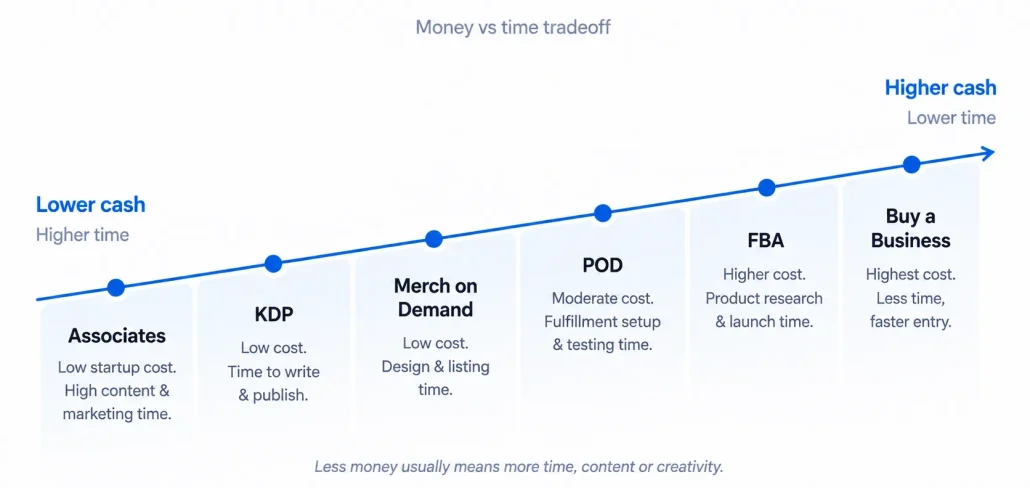
There is no single startup cost because the different Amazon income models require very different combinations of capital, time, creativity and existing audience.
The broad pattern is simple: the less money you invest upfront, the more work you generally need to contribute yourself.
At the lower-capital end are models such as Amazon Associates, the Influencer Program, KDP and Merch on Demand. These do not require you to purchase conventional inventory before you can start earning. Instead, the investment comes through content creation, writing, design, niche research or audience-building.
Print on demand sits somewhere in the middle. It reduces the need to commit heavily to inventory, but sellers may still face costs for product creation, samples, Amazon selling fees, advertising and fulfillment integrations.
Amazon inventory management usually requires substantially more capital because inventory must typically be purchased before it is sold. Amazon’s US Individual selling plan currently costs $0.99 per item sold, while the Professional plan costs $39.99 per month, before referral fees, FBA costs and advertising. In practice, however, inventory is usually a much larger financial commitment than the selling-plan fee itself.
Buying an existing Amazon business sits at the highest-capital end. You are effectively paying to acquire an asset that already has products, sales history, supplier relationships and operating systems in place.
The important takeaway is therefore not that one Amazon model is “cheap” and another is “expensive.”
Every model requires an investment. The investment simply changes form: money, time, expertise, creativity, audience, or some combination of them.
How to Make an Existing Amazon FBA Business More Passive
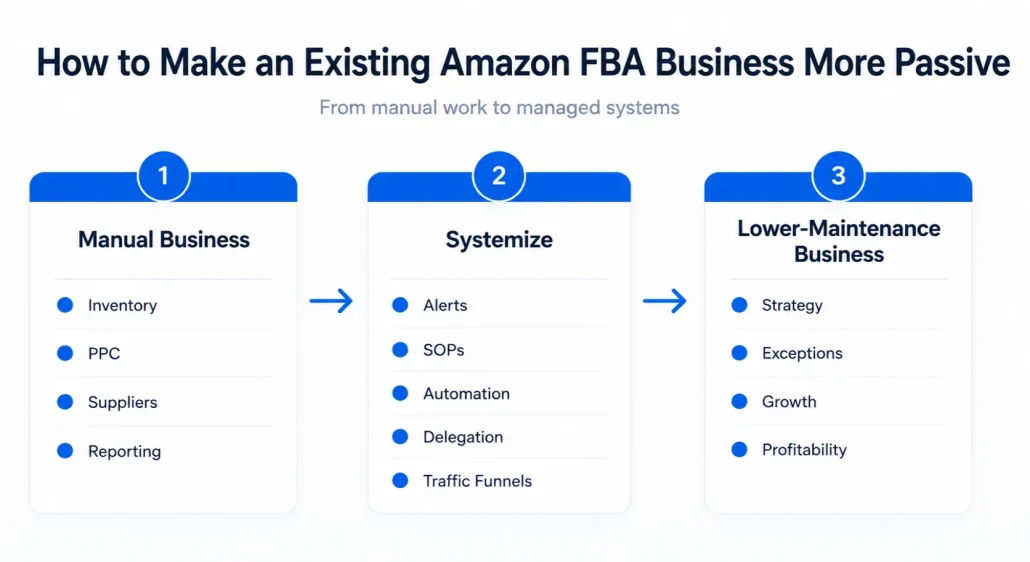
If you’re already selling successfully on Amazon, you may not need another income stream.
You may need to make the one you already own less dependent on you.
That’s a very different objective.
A seller who spends four hours every morning checking PPC campaigns, reviewing inventory, messaging suppliers and updating spreadsheets hasn’t created passive income. They’ve created a job they happen to own.
The route toward lower-maintenance income is to systematically remove yourself from repeatable decisions.
Stop managing inventory manually
Inventory is one of the first areas to systemize because both stockouts and excess stock are expensive.
A stockout can kill sales momentum and organic visibility. Too much inventory ties up cash and can generate additional storage expenses. Amazon’s 2026 schedule begins the aged-inventory surcharge at 181–210 days. Rather than deciding when to reorder based on instinct, define the variables that should trigger a purchase order:
- average daily sales;
- lead time;
- production time;
- freight time;
- safety stock;
- seasonality;
- promotional plans;
- minimum order quantity.
Amazon itself provides tools such as replenishment alerts and restock functionality to help sellers maintain inventory.
The goal isn’t to remove human judgment. It’s to make human judgment necessary only when something falls outside the expected range.
Automate repetitive PPC work without automating strategy
Advertising is another area where Amazon businesses become owner-dependent.
Many sellers spend enormous amounts of time adjusting individual bids, budgets and search terms manually. A mature business should use automation to handle repeatable campaign decisions while preserving human oversight for strategy.
Rules can identify search terms that have spent too much without converting. Campaigns can be flagged when ACOS rises beyond an acceptable threshold. Budgets can be monitored before profitable campaigns run out of money. Search-term harvesting and negative-keyword workflows can be systemized.
But “automated PPC” should not mean leaving campaigns untouched for six months.
Competition changes. Conversion rates move. Product economics change. Amazon fees change. Search behavior changes.
Automation should reduce the number of decisions you personally have to make, not eliminate accountability for them.
For an owner trying to make an Amazon business less hands-on, the ideal PPC setup is one where the system handles routine optimization and the operator spends their time on exceptions, strategy and new opportunities.
Build evergreen external-traffic systems
Amazon traffic is powerful, but relying entirely on Amazon’s internal ecosystem leaves you dependent on rankings and advertising auctions that you don’t control.
External traffic can reduce some of that dependency.
The mistake is treating external traffic as a sequence of isolated campaigns.
A Facebook promotion that requires you to manually rebuild the audience, landing page and tracking every time is not passive.
An evergreen acquisition funnel is different.
You can create campaign structures around your best products, route traffic through purpose-built landing pages, track performance and continue improving the same system rather than rebuilding it from scratch.
Turn repeatable tasks into SOPs
A surprisingly useful test is this:
If you disappeared for four weeks tomorrow, which processes would stop?
Write those down. They might include:
- placing supplier orders;
- creating inbound shipments;
- processing reimbursements;
- monitoring account-health notifications;
- updating forecasts;
- answering supplier emails;
- running weekly PPC checks;
- responding to listing suppressions;
- compiling profitability reports;
- checking review trends;
- updating pricing.
Every repeatable activity should eventually have three things:
an owner, a process and a trigger.
The owner doesn’t have to be you. The process shouldn’t exist exclusively in your head. And the trigger should specify when the work actually needs to happen. Once you have that structure, tasks can be delegated to employees, virtual assistants, specialist agencies or software without the business becoming chaotic.
Manage by exceptions rather than activity
The final step is changing what you look at. New sellers often watch everything. Experienced operators should increasingly watch exceptions.
- Instead of reviewing every ASIN, identify the ASINs whose conversion rate has fallen materially.
- Instead of checking every advertising campaign, surface campaigns that moved outside their acceptable efficiency range.
- Instead of looking at every SKU’s inventory every morning, flag SKUs that are approaching a stockout or an aged-inventory threshold.
- Instead of manually logging into multiple dashboards every day, the right Amazon analytics tools can help you build a weekly management view around the handful of numbers that tell you whether the system is healthy.
For an FBA business, those might include contribution margin, advertising efficiency, conversion rate, stock coverage, forecasted stockouts, refund rate and account-health issues.
Passive income doesn’t come from ignoring the business. It comes from building a business that tells you where your attention is actually required.
The Risks of Passive Income on Amazon
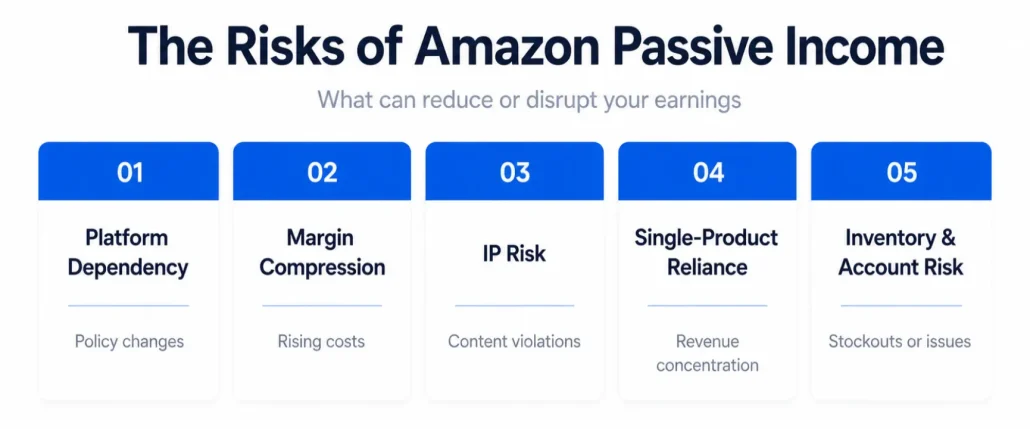
The biggest danger with Amazon passive income is believing that low day-to-day workload means low risk.
It doesn’t.
In some models, the opposite is true. The less frequently you look at the business, the more important your controls become.
Platform dependency
Every method in this guide depends to some degree on Amazon.
A KDP publisher can lose visibility. An FBA listing can be suppressed. An Associates account can lose eligibility. A Merch design can be rejected. An Influencer’s content can stop receiving onsite distribution.
That doesn’t make Amazon a bad platform. It means Amazon should be treated as a business partner whose rules you do not control. Read program policies rather than assuming an old YouTube tutorial is still accurate.
The Associates changes that took effect in April 2026 and KDP’s current AI-disclosure requirements are good examples of how quickly operational assumptions can change.
Margin compression
Revenue can continue rising while the business becomes worse. That happens when Amazon fees, advertising costs, shipping, manufacturing or return rates increase faster than prices.
For FBA sellers, Amazon’s 2026 fee update alone is a reminder that today’s unit economics should never be treated as permanent. Build your dashboards around profit and contribution margin, not vanity revenue.
Intellectual-property risk
Merch and KDP are particularly exposed to IP issues because creators can publish quickly. That speed is not an excuse to use somebody else’s trademarks, characters, artwork or copyrighted text.
The same is true of AI-generated assets. An AI system producing an image doesn’t automatically give you permission to use protected brands or characters contained in that output. Build around assets you own or have properly licensed.
Single-Product Concentration
One successful ASIN can make an Amazon business look far more stable than it really is.
If a large share of your revenue comes from a single product, any disruption to that listing can have an outsized impact on the entire business. A stockout, sudden ranking drop, new competitor, listing suppression or margin squeeze can quickly reduce income that previously appeared predictable.
The same principle applies beyond FBA. A KDP publisher relying on one bestselling title, a Merch seller dependent on one evergreen design or an affiliate site dominated by one high-converting page all face concentration risk.
Inventory and Account Risks
For FBA sellers, inventory creates a risk that does not exist in the same way with KDP, Merch on Demand or Amazon Associates. Too little stock can interrupt sales momentum and organic visibility, while excess inventory ties up cash and can trigger higher storage costs; Amazon’s 2026 aged-inventory surcharge schedule begins with inventory in the 181–210-day tier.
Account issues can be even more disruptive. Listing suppressions, policy violations, IP complaints or broader account-health problems can quickly reduce revenue, which is why a lower-maintenance Amazon business still needs strong safeguards such as replenishment thresholds, account-health alerts and exception-based reporting.
A more resilient passive-income model spreads revenue across multiple products, titles, designs or content assets. That way, one weak performer does not immediately threaten the whole income stream.
One strong asset can generate income. A portfolio makes that income more durable.
Conclusion: Is Amazon Passive Income Worth It in 2026?
Amazon passive income is real. Effortless Amazon income isn’t. The distinction matters.
The most sustainable models on Amazon work because you create an asset (a product catalog, a book, a design, a piece of content or an operating business) and then use Amazon’s marketplace and infrastructure to reduce the work required for each future sale.
FBA can make fulfillment dramatically less hands-on, but you still have to manage the economics and inventory behind the products. KDP and Merch remove much of the fulfillment burden, but they require valuable creative assets. Associates and Influencer can turn content into long-lived earning assets, but only after you’ve earned people’s attention. Buying an existing Amazon business can skip years of setup, but it replaces the time requirement with capital and due diligence.
For existing Amazon sellers, the most important lesson may be even simpler:
You don’t necessarily need another source of passive income. You may need to make your current Amazon business less dependent on you.
Build the processes. Automate repetitive decisions. Delegate execution. Track the exceptions. Protect your margins. Keep building assets that can continue working after the initial work is finished.
That’s a much less exciting promise than “make money while you sleep.”
It’s also far more realistic and far more valuable.
Frequently Asked Questions About Amazon Passive Income
Yes, but most Amazon income is better described as semi-passive or front-loaded. FBA, KDP, Merch on Demand, Amazon Associates and the Influencer Program can all produce revenue without requiring an equivalent amount of work for every additional sale. They still require setup, monitoring and periodic maintenance.
Merch on Demand and KDP can become relatively low-maintenance because Amazon handles much of the fulfillment and you don’t need to continually replenish conventional inventory. However, both require valuable creative assets and ongoing attention to listings, competition and Amazon policies. There is no genuinely zero-work Amazon business.
FBA can make an Amazon business semi-passive, but FBA itself is simply a fulfillment service. Amazon can store, pick, pack and ship orders and handle customer service and returns related to fulfillment, while the seller remains responsible for products, sourcing, inventory, pricing, advertising and account management.
There is no single FBA startup figure because the largest cost is usually the inventory you choose to purchase. Amazon’s US Individual selling plan currently costs $0.99 per item sold, while the Professional plan costs $39.99 per month, before referral fees and optional FBA services. Fulfillment, storage and other potential FBA costs vary by product.
Yes. Amazon KDP lets you publish digital books, Amazon Associates lets you earn commissions from qualifying referrals, and qualifying Amazon Influencers can monetize creator content and product recommendations. These models avoid conventional physical-product inventory, although each requires substantial work upfront.
KDP remains a viable publishing platform, but simply uploading generic books isn’t a sustainable strategy. Strong titles solve a specific reader need or provide genuinely valuable entertainment or expertise. Amazon also requires publishers to disclose AI-generated content, including AI-generated text, images or translations.
KDP offers 35% and 70% ebook royalty options. Effective July 7, 2026, eligible Amazon.com ebooks priced from $2.99 to $12.99 can qualify for the 70% option, subject to Amazon’s other eligibility and territory requirements. Delivery costs can also affect the final royalty under the 70% option.
Amazon Associates generally uses a 24-hour session after a customer reaches Amazon through an Associates link. If an eligible product is added to the cart during the session, a later purchase may still qualify if the order is completed before the cart expires, normally within 90 days. The session can end earlier if the customer orders or follows another Associate’s link.
Amazon currently describes Merch on Demand as offering a free account with no out-of-pocket cost to begin selling eligible merchandise. Creators upload designs and set list prices, while Amazon handles manufacturing and fulfillment. Royalties are calculated from the offer price after applicable taxes and Amazon’s costs.
You can use AI tools, but you must follow Amazon’s current content rules. Amazon requires disclosure of AI-generated text, images and translations submitted through KDP. AI-assisted work (for example, using AI to brainstorm, edit or refine material you created) does not currently require the same disclosure. Publishers remain responsible for accuracy, quality and intellectual-property compliance.
For a seller who already has profitable products, the highest-return move may be to make the existing FBA business more automated rather than starting another Amazon side hustle. Systemizing inventory planning, advertising, reporting, external traffic, supplier workflows and routine account management can gradually reduce owner involvement without requiring a completely new revenue model.
RANK LIKE THE PROS
Discover a better way to rank products from external traffic, like Facebook, Google and TikTok, with LandingCube promo pages.
Try it free for 21 days.