
Aug 30th 2026
Resources
- Facebook Ads for Amazon [Video Course]
- Drive Traffic To Amazon [Ultimate Guide]
- Get More Amazon Reviews [Ultimate Guide]

TL;DR
When is a simple Amazon product link enough?
A clean amazon.com/dp/ASIN link is usually enough when you simply want to direct someone to a product. It keeps the destination simple without unnecessary search or session information. Sellers running paid or measurable campaigns will usually need more tracking behind the link.
Why should different campaigns use different short links?
Reusing one Amazon link everywhere makes it harder to see which traffic source is performing. Separate links for Google Ads, Meta, email or influencers make campaign results easier to compare. A consistent naming system also makes dozens of active links much easier to manage.
Where are Amazon short links most useful?
Short links are especially useful in social posts, ads, emails, video descriptions and other external marketing. They also work well anywhere customers may need to remember, type or scan a destination. The goal is to reduce friction while keeping the campaign organized.
What should sellers check before publishing a short link?
Always test that the link reaches the correct product, marketplace and mobile page. If the campaign uses tracking, confirm that the intended destination and measurement setup are still intact. A quick test before launch can prevent paid traffic from being sent through the wrong link.
Amazon product URLs can become absurdly long. Copy a product link after browsing through Amazon search and it may contain the product name, ASIN, search terms, referral information and a long string of additional parameters.
Fortunately, the link a customer actually needs can be much simpler.
Table of Contents
- How to Shorten an Amazon Link in 30 Seconds
- What is an Amazon Shortlink?
- The Four Amazon Link Types Sellers Should Understand
- What Is an a.co Link?
- How to Shorten Amazon Links
- When and Where to Use Shortened Links
- How to Organize Amazon Short Links Across Your Marketing
- Why Amazon Sellers Use Short Links: The Benefits
- Amazon Attribution and Short Links: What Sellers Need to Know
- How to Shorten and Track Amazon Links With LandingCube
- Amazon Seller Links and Affiliate Links Are Not the Same Thing
- Common Pitfalls with Amazon Shortlink Usage
- Final Thoughts
- FAQs: All About Amazon Short Links
For a standard Amazon product page, you can often reduce the URL to a clean format such as amazon.com/dp/ASIN. Sellers who need more than a basic link can also create a branded Amazon short link with LandingCube, track clicks, organize links by campaign and connect external traffic with Amazon Attribution.
The important part in 2026 is knowing which information can safely be removed and which tracking information needs to stay intact. A normal product URL, an Amazon Attribution link and an Amazon Associates link may all point to the same product, but they serve different purposes and should not be treated as interchangeable.
In this guide, we’ll show you how to shorten an Amazon link step by step, explain what a.co and Amazon short links actually are, the best Amazon URL shortener for sellers in 2026, and show Amazon sellers how to create cleaner links without sacrificing the measurement they need.
How to Shorten an Amazon Link in 30 Seconds
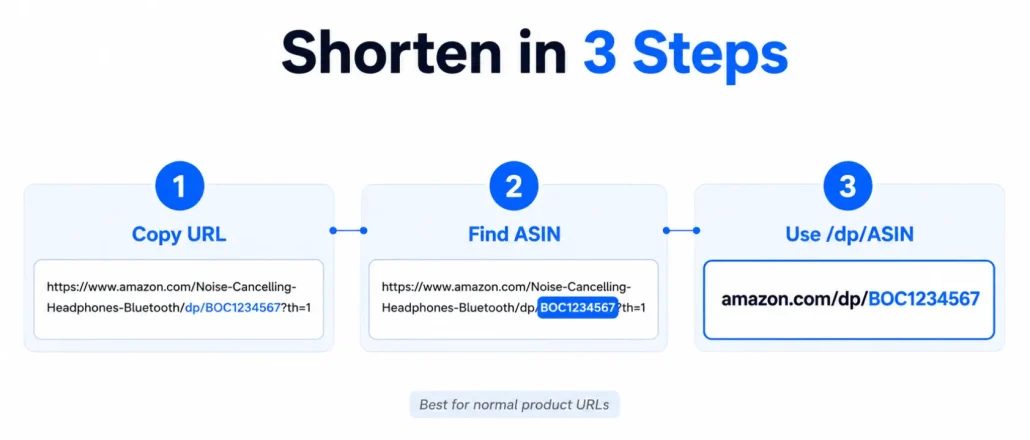
If all you need is a clean URL that takes somebody to an Amazon product page, shortening an Amazon link is surprisingly simple.
Start by opening the product on Amazon and finding its ASIN. The ASIN is the ten-character identifier Amazon assigns to a product and it appears in the URL immediately after /dp/ on most product-detail pages.
A URL copied after an Amazon search may look something like this:
https://www.amazon.com/Product-Name/dp/B07ZD7R4RF/ref=sr_1_16?keywords=example&qid=123456789For a normal product link, everything after the ASIN is usually unnecessary for reaching the product. The product name in front of /dp/ is unnecessary too.
That leaves you with:
https://www.amazon.com/dp/B07ZD7R4RFOpen the shorter version in a new browser tab and you should arrive at the same product page.
There is one important exception: do not use this method to clean an Amazon Attribution URL or an Amazon Associates link by simply deleting parameters. Those URLs contain information used for measurement or commission tracking. Amazon specifically tells advertisers not to change Amazon Attribution tags because doing so can affect measurement.
For sellers running marketing campaigns, a better workflow is therefore:
- Start with the correct Amazon destination.
- Add Amazon Attribution where appropriate.
- Use LandingCube to turn that destination into a cleaner, branded short URL.
- Test the finished link before publishing it.
That way, customers see a manageable link while your underlying campaign measurement remains intact.
What is an Amazon Shortlink?
An Amazon short link is a shorter URL that ultimately takes the user to an Amazon destination. It may be a cleaned-up direct Amazon product URL, an Amazon-generated short URL or a managed redirect that points to the full Amazon destination behind the scenes.
Take this for example – the URL for a product I viewed after making a search:
https://www.amazon.com/Magnesium-Glycinate-400mg-Bioavailable-Vegetarian/dp/B07ZD7R4RF/ref=sr_1_16?crid=3TLV15LS9YSHM&keywords=magnesium+glycinate&qid=1675234792&sprefix=%2Caps%2C330&sr=8-16That’s a straight copy + paste from my address bar.
The URL contains a ton of information related to the product show, and how the person got to the product listing, such as:
- Name of the product
- ASIN
- The keywords used in the search
- Where the product was in the search results when it was clicked
- A unique time identifier for when it was clicked
- Other data that Amazon uses for internal purposes
RANK LIKE THE PROS
Discover a better way to rank products from external traffic, like Facebook, Google and TikTok, with LandingCube promo pages.
Try it free for 21 days.
You don’t need all these details to get to the product page, though. You can share the same thing, but with a lot of these numbers and letters stripped away, and still send someone to the same page.
An Amazon short link could be the shortest version of the above link, that doesn’t miss out on anything important for the link to function correctly. It could also be a link generated by a third-party tool that redirects the clicker to the product page, and the full URL in question.
The Four Amazon Link Types Sellers Should Understand
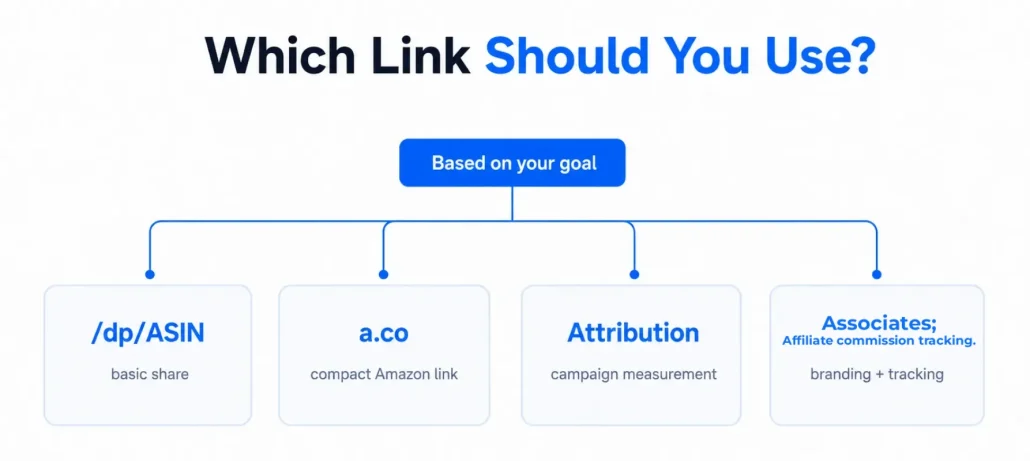
Not every Amazon link serves the same purpose. Before shortening anything, identify what kind of link you are working with and what information needs to remain intact.
1. A Clean Amazon Product URL
For many product pages, the simplest direct URL follows this structure:
https://www.amazon.com/dp/ASINThis is useful when your only objective is to send someone to the product. It is substantially cleaner than a URL copied after searching or browsing Amazon because it removes parameters connected with the shopper’s previous search session.
The limitation is equally important: a plain /dp/ASIN URL does not, by itself, tell you which ad, influencer, social post or email generated an Amazon conversion.
If you are investing money in external traffic, “short” and “measurable” are two different requirements.
2. An a.co Amazon Short Link
An a.co link is a compact Amazon-hosted URL designed to make Amazon destinations easier to share. It is convenient, but sellers should not assume that an a.co link contains the Amazon Attribution tracking required to measure a specific external campaign.
3. An Amazon Attribution Link
Amazon Attribution is built for measuring non-Amazon marketing such as search, social, display, video and email campaigns. Amazon adds parameters to the destination URL so it can associate later Amazon activity with the external click.
For eligible sellers, that means a longer URL can actually contain extremely valuable information.
Amazon’s May 2026 implementation guidance is very specific: create a tag for each individual ad, link or button and don’t modify the Attribution tag after it has been generated. Amazon also says Attribution tags should not be combined with Amazon Affiliate links.
This is where a short-link management layer becomes valuable. The customer can receive a clean LandingCube URL while the underlying destination retains the campaign-specific Amazon Attribution information you need.
4. An Amazon Associates Link
Amazon Associates is a separate program intended for publishers and creators earning commissions by referring customers to Amazon.
Associates can create full or short links using Amazon’s SiteStripe feature. Amazon says SiteStripe’s Text link option can generate short and long links and automatically incorporate the selected Associate ID and tracking ID.
Do not confuse that with Amazon Attribution.
If you are a seller promoting your own brand, Amazon Attribution is usually the relevant measurement system. If you are acting as an Amazon Associate and earning affiliate commissions, the Associates Operating Agreement and Program Policies apply instead.
That distinction matters because the rules governing where and how affiliate Special Links can be distributed are different from the rules for a seller’s own external advertising.
What Is an a.co Link?
An a.co link is a compact Amazon URL that redirects the user to content on Amazon. You may encounter a.co links when Amazon makes a product easier to share instead of exposing the complete product-page URL.
That makes a.co useful from a purely practical point of view. A link such as:
https://a.co/d/exampleRANK LIKE THE PROS
Discover a better way to rank products from external traffic, like Facebook, Google and TikTok, with LandingCube promo pages.
Try it free for 21 days.
is obviously easier to paste into a message than a product URL containing dozens of characters of search and session information.
For Amazon sellers, however, the more useful question is not simply “Is the link short?” It is “What can I measure from it?”
An a.co link and an Amazon Attribution link solve different problems. The first gives you a compact Amazon-hosted URL. The second is intended to connect non-Amazon marketing activity with actions on Amazon.
If you are sending a friend a product, that distinction may not matter. If you are spending $10,000 a month driving paid social traffic to an Amazon listing, it matters a great deal.
For campaign traffic, your workflow should therefore start with measurement rather than cosmetic shortening. Build the correct Attribution destination for the individual campaign, preserve that destination and then use LandingCube if you want a cleaner link, campaign naming, click reporting, a branded domain or a QR code.
The same principle applies whenever you inherit an a.co link from somebody else: don’t assume that because the destination works, your own campaign tracking is present.
How to Shorten Amazon Links
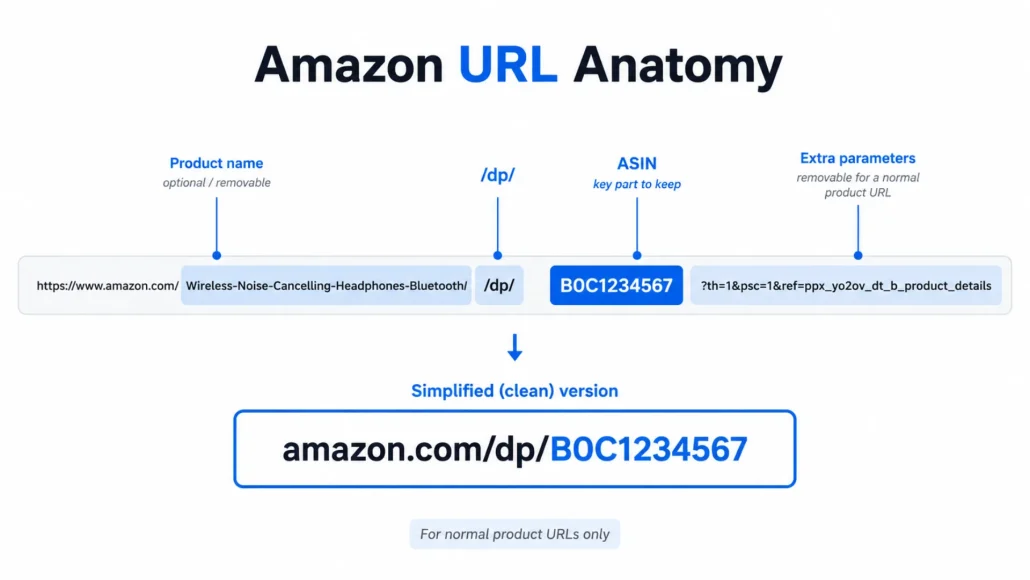
The first way to shorten Amazon URLs is to do it yourself.
With the link above, most of this can be cleared away, and people will still end up on the same page.
We can clear this information, that relates to when, where, and how the person got to the product listing:
- sr=8-16
- sprefix=%2Caps%2C330
- qid=1675234792
- keywords=magnesium+glycinate
- crid=3TLV15LS9YSHM
- ref=sr_1_16
Now we have this:
https://www.amazon.com/Magnesium-Glycinate-400mg-Bioavailable-Vegetarian/dp/B07ZD7R4RFThis is cleaner and more friendly to look at.
But we can cut it down even more. The name of the product isn’t important – all you need is the ASIN:
https://www.amazon.com/dp/B07ZD7R4RFIf you try the link above, and the first link we showed, you’ll end up in exactly the same place.
An alternative option is to use a URL shortener to do it for you. Using this, you can not only shorten the URL, but customize it further. There are many options for amazon link shorteners available online.
Here’s an example, using LandingCube:
https://lncb.me/mg-glycinate/This is a great way to cut out the confusing details from an Amazon URL, make it more friendly to click on, and easier for people to remember and type.
How To Shorten Amazon Affiliate Links
If you participate in Amazon Associates, Amazon provides its own link-generation feature called SiteStripe. You do not need to install a separate browser extension. When SiteStripe is enabled and you are signed into the Amazon account connected to Associates, the toolbar appears while you browse Amazon.
Open the Amazon page you want to promote and select the Text link option in SiteStripe. Amazon can then generate either a full link or a shorter Amazon link, with your Associate ID and tracking ID incorporated into the link.
There is an important distinction here for sellers: an Amazon Associates link is not the same thing as an Amazon Attribution link. Associates links are designed to track affiliate commissions. Amazon Attribution links are designed for eligible advertisers and sellers measuring non-Amazon marketing campaigns.
Do not treat the two tracking systems as interchangeable. Amazon’s current Attribution documentation explicitly states that Amazon Attribution tags should not be combined with Amazon Affiliates links.
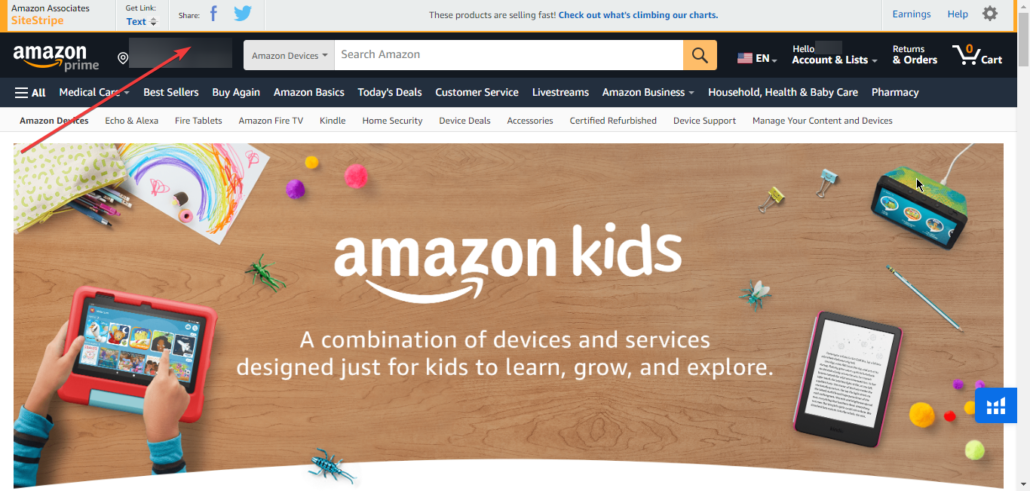
When you’re logged into Amazon Associates, SiteStripe allows you to generate full or shortened affiliate links by clicking the desired radio button.
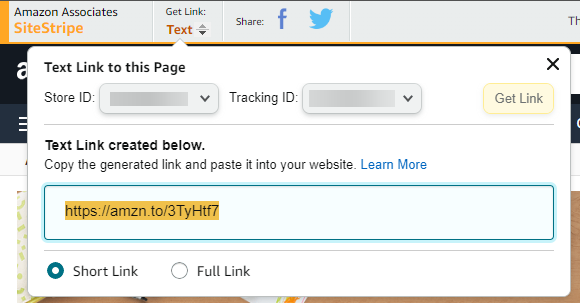
If you are an Associate, check the current Associates and OneLink requirements before placing a Special Link behind a third-party redirect.
When and Where to Use Shortened Links
You should use a shortened URL whenever you link to your product from somewhere outside Amazon or you want to know how to send an Amazon link via email.
This includes:
- Facebook Ads
- TikTok Ads
- Ads on other social platforms (Snapchat, Instagram, Pinterest, etc)
- Organic social media posts
- Links in social media profiles
- Emails
- SMS messages (or Messenger, WhatsApp, etc)
- Blog posts
- Links in show notes/video descriptions (e.g. for podcasts or YouTube videos)
Another place to use a short link is on your product inserts or packaging. If you want to put your product or storefront URL, you should use as simple a URL as possible, since people will have to type this URL manually.
Google Ads note: Amazon Attribution can measure traffic from Google search campaigns, but Google’s advertising policies separately govern what you can use as the ad’s Final URL. A third-party short URL that redirects to Amazon may trigger a Destination Mismatch unless your setup falls within an approved exception, so verify Google’s current requirements before launch.
How to Organize Amazon Short Links Across Your Marketing
Creating one short URL is easy. Managing 150 of them across paid social, search, creators, email, product launches and evergreen campaigns is where sellers usually run into trouble. A simple structure prevents that.
Use One Measurable Link Per Meaningful Traffic Source
Do not use one catch-all Amazon URL across every campaign merely because all traffic ends at the same ASIN. If Meta, paid search, email and an influencer campaign all share the same measurement setup, you lose useful granularity.
Instead, separate links wherever knowing the source would change a decision you make. That does not mean creating a new link for every minor creative variation. It means creating enough separation to understand which channels and campaigns deserve more budget.
Use a Consistent Naming Convention
A naming system such as:
Product – Channel – Campaign – Variant
makes links much easier to audit.
For example:
protein-meta-summer-prospectingprotein-paid-search-brandprotein-email-prime-dayThe customer does not necessarily need to see that internal naming structure if you use a simpler public slug, but your link-management system should make the campaign identifiable.
Avoid Reusing Historical Campaign Links
Suppose you used [/summer-sale] in 2025 and then reuse exactly the same tracked link for a completely different 2026 campaign.
Your historical click data becomes harder to interpret because two unrelated marketing periods are mixed together.
Create a new campaign link when the marketing activity is meaningfully new.
Test the Destination Before Launch
Every short URL should be checked before money or physical inventory is committed to it.
Verify:
- the correct product or Store opens;
- the correct Amazon marketplace opens;
- the ASIN is still live;
- the page is available on mobile;
- the intended campaign measurement remains present;
- any QR code resolves correctly from an actual phone;
- the link has not accidentally been reused from another campaign.
For Amazon Attribution specifically, Amazon recommends allowing one to two days after launch before reviewing and validating Attribution reporting.
A two-minute link QA before launch can prevent thousands of paid clicks from being sent through the wrong destination.
Why Amazon Sellers Use Short Links: The Benefits
Amazon sellers use short links for a more practical reason than simply making a URL shorter.
A well-managed short link separates the customer-facing URL from the complicated destination and tracking setup behind it. That gives the seller more control over how the link looks, how it is organized and what can be measured.
Cleaner Links Are Easier to Share
An Amazon URL copied after browsing or searching can contain far more information than a customer needs to reach the product. Removing that clutter makes the link easier to paste into social posts, creator briefs, presentations and campaign documentation.
Branded URLs Provide More Context
A custom domain and descriptive slug can tell the customer something about where the link came from before they click it.
Instead of promising that branded links universally generate a particular percentage more clicks, think of the benefit as improved clarity and consistency. The effect on CTR will vary according to the audience, placement, offer and creative.
Short Links Make Offline Promotion Practical
If a URL needs to be spoken aloud, printed or represented by a QR code, brevity matters. Nobody wants to manually type a long Amazon search URL from a podcast or printed card.
For sellers, a memorable short URL or QR code greatly reduces the friction involved in reaching the Amazon destination.
Link Management Makes Campaign Analysis Easier
The largest benefit appears when links are treated as campaign assets rather than disposable redirects.
If each important traffic source has its own managed link, sellers can compare click activity across campaigns instead of relying on one generic Amazon URL everywhere.
When that structure is combined with Amazon Attribution for eligible campaigns, the seller can compare what happened before the Amazon visit with what happened after it.
That is a much stronger reason to use a link shortener than the unsupported promise that “short links automatically mean more sales.”
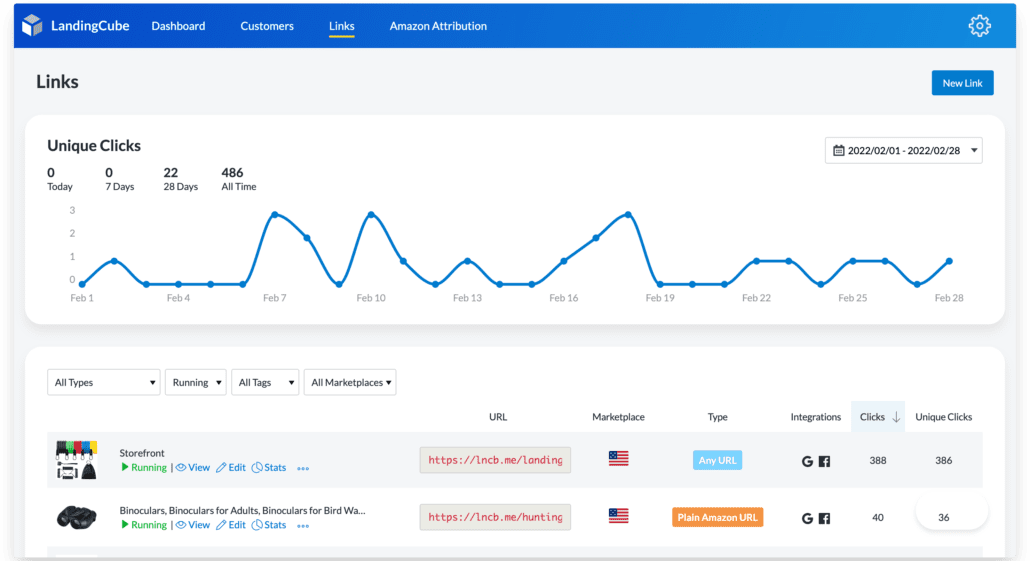
This is an amazing way to analyze your marketing efforts, and see what’s bringing you the best results.
Amazon Attribution and Short Links: What Sellers Need to Know
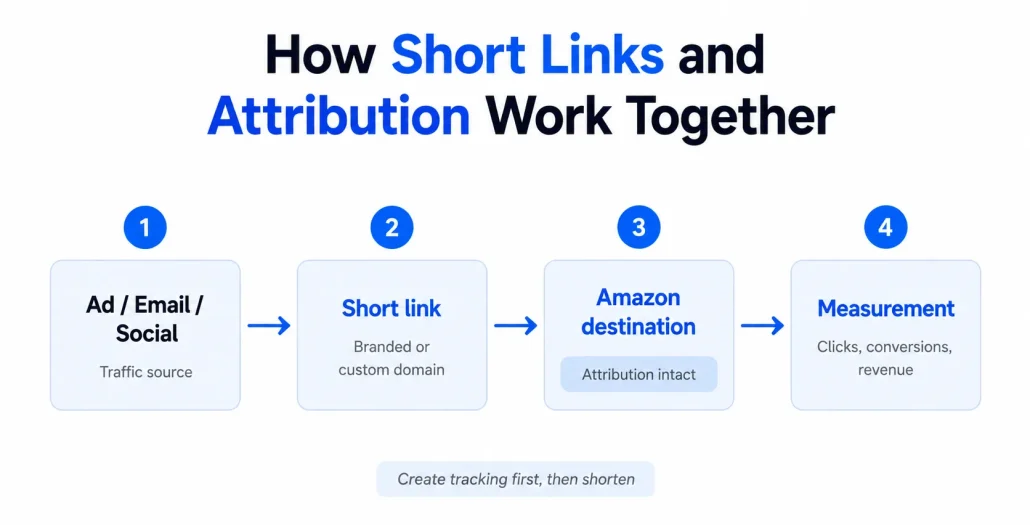
For Amazon sellers, shortening a link is only useful if you preserve the tracking behind it. This is particularly important when using Amazon Attribution to measure external traffic from channels such as paid search, social media, email or influencer campaigns.
Amazon recommends creating a separate Attribution tag for each ad, link or button and advises advertisers not to modify the generated Attribution URL. Where the advertising platform permits a managed redirect, the complete Attribution destination can sit behind a cleaner LandingCube link. For platforms such as Google Ads, however, always check the publisher’s destination requirements before using a third-party short URL as the Final URL.
| Link Type | Best For | Tracking | Can You Shorten It? |
|---|---|---|---|
| amazon.com/dp/ASIN | Basic product sharing | Limited | Yes |
| Amazon Attribution URL | External seller campaigns | Amazon campaign measurement | Yes, but preserve the full destination URL |
| LandingCube Short Link | Branded and trackable campaigns | Clicks + underlying Amazon Attribution | Already shortened |
Best practice: create the correct Amazon Attribution destination first, then shorten that URL with LandingCube. This gives customers a cleaner link without sacrificing the Amazon-side campaign data you need.
How to Shorten and Track Amazon Links With LandingCube
If you’re driving external traffic to Amazon, a short link should do more than simply look cleaner. With LandingCube, you can create branded Amazon short links while keeping important campaign tracking, including Amazon Attribution, intact.
Once your Amazon destination and measurement setup are ready, LandingCube adds the customer-facing layer. You can turn the destination into a shorter branded URL, organise campaign links and monitor click activity from one dashboard.
| LandingCube Feature | Why It Matters |
|---|---|
| Short Amazon URLs | Turn long Amazon URLs into cleaner, easier-to-share links. |
| Custom Domains & Slugs | Create recognizable links such as yourbrand.com/summer-sale. |
| Amazon Attribution | Preserve campaign-specific Amazon Attribution destinations behind your short links. |
| Click Tracking | Compare traffic from different campaigns and marketing channels. |
| QR Codes | Use your Amazon links in offline campaigns and mobile-first promotions. |
It’s not limited to links directly to your product listing, either. You can create Add to Cart or Buy Together links, which send someone straight to the Add to Cart page with one or more products pre-filled.
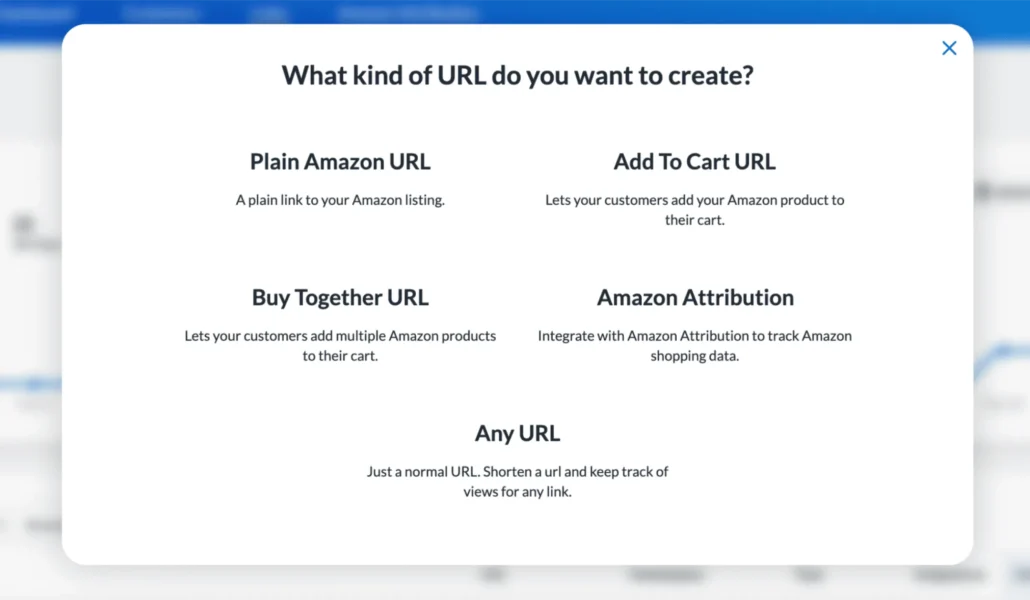
You can also use it for non-Amazon links, or links to your Amazon Storefront.
For best results, use separate measurement setups for important traffic sources such as paid search, Meta campaigns, influencers and email. Where a platform permits managed redirects, separate LandingCube links can also make campaign-level click data easier to compare.
Click here to sign up for a free trial, and start using LandingCube to shorten your Amazon links. The link shortener is included on all plans, with full link management from your dashboard.
You’ll also have access to our landing page builder, which will help you build high-converting Amazon sales funnels.
If you’re marketing with external traffic, a well-managed Amazon URL shortener makes it easier to organize, track and optimize your campaigns. Try it now for free and start getting more from your external traffic.
Amazon Seller Links and Affiliate Links Are Not the Same Thing
A common source of confusion is that “Amazon link” can refer to two very different marketing relationships.
- An Amazon seller may be directing customers from their advertising, social channels or owned marketing to a product they sell on Amazon.
- An Amazon Associate is promoting Amazon products under the Associates Program in exchange for potential commission income.
Those activities do not share identical rules.
If You Are an Amazon Seller
For sellers promoting their own products, Amazon Attribution is the key measurement system to investigate eligible non-Amazon campaigns.
Amazon describes Attribution as a way to measure advertising impact from non-Amazon media, and the current implementation guidance covers campaign destinations used in external advertising.
A managed LandingCube URL can then give you a cleaner customer-facing link and additional off-Amazon link management.
If You Are an Amazon Associate
Follow the Associates Operating Agreement and current Program Policies for the particular channel where you intend to publish a Special Link.
Amazon requires Special Links to use the appropriate tagged format it provides.
There are also distribution restrictions that sellers should not accidentally copy across from their own campaigns. For example, the current Participation Requirements restrict Associates’ use of Special Links in offline promotion, printed material, mailings, SMS and email, and contain separate requirements for paid-search advertising.
So a statement such as “put your Amazon short link in an SMS” can be perfectly reasonable advice for a brand sending customers to its own product, yet misleading if a reader interprets it as blanket permission to distribute an Associates Special Link by SMS.
What About Amazon OneLink?
Associates using Amazon OneLink for international traffic need another caveat.
Amazon says OneLink supports Amazon full links and Amazon-generated short links, but that links shortened using third-party link shorteners are currently not supported for OneLink redirection.
If international Associates redirection matters to your campaign, check the current OneLink requirements before wrapping the affiliate destination in another redirect.
Common Pitfalls with Amazon Shortlink Usage
Knowledge is power. There are some mistakes to avoid when using Amazon shortlinks. Being aware of these before you start will help you optimize your strategy from the beginning and save you a lot of damage control down the road.
Avoid these common pitfalls when implementing Amazon shortlinks in your marketing strategies:
Overuse of Shortlinks
Pitfall: Using too many shortlinks in your content will overwhelm your audience. Short-form content like social posts and ads only need on link. Including too many links will look spammy and reduce the chance that someone will click any of your links.
Solution: Use shortlinks sparingly and strategically.
Ignoring Link Placement
Pitfall: Poorly placed shortlinks can lead to low engagement.
Solution: Place you links in the most logical places, usually behind your call-to-action.
Neglecting to Monitor Performance
Pitfall: Not tracking the performance of your shortlinks can result in missed opportunities for optimization.
Solution: Utilize the the data Amazon and LandingCube provide to track your performance and adjust accordingly.
Using Shortlinks Outside of Approved Platforms
Pitfall: Distributing Amazon shortlinks on platforms not approved by Amazon or in ways that violate the terms of Amazon’s guidelines can lead to sanctions, including removal from the program.
Solution: Familiarize yourself with Amazon’s policies regarding where and how you can share Amazon links. Ensure all platforms you use for distribution are compliant with these guidelines.
Failing to Update Links
Pitfall: Links that lead to unavailable products or outdated pages provide a poor user experience and can diminish your credibility.
Solution: Regularly review and update your shortlinks to ensure they direct to valid, available products. This maintenance is crucial for preserving the integrity of your content and the trust of your audience.
Best Practices to Avoid Pitfalls
- Regularly review Amazon’s Affiliate Program policies to stay updated on compliance requirements.
- Engage with your audience to understand their needs and preferences, ensuring your affiliate links are relevant and valuable.
- Test and optimize your link placement and content strategy based on performance data and audience feedback.
Being aware of these pitfalls will help you develop methods to avoid them.
How Do Amazon Short Links Comply with Amazon’s Marketing Policies?
Using an Amazon-generated Associates link does not by itself guarantee compliance. Affiliates must also follow Amazon’s rules on placement, disclosure, advertising and distribution. These policies mandate clear disclosure of the affiliate relationship, prohibiting misleading practices and requiring that the use of affiliate links does not violate any applicable laws or regulations.
Final Thoughts
Shortening an Amazon URL is easy. The more important decision is what needs to survive behind the short link.
For a basic product page, amazon.com/dp/ASIN may be all you need. For a seller investing in external marketing, a well-structured link should also help you distinguish campaigns, preserve Amazon Attribution and understand which traffic actually contributes to Amazon performance.
LandingCube lets sellers put a cleaner, branded URL in front of that tracking setup while managing links, clicks and campaigns from one place.
So don’t shorten a link simply because the original looks ugly. Build the right destination first, preserve the measurement you need, and then make the URL easy for customers to use.
FAQs: All About Amazon Short Links
For an ordinary Amazon product page, find the product ASIN and create a clean URL in the format https://www.amazon.com/dp/ASIN. If you need branding, click tracking, Amazon Attribution integration or link management, you can create a managed short URL with LandingCube instead. Do not manually remove parameters from an Amazon Attribution URL because those parameters are used for measurement.
An Amazon link shortener turns a long Amazon destination into a shorter URL that redirects to the same page. A seller-oriented link shortener can also add useful capabilities such as branded domains, campaign organization, click analytics, QR codes and integration with Amazon Attribution.
An a.co link is a compact Amazon URL used to redirect users to Amazon content, including product pages. It is useful for sharing but should not automatically be treated as a substitute for Amazon Attribution when a seller needs campaign-level measurement.
Yes. For an ordinary product URL, you can usually reduce the address to amazon.com/dp/ASIN. For example, if the ASIN is B07ZD7R4RF, the clean URL is https://www.amazon.com/dp/B07ZD7R4RF.
For a basic product link, the ASIN is the essential identifier. However, if the URL contains Amazon Attribution or Associates tracking, those parameters may be important. Do not indiscriminately remove everything after the ASIN from a tracked campaign URL.
“Short link” describes the URL format. “Affiliate link” describes the commercial purpose and tracking arrangement. An Amazon Associates link contains an Associate ID so eligible commissions can be tracked. A seller’s ordinary short product URL does not automatically become an affiliate link.
Often yes for a normal product URL, but not universally. Amazon Attribution URLs contain parameters required for campaign measurement, and Associates links contain tracking information used for affiliate commissions. Know what kind of link you are editing before removing parameters.
A URL shortener can track activity before the visitor reaches Amazon, such as link clicks. For eligible seller campaigns, Amazon Attribution can provide measurement of actions that occur after the click on Amazon. Using the two together can give sellers a more complete picture of external campaign performance.
Yes, provided the underlying Amazon Attribution destination is preserved correctly. Amazon tells advertisers not to modify Attribution tags because doing so can affect measurement. LandingCube can be used to create a cleaner managed URL while retaining the correct campaign destination.
Amazon says it does not support combining Amazon Attribution tags with Amazon Affiliates links. Decide whether the link is being used for seller Attribution measurement or for Associates commission tracking and configure it accordingly.
Associates should check the current Associates Operating Agreement and Program Policies before modifying or redirecting Special Links. Amazon also states that third-party-shortened links are not currently supported for OneLink international redirection.
RANK LIKE THE PROS
Discover a better way to rank products from external traffic, like Facebook, Google and TikTok, with LandingCube promo pages.
Try it free for 21 days.