What are the two ways Amazon sellers can use affiliate marketing?
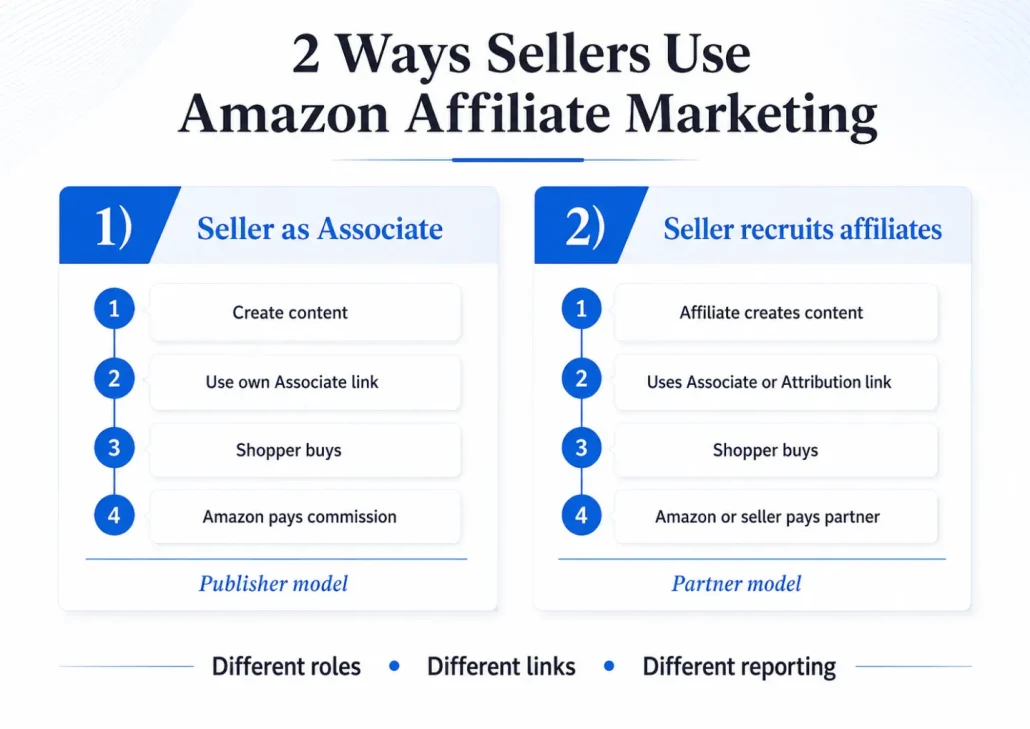
Sellers can become Amazon Associates and earn commissions through their own content, or recruit independent affiliates to promote their Amazon products. These models use different accounts, tracking methods, and payment arrangements.
What to do before recruiting affiliates?
Optimize product listings. Affiliates generate attention, but they cannot compensate for weak product images, unclear benefits, poor reviews, uncompetitive pricing, or unavailable inventory. External traffic is most valuable when the listing is already capable of converting interested shoppers.
What should sellers give affiliates before a campaign begins?
Provide a clear creative brief covering the customer problem, product use cases, differentiators, limitations, factual claims, promotion dates, and available creative assets. Give partners enough information to create accurate content without forcing them to repeat a rigid advertising script.
What makes someone a good affiliate partner?
The best partner is not always the creator with the largest following. Look for publishers whose audiences closely match your customers and who can explain the product credibly through useful reviews, comparisons, tutorials, or demonstrations.
Affiliate marketing can help Amazon sellers reach shoppers beyond Amazon search results, sponsored placements, and recommendation widgets. However, doing affiliate marketing through Amazon is not the same as recruiting independent affiliates to promote your products.
As an Amazon seller, you can approach affiliate marketing in two ways. You can become an Amazon Associate and monetize content published through your own website, YouTube channel, or eligible social media account. You can also work with independent publishers and creators who recommend your products to their audiences and send interested shoppers to your Amazon listings.
This guide explains both approaches. You will learn what Amazon looks for when reviewing Associates applications, how to improve your chances of acceptance, how to generate your first qualifying sales, and how to recruit, manage, and measure external affiliate partners.
What is Amazon Affiliate Marketing?
Affiliate marketing is a performance-based marketing strategy where businesses partner with individuals (affiliates) who promote their products. Affiliates earn a commission for driving traffic or sales through unique referral links (What is a good CTR for Amazon Ads?).
Meet the Affiliate Marketing Trio
Affiliate marketing involves 3 key players:
Merchants (You): As an Amazon seller, you provide the products and earn revenue from sales.
Affiliates: Influencers, bloggers, email marketers, coupon websites and niche content creators who promote your listings.
Customers: The end consumers who purchase your products through affiliate recommendations.
How It Works
Affiliates share unique referral links through blogs, social media, or email campaigns.
Customers click on these links and purchase products.
Affiliates receive a percentage of the sales as commission.
What Amazon Affiliate Marketing Means for Amazon Sellers
The phrase “Amazon affiliate marketing for sellers” is often used to describe two different business models.
Model 1: The Seller Becomes an Amazon Associate
In this model, you operate as a publisher as well as a seller. You may run a niche website, educational blog, YouTube channel, newsletter, or social media account that serves an audience related to your product category.
For example, a seller of hiking accessories could publish trail guides, equipment comparisons, packing checklists, and product demonstrations. Some of those resources might recommend the seller’s own products, while others might recommend complementary products sold by different brands.
The objective is to build a useful publication rather than a collection of thin pages designed only to send visitors to Amazon. Amazon evaluates whether your channel gives customers insight, commentary, analysis, or another form of original value.
This model can diversify your content revenue, but it should not be treated as a method of earning rebates on your own purchases. Amazon does not pay commissions on products bought through your own links, including purchases made for you by friends, relatives, or associates.
Model 2: The Seller Recruits Independent Affiliates
In this model, you remain the merchant. Bloggers, publishers, reviewers, creators, and influencers independently recommend your products and use their own Amazon Associate links.
Amazon generally pays the standard Associates commission rather than deducting that commission directly from your seller account. However, you may still incur costs for product samples, content production, creator fees, exclusive discounts, affiliate-management software, or campaign support.
This strategy can expose your products to audiences that may never discover them through Amazon search alone. Its success, however, depends on choosing relevant partners and sending qualified traffic to a listing that is ready to convert.
A poorly matched creator can generate clicks without sales. A strong partner reaches people who already have the problem your product solves and can explain why the product deserves consideration.
Success Stories
Bloggers in tech and lifestyle niches have built entire businesses around Amazon Associates, driving substantial sales for sellers by reviewing and recommending products.
Consider the journey of The Wirecutter (now Wirecutter). The product testing and reviews website, monetized through Amazon affiliate links, began by writing easy to read consumer guides on tech gadgets and providing top product recommendations for products within the category, and eventually expanded across different niches.
In 2016, The New York Times acquired Wirecutter for a reported price of more than $30 million. At the time, Wirecutter was reportedly driving approximately $150 million in annual ecommerce transactions through its recommendations. That figure represented purchases generated for retailers—not Wirecutter’s own revenue.
Another example is Pack Hacker, a travel-gear review website monetized partly through affiliate links. By the time AllGear Digital acquired it in December 2023, Pack Hacker had reached seven figures in annual revenue.
Imagine how one of these review sites that focus on your product niche can send quality traffic from 90+ countries across the globe to your listings, and what a visibility and sales boost this would be.
Amazon Associates Requirements and How to Improve Your Chances of Acceptance (US Applicants)
Before applying to Amazon Associates, your publishing channel must meet both eligibility and quality standards, and you should take deliberate steps to avoid the most common rejection reasons.
Your website or social channel must be publicly accessible. Private communities, closed groups, paywalled content, or profiles that hide posts or follower counts are unlikely to pass review. Content must also be original and genuinely useful—lightly rewritten product descriptions are not enough. Strong applications include first-hand experience, comparisons, demonstrations, original images, practical use cases, or analysis that helps readers make better buying decisions.
For websites, Amazon recommends having at least 10 substantive posts as a practical benchmark, and the site should be active with recent updates (generally within the last 60 days). For social applications, Amazon currently accepts platforms such as Facebook pages and open groups, Instagram, X (Twitter), YouTube, TikTok, and Twitch. These accounts should have an established organic audience and, in most cases, at least 500 followers or likes. You must submit the exact public URL of each channel in your application.
Your content must also avoid prohibited or unsuitable material, including illegal, deceptive, hateful, sexually explicit, privacy-invasive, or dangerous content, as well as content directed at children where it violates applicable rules. In addition, Amazon trademarks must not be used in domain names, social handles, or tracking IDs in a way that implies an official relationship with Amazon.
There is no shortcut to approval, but you can significantly improve your chances by addressing the most common failure points:
Start by building your site before applying. Do not submit an empty domain or “coming soon” page. Instead, publish enough content to clearly demonstrate your niche, audience, and value. A strong starting set of content is more effective than a large number of thin, repetitive product pages. For example, a solid foundation might include a detailed buyer’s guide, a few product comparisons, practical tutorials, a troubleshooting article, an FAQ page, a glossary, a seasonal guide, and at least one hands-on review or demonstration. Each piece should serve a distinct purpose rather than repeating the same information with minor keyword variations.
Next, establish a clear niche. Amazon needs to understand who your content is for, and a focused niche also makes it easier to generate your first qualifying sales. Vague positioning like “products I like” is not effective. A more specific angle such as “practical equipment advice for first-time apartment gardeners” clearly defines the audience, their problem, and the reason they would return. Amazon sellers already have an advantage here because they understand their product category, customer objections, and buying language—this insight should be turned into content rather than just republishing product listings.
You should also add strong trust signals. Include an About page, Contact page, privacy policy, and clear affiliate disclosure. Make it obvious who creates or reviews the content and what their expertise is. Reviews should be balanced, acknowledging both strengths and limitations, since overly promotional content reduces credibility.
The site should be easy to review and navigate. Ensure important pages are accessible within a few clicks, remove broken links, placeholder content, and unfinished pages, and avoid intrusive pop-ups that block access to the main content—especially on mobile.
Publishing recent content is also important. A site that appears inactive can reduce trust during review. Instead of simply updating timestamps, improve older content with new examples, updated product information, original visuals, or clearer explanations.
Finally, only submit channels you fully control. Provide accurate URLs for all websites and social profiles where you intend to use affiliate links. Do not include domains or accounts you do not own or cannot manage. Keep this list updated after approval, as Amazon reviews declared channels to understand where your traffic originates and how your content is being used.
How the Amazon Associates Review Process Works
Registration gives you temporary access to Amazon Associates tools, but it is not the same as final approval.
During the initial period, you can create tagged links and begin publishing them on the channels declared in your application. Once you have generated three qualifying sales, Amazon reviews those channels.
The review considers more than traffic volume. Amazon evaluates whether the channel is publicly available, contains robust original content, gives customers a reason to visit, and complies with the operating agreement.
Amazon may reject an application when it cannot see enough original value, when links do not contain the correct tag, when the channel contains unsuitable material, or when Amazon trademarks are used improperly.
If the application is rejected, correct the cited problems before reapplying. Links from a previous application may contain an old tracking ID, so replace them with links generated through the new application.
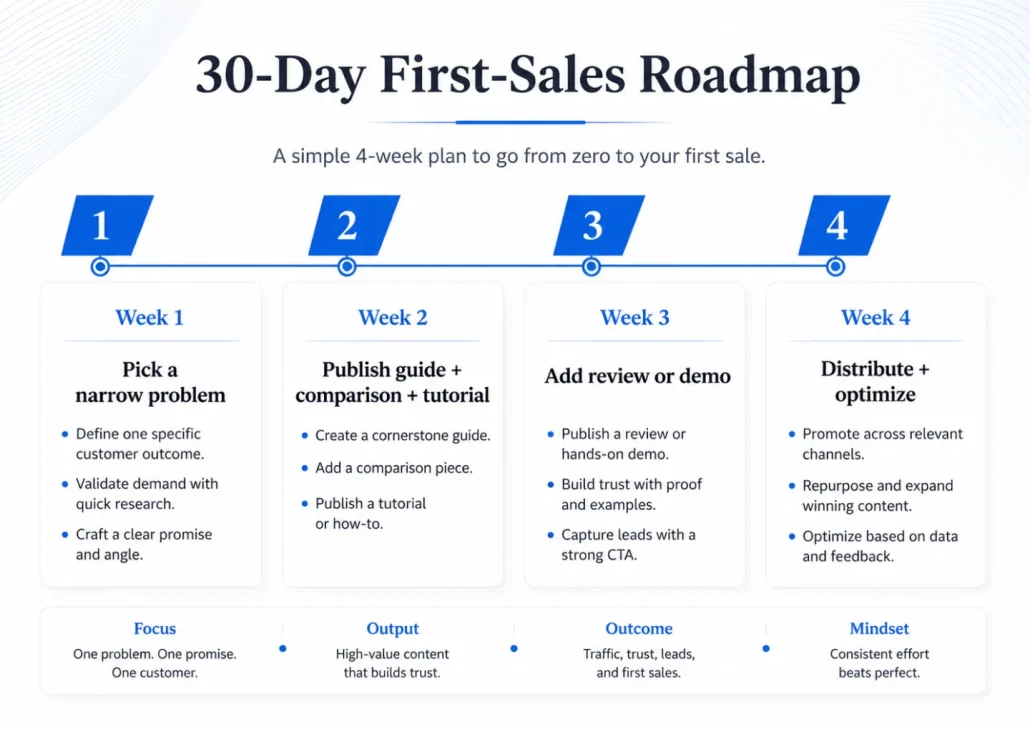
A 30-Day Plan for Generating Your First Three Qualifying Sales
The objective is not to produce the largest possible number of articles. It is to publish a focused group of resources that reaches people with a real buying need.
Week 1: Choose a Narrow Problem
Select one product cluster closely connected to your experience and audience. Instead of covering “home products,” focus on a narrower problem such as equipment for organizing a small home office.
Identify the questions customers ask before buying:
Which features matter?
Which size is appropriate?
What are the main alternatives?
What usually goes wrong?
Which product is appropriate for a beginner?
When is a more expensive option justified?
Use those questions to create a small content cluster.
Week 2: Publish Decision-Support Content
Publish one comprehensive buyer’s guide, one comparison, and one practical tutorial.
The buyer’s guide should explain the decision criteria before recommending products. The comparison should help readers choose between two genuine alternatives. The tutorial should solve a problem and mention products only where they help complete the task.
This balance prevents the site from looking like a collection of advertisements.
Week 3: Add Demonstration and Evidence
Publish a first-hand review, demonstration, case study, or annotated example.
Original photographs and video can make the content materially more useful. Show dimensions, setup, limitations, or real-world context that is difficult to understand from an Amazon product page alone.
Add clear affiliate disclosures and test every link.
Week 4: Distribute the Content
Share the resources with an existing audience through appropriate organic channels. Repurpose the main article into a short video, visual checklist, or social post.
Do not promise rewards for clicking or buying. Do not make purchases yourself or coordinate purchases with people you know.
Monitor which pages receive clicks and which products are ordered. Improve the calls to action and product selection based on real reader behavior rather than adding more links indiscriminately.
Common Reasons Amazon Affiliate Applications Are Rejected
Insufficient Original Content
A site containing only short product summaries, copied specifications, generic AI-written descriptions, or retailer images may not demonstrate enough added value.
The solution is not merely to increase the word count. Add genuine analysis. Explain who a product is for, when it is unsuitable, how it compares with alternatives, how you evaluated it, and which buying considerations matter most.
Too Little Content
One or two posts may not give Amazon enough evidence to understand your publication. Build a small but coherent content library before applying.
An Inactive or Private Channel
A website with outdated content or a social profile hidden from non-followers is difficult to review. Make the relevant material public and current.
Incorrect Affiliate Links
All Amazon links intended to earn commissions need the correct tracking information. Use Amazon’s official link tools and test the links after publishing.
Trademark Misuse
Do not suggest that your website is owned, sponsored, or formally endorsed by Amazon. Avoid using Amazon trademarks in domain names, social usernames, or tracking IDs unless explicitly permitted.
Personal or Incentivized Purchases
Buying through your own link, arranging purchases through people you know, or rewarding someone for using a link is not a valid way to meet the three-sale requirement.
A Poor Customer Experience
Broken navigation, excessive pop-ups, thin doorway pages, misleading buttons, and aggressive redirects can undermine both the Amazon review and the reader’s trust.
How Amazon Sellers Can Recruit Affiliates to Promote Their Products
Amazon Associates is designed for publishers, creators, and other content owners who recommend products to their audiences. Amazon sellers can benefit from this ecosystem by building relationships with those publishers and giving them a compelling reason to feature the seller’s products.
However, recruiting affiliates is not as simple as sending a product link to a large group of influencers. The seller first needs a product and listing that can convert external traffic. The right publishers must then be matched with the product, given accurate information, and allowed to create recommendations that suit their audiences.
Sellers must also decide how each partnership will be structured. Some creators may use their own Amazon Associates links and receive commissions directly from Amazon. Others may participate in a seller-funded campaign that uses Amazon Attribution links, with compensation negotiated separately between the seller and the publisher.
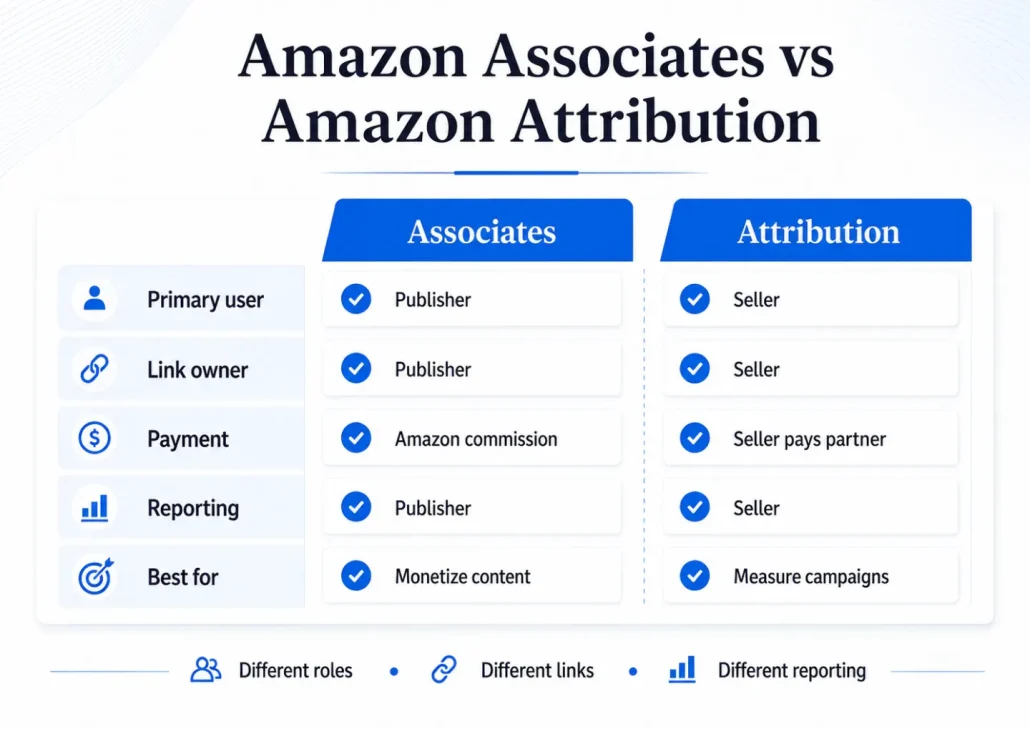
Understanding this distinction is essential. Amazon Associates and Amazon Attribution can both send shoppers to Amazon, but they serve different purposes and use different tracking and payment arrangements.
Choose Products That Are Ready for External Traffic
Do not begin affiliate outreach simply because a product is available on Amazon. First confirm that the listing is ready to convert shoppers who may know little about your brand.
Affiliates can generate attention, but they cannot compensate for an unclear value proposition, weak images, poor reviews, an uncompetitive price, or unreliable inventory. Sending a creator’s audience to an underdeveloped listing can waste the opportunity and make the publisher less willing to work with the brand again.
Before recruiting affiliates, review the product’s title, images, bullet points, A+ Content, reviews, price, promotions, fulfillment promise, and mobile presentation. The listing should clearly communicate what the product does, who it is for, and why a shopper should choose it over the most obvious alternatives.
Pay particular attention to the claims an affiliate would need to explain. A creator should not have to reverse-engineer the product’s main benefit from a crowded title or a collection of technical specifications. If the most persuasive selling points are not evident on the product page, improve the listing before investing in external promotion.
Inventory also matters. A product that is likely to go out of stock during a campaign is a poor candidate for evergreen affiliate content. Publishers may spend hours testing, photographing, filming, and writing about a product. If the item becomes unavailable shortly after publication, both the seller and the publisher lose potential revenue.
The strongest candidates for affiliate promotion generally have a clearly defined audience, a defensible point of difference, healthy inventory, a competitive offer, and enough margin to support samples or creator fees where necessary.
Find Affiliates With a Relevant Audience
Follower count should not be the primary selection criterion. A creator with a smaller but highly relevant audience may generate more qualified traffic than a general-interest influencer with hundreds of thousands of followers.
Start by examining who consumes the publisher’s content and why they follow it. A kitchenware seller, for example, might consider recipe creators, meal-preparation channels, small-kitchen publishers, culinary educators, or reviewers specializing in cooking tools. The most relevant partner may not describe themselves as an “Amazon influencer.” They may simply be a respected specialist whose audience regularly buys products in the category.
Review the publisher’s previous commercial content before making contact. Look at how they introduce products, whether their recommendations contain useful detail, and whether their audience asks genuine buying questions. Comments such as “Which size should I choose?” or “How does this compare with the previous model?” can be more commercially meaningful than a large number of passive likes.
Also evaluate the publisher’s editorial style. A creator who produces detailed comparisons may be well suited to a technically differentiated product. A creator known for short demonstrations may be better for a product whose value becomes obvious as soon as it is shown in use.
The objective is not simply to find people who can generate impressions. It is to find publishers who can credibly explain the product to people with a relevant need.
Potential partners can be discovered through organic searches on Google, YouTube, TikTok, Instagram, and other niche communities. Influencer-discovery platforms such as Aspire or Upfluence may help sellers identify and organize potential partners, while broader affiliate networks can support formal recruitment and program administration. Regardless of the discovery method, each publisher should be evaluated individually rather than accepted solely because they appear in a database.
When contacting a publisher, show that you understand their work. Explain why the product is relevant to their audience and reference a specific article, video, or content series where it could fit naturally. Generic outreach that asks a creator to “promote our bestselling Amazon product” gives them little reason to respond.
Give Partners a Compliant Creative Brief
A useful creative brief should help the publisher understand the product without turning their content into a scripted advertisement.
Explain the customer problem, the main use cases, the product’s most important differentiators, and any limitations the publisher should understand. Include factual product specifications, supporting evidence, frequently asked questions, current promotion dates, and any claims that must not be made.
Provide high-quality product images, demonstration footage, logos, instructions, and brand assets where appropriate. If the publisher will use seller-owned trademarks, product photography, or other creative material, clearly document what may be used and how.
Do not give every partner identical promotional copy and require them to repeat it word for word. Publishers understand the tone, format, and level of detail their audiences expect. A rigid script can make an otherwise credible recommendation feel unnatural.
At the same time, make the compliance boundaries explicit. Publishers should disclose commercial relationships clearly, avoid misleading product claims, and use Amazon links that contain the correct tracking information.
Amazon requires Associates to use properly tagged Special Links containing the Associate ID or an associated tracking ID. A seller should therefore not create one Amazon Associates link and distribute it to multiple publishers as though it were each publisher’s individual affiliate link. Associates should create their own Special Links through their own accounts.
The seller can instead provide the ordinary product URL, the ASIN, product information, creative assets, and promotion details. The Associate then generates a correctly tagged link using the tracking ID connected to their own account.
A creative brief should also distinguish between a legitimate Amazon promotion and an incentive for using an affiliate link. A publisher may tell shoppers about a valid coupon or sale available on the product. However, Amazon Associates may not offer money, rebates, discounts, loyalty points, donations, or other benefits in exchange for using a Special Link.
Choose Between Associates Links and Seller-Funded Attribution Links
There are two common ways to structure the tracking relationship.
Under the first model, the publisher participates in Amazon Associates and generates a Special Link containing their own Associate or tracking ID. The publisher may receive commission income from Amazon when eligible shoppers make qualifying purchases. The seller does not control the publisher’s Associates account or receive its complete reporting data. The publisher may choose to share performance information, but the seller should not assume that Associates Central will provide seller-level reporting for every partner.
This model is relatively simple for the seller, but the standard Amazon Associates commission may not always be enough to motivate a publisher. The expected earnings depend on the product category, purchase price, conversion rate, return rate, and current commission schedule.
Under the second model, the seller creates an Amazon Attribution link and assigns it to the publisher. Amazon Attribution is a measurement system for non-Amazon marketing that helps eligible advertisers measure how external campaigns contribute to product discovery, consideration, and purchases on Amazon. Its standard reports use a 14-day attribution window.
Amazon Attribution does not automatically pay the publisher an Amazon Associates commission. The seller and publisher must agree separately on any fixed fee, revenue share, commission, content-production payment, or other compensation.
For example, a seller might offer a creator a fixed content fee plus a performance payment based on sales measured through the creator’s unique Attribution link. Another partnership might provide a product sample and a percentage of eligible attributed revenue. The exact commercial structure is a matter between the seller and publisher.
Eligible US brand owners may also be able to earn Brand Referral Bonus credits on qualifying sales measured through Amazon Attribution. That potential seller benefit is separate from any compensation promised to the publisher.
The two tracking methods should not be blended carelessly. A seller-funded Amazon Attribution campaign should use its own tracking structure and commercial agreement. An Associate using Amazon’s standard program should use their own Special Links and follow the Associates Operating Agreement.
Sellers should also avoid attempts to manipulate tags to claim multiple Amazon incentives improperly on the same transaction. Keep the program model, payment terms, and tracking process clear before the content is published.
Structure Samples, Fees, Promotions, and Commissions
A successful affiliate relationship may involve more than Amazon’s standard Associates commission. Publishers often invest time in research, testing, filming, photography, editing, and distribution. A product with a low retail price or commission rate may not generate enough expected Associates income to justify that work.
Product samples are common when first-hand experience is necessary to create meaningful content. Treat a sample as a content-enablement cost, not as a guarantee of a positive review. A credible publisher must be able to discuss limitations and should not be required to make claims they cannot substantiate.
Establish what happens to the sample after the campaign. Depending on the product, agreement, and publisher, it may be gifted, returned, loaned for a defined period, or incorporated into a longer-term testing arrangement.
Fixed fees can be appropriate when the publisher is being compensated for production and access to their audience. Define the deliverables carefully, including the content format, approximate publication date, number of revisions, usage rights, exclusivity period, and disclosure requirements.
Performance-based payments can align incentives, but the agreement should specify which report acts as the source of truth, which products qualify, what attribution window applies, how returns are treated, and when payments are calculated.
Do not use vague language such as “commission on all sales” without defining whether that means promoted-product sales, Brand Halo sales, gross revenue, net revenue, or revenue after returns. A clear agreement reduces disputes after the campaign.
Promotions can improve the campaign’s value to the audience, but they should be genuine offers rather than artificial urgency. Give the publisher accurate start and end dates, eligibility restrictions, coupon details, and inventory limitations.
Never describe a standard price as a temporary discount, and do not ask a creator to claim that an offer is exclusive unless it actually is.
For Amazon Associates campaigns, the seller should not promise shoppers a benefit specifically for clicking the Associate’s Special Link. Amazon prohibits Associates from offering consideration or incentives in exchange for link use.
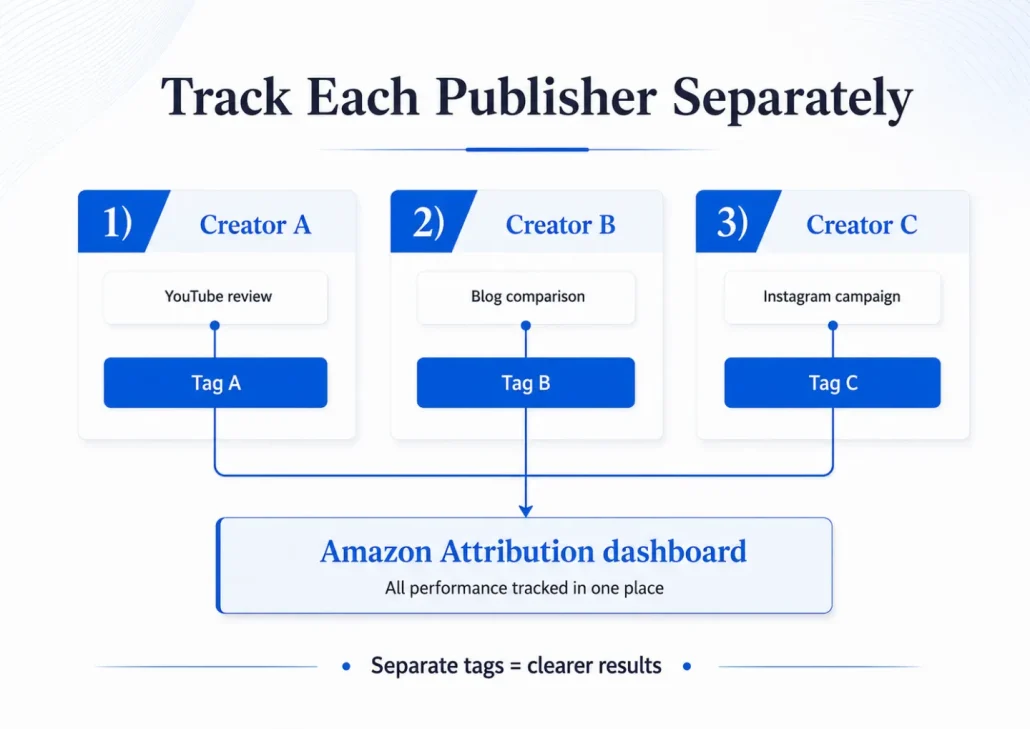
Track Each Publisher Separately
Before launching an affiliate campaign, confirm that you have selected a relevant partner, optimized the listing, agreed on tracking and compensation, documented compliance requirements, and established a communication schedule.
Use a consistent naming convention such as:
Publisher – Channel – Content – Campaign date
For example:
HomeCreator – YouTube – BlenderReview – Sep2026
This makes campaign reports easier to interpret once the number of publishers begins to grow.
Tracking should be agreed upon before publication rather than added after traffic has already begun. Confirm that every link leads to the intended product or Store page and that the appropriate Associate or Attribution tag is present.
The following section explains how to evaluate that data using Associates Central, Amazon Attribution, Brand Referral Bonus reporting, and contribution-margin calculations.
How to Measure Amazon Affiliate Marketing Correctly
There are two different measurement environments, and they should not be treated as interchangeable.
Associates Central Reports
Use Associates reports when you are acting as the publisher. These reports help you evaluate activity associated with your tracking IDs, including clicks, ordered items, shipped items, conversion indicators, and commission income.
Separate tracking IDs make it easier to compare a buyer’s guide with a YouTube channel or social account.
Amazon Attribution
Use Amazon Attribution when you are acting as the seller or brand advertiser and want to measure non-Amazon marketing that sends shoppers to your products.
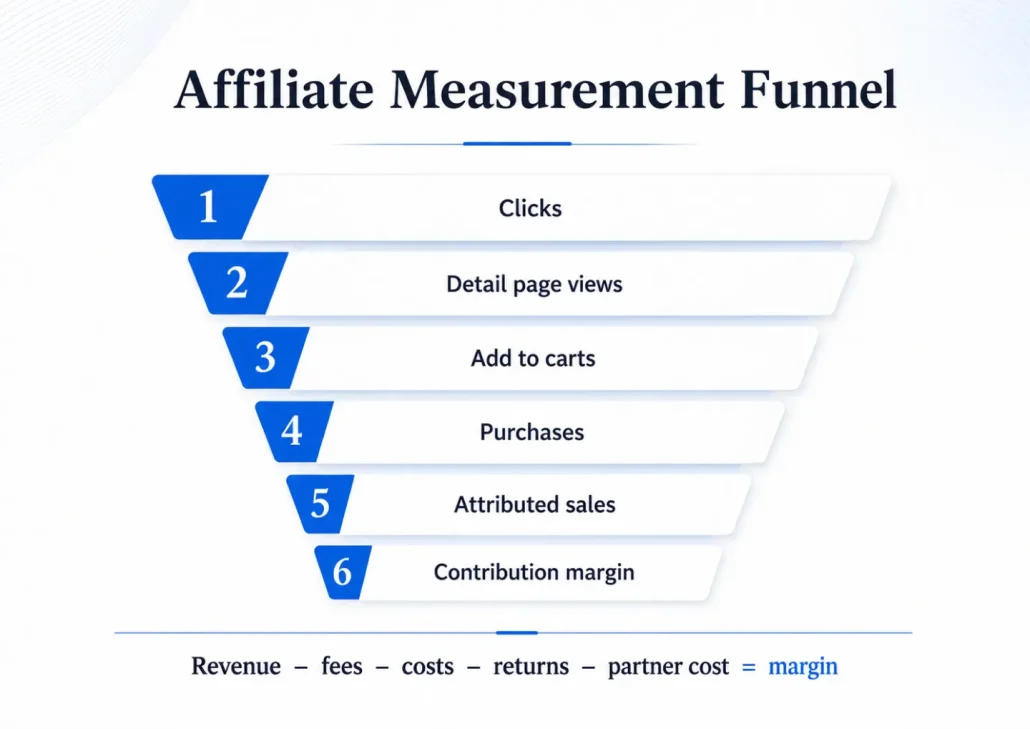
Amazon Attribution provides a 14-day measurement framework and reports metrics such as clicks, detail-page views, add-to-carts, purchases, units, and sales. It does not provide a conventional customer lifetime value metric for every referred shopper.
Create separate attribution tags for each partner, channel, creative, or campaign. A single tag shared by every affiliate may show total performance but will not tell you which relationship generated the result.
Brand Referral Bonus
Eligible US brand owners may also be able to earn a Brand Referral Bonus on qualifying sales measured through Amazon Attribution. Amazon describes the average bonus as approximately 10% of product sales driven by eligible non-Amazon marketing, although eligibility and calculation rules apply.
Do not try to claim Associates commissions and another Amazon incentive on the same traffic through tag manipulation. Amazon’s policies allow it to withhold commissions or terminate participation when it detects attempts to claim multiple program benefits improperly.
Metrics That Matter to Sellers
Track performance from click to contribution margin:
Clicks: How much traffic did the partner generate?
Detail-page view rate: Did visitors reach and engage with the intended Amazon product page?
Add-to-cart rate: Did the listing create meaningful purchase consideration?
Purchase rate: What percentage of attributed visitors purchased?
Attributed sales: How much revenue was generated?
Brand Halo sales: Did shoppers buy other products from the same brand?
Partner cost: Include fees, samples, production costs, software, and discounts.
Contribution margin: Subtract Amazon fees, cost of goods, fulfillment, returns, partner costs, and other variable expenses from attributed revenue.
A campaign with high sales may still be unprofitable. A campaign with modest immediate sales may still be useful when it produces reusable content, branded search demand, or a strong relationship with a relevant publisher. Keep those secondary benefits separate from directly measured revenue.
Common Affiliate Marketing Mistakes to Avoid
While affiliate marketing can be highly lucrative, there are several pitfalls that sellers should avoid:
1. Poor Affiliate Selection
Partnering with affiliates who don’t align with your brand can harm your reputation. Always vet affiliates to ensure their values and content resonate with your target audience.
2. Failing to Track Performance
Without performance tracking, you may not identify what’s working and what isn’t. Use Amazon’s affiliate reporting tools to monitor key metrics.
3. Overlooking Compliance
Affiliates must follow Amazon’s terms and conditions. Ensure they avoid prohibited practices like misleading promotions or unauthorized use of intellectual property.
4. Ignoring Product Demand
Promoting products with low demand or poor reviews can waste resources. Focus on high-quality products that have proven market demand.
5. Neglecting Regular Communication
Maintaining regular communication with your affiliates is essential. Offer updates, share new promotions, and provide feedback to keep the partnership strong.
Conclusions
Amazon affiliate marketing gives sellers more than one path to growth. You can build an owned content channel and apply to Amazon Associates, or you can partner with independent publishers who introduce your products to relevant audiences.
For prospective Associates: the immediate priority is to build a real publication before applying. Create original content, make your channel public, use correctly tagged links, disclose the relationship, and generate three legitimate qualifying sales within 180 days.
For sellers recruiting affiliates: focus on relevance and economics rather than reach alone. Choose products with strong listings, give partners useful information, track each source separately, and measure contribution margin rather than celebrating clicks or revenue in isolation.
Affiliate marketing works best when the recommendation itself is useful. Help the reader solve a problem, choose the right product, or avoid an expensive mistake. The traffic and commissions should follow from that value—not replace it.
Begin by signing up for the Amazon Associates program and applying the strategies discussed in this guide. Start collaborating with affiliates today and watch your sales take off. Let us know your experience in the comments section below. And, as always, feel free to contact us for tailored advice!
Frequently Asked Questions About Amazon Affiliate Marketing
How do I get accepted into the Amazon Affiliate Program?
Apply with a public website, eligible social media account, approved mobile app, or another qualifying channel containing useful original content. After registration, you must generate at least three qualifying sales within 180 days before Amazon reviews your channels, tracking tags, and compliance with its program policies.
Do I need a website to become an Amazon affiliate?
No. Amazon also accepts certain public social media accounts, approved mobile apps, and Alexa skills, including Facebook pages and open groups, Instagram, X/Twitter, YouTube, TikTok, and Twitch. Your channel must be established, publicly accessible, and submitted with its exact URL.
How many followers do I need to join Amazon Associates?
Amazon does not guarantee acceptance based on a single follower threshold, but social applicants should generally have an established organic audience of at least 500 followers or likes. Amazon also evaluates whether the account is public, active, original, and useful to its audience.
How many posts should I publish before applying?
Amazon describes at least 10 substantive, original posts as a good rule of thumb. Website content should also be recent—generally published or meaningfully updated within the previous 60 days.
How many sales are required for Amazon Associates approval?
You must generate at least three qualifying sales within the first 180 days after submitting your application. Personal purchases and orders arranged through friends, relatives, employees, or associates do not count.
What happens if I miss the 180-day sales threshold?
Amazon may withdraw your application if you do not generate the required qualifying sales within 180 days. Before reapplying, improve the content, traffic, or audience problems that prevented you from generating legitimate sales.
Can I reapply after Amazon rejects my application?
Yes. You can reapply after establishing or improving your website or publishing channel, but a rejected application cannot be reinstated. The new application creates a new tracking tag, so replace affiliate links containing the previous tag.
Can Amazon sellers join the Amazon Associates Program?
Yes. An Amazon seller can operate a qualifying website, social channel, app, or other publishing property and apply to Amazon Associates. The seller must meet the same content, audience, disclosure, and compliance requirements as any other applicant.
Can I promote my own Amazon products using affiliate links?
You may publish compliant content that discusses or recommends products you sell, but you cannot buy through your own links or arrange purchases through friends, relatives, associates, or customers to generate commissions. For seller-controlled external campaigns, Amazon Attribution is generally more appropriate, while independent Associates should use their own Associate IDs.
How does the Amazon affiliate 24-hour session work?
The session ends after 24 hours, when the shopper orders a physical product, or when they click another Associate’s Special Link. An eligible physical product added to the cart during the session may still qualify if purchased from the cart within 90 days and all other requirements are satisfied.
What is the difference between Amazon Associates and Amazon Attribution?
Amazon Associates is a publisher monetization program that may pay commissions for qualifying purchases made through Special Links. Amazon Attribution helps eligible sellers and advertisers measure how non-Amazon channels contribute to engagement and sales, but it does not automatically pay publishers, so compensation must be arranged separately.
Can I put Amazon affiliate links in emails?
Yes, provided recipients have opted in and are given an easy way to opt out. The messages must also comply with Amazon’s agreement, brand guidelines, and applicable marketing laws, and Amazon may request examples or written confirmation of compliance.
Can I use Amazon affiliate links in Google Ads or social media ads?
Do not use a Special Link as the direct destination of paid or boosted advertising unless Amazon expressly permits it. Amazon’s April 14, 2026 policy update expanded its disqualified-purchase rules for paid or boosted advertising linking to Amazon, while sellers running paid campaigns to their listings should generally use Amazon Attribution.