
Jun 26th 2026
Resources
- Facebook Ads for Amazon [Video Course]
- Drive Traffic To Amazon [Ultimate Guide]
- Get More Amazon Reviews [Ultimate Guide]
TL;DR
Why can’t brands sustain growth by only bidding on top search keywords anymore?
High cost-per-click (CPC) rates and intense search page competition mean single-format strategies can no longer sustain long-term brand growth. Amazon now operates as a full-funnel retail media platform, making it necessary to capture shoppers through diversified formats before they even search for a generic keyword.
What should be the primary financial objective when allocating ad budget to a new product launch?
The immediate goal during a launch is the acquisition of algorithmic relevance and sales velocity rather than short-term profitability. Capital should be strictly channeled into highly targeted Sponsored Products exact-match campaigns for long-tail keywords to build this baseline ranking.
How can an established brand effectively protect its search results from aggressive competitor conquesting?
Brands can deploy Sponsored Brands custom images or video advertisements to blanket and dominate the top of the search results page. This visual takeover forces competitor advertisements further down the page and safeguards valuable branded traffic.
What advanced methods do top sellers use to accurately isolate the true causal impact of their ad spend?
Elite advertisers look past standard dashboard data by leveraging the Amazon Marketing Cloud (AMC) or executing geographic and temporal holdout tests. By intentionally turning off specific ad formats in designated regions, they isolate true incremental revenue from the sales that would have naturally occurred organically.
Amazon advertising has changed sharply over the past few years. Years ago, a United States-based seller could dominate their category simply by aggressively bidding on exact match keywords within a few core Sponsored Products campaigns. At that time, most campaigns focused on shoppers who were already close to buying. In 2026, CPCs remain high across many major categories, and the search results page is more competitive than before. Relying solely on one type of advertising is no longer a viable strategy for sustainable brand growth.
Table of Contents
Today, Amazon works more like a full-funnel retail media platform. The platform offers a diverse array of advertising formats that reach shoppers before they search for a generic keyword. From Sponsored Brands that showcase a curated product collection, to Sponsored Display ads that follow shoppers across the internet, to interactive Streaming TV formats on Prime Video, Amazon sellers now have more ad options than they had before. But more options also make budget decisions harder.
For many brand managers and agency teams, the main question is not how to set up each campaign. The main question is when to use each format. When should a brand divert funds away from the highly efficient Sponsored Products engine and invest in mid-funnel awareness? How do you mathematically justify the seemingly lower returns of top-of-funnel video advertising?
This guide explains the main Amazon ad formats and shows where each one fits. It also gives you a practical framework for choosing ad types based on your brand stage, competition, and growth goals. Furthermore, we will explain why “average ROAS” can mislead budget decisions, introducing you to the critical concept of Incremental Return on Ad Spend (iROAS), so you can scale ad spend without ignoring profit margins.
Decoding the Amazon Advertising Formats
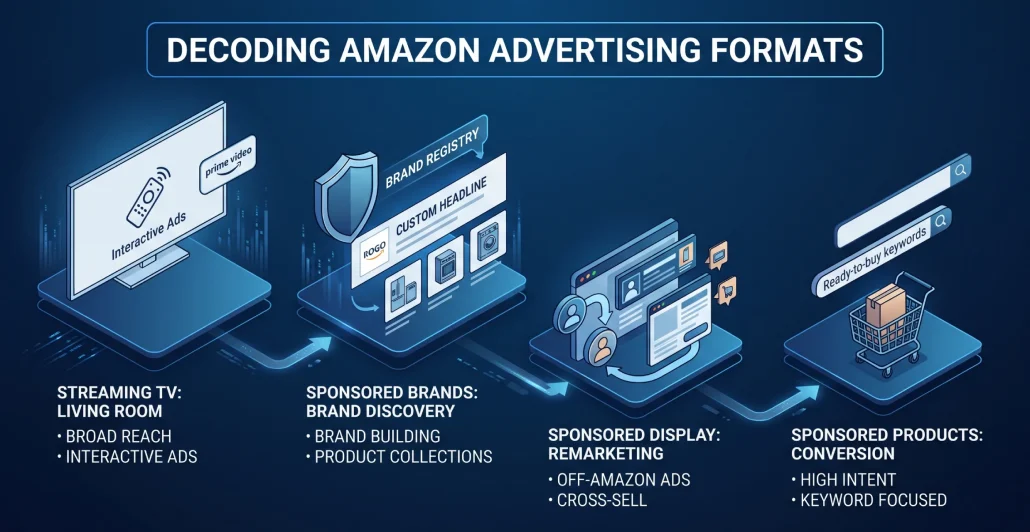
To build a strong ad strategy, you first need to understand how each format drives traffic. Amazon categorizes its advertising solutions based on the shopper’s journey, stretching from initial brand discovery all the way to loyalty and retention.
Sponsored Products: The High-Intent Conversion Engine
Sponsored Products remain the starting point for most Amazon advertising accounts. These are cost-per-click (CPC) advertisements that promote individual product listings. They integrate seamlessly into the organic search results and appear prominently on competitor product detail pages. They look similar to organic listings, except for the “Sponsored” label. This often helps them earn strong click and conversion rates.
The primary function of a Sponsored Products campaign is to capture existing demand. When a shopper types “stainless steel garlic press” into the search bar, they are in a highly transactional state of mind. Sponsored Products allow you to bid on that specific keyword, placing your product directly in the line of sight of a ready-to-buy consumer. This format relies heavily on algorithmic relevance. Amazon rewards products that demonstrate a strong history of converting for specific search terms by lowering their required cost-per-click to win the top-of-search placement.
For sellers launching new products, Sponsored Products are usually the first ad format to test. They provide the initial sales velocity required to climb the organic ranking ladder. You can use automatic targeting to find search terms and exact-match campaigns to focus on your most relevant keywords. Sponsored Products are your primary mechanism for driving direct, measurable revenue.
Sponsored Brands: The Mid-Funnel Discovery Engine
While Sponsored Products highlight a single item, Sponsored Brands elevate your entire brand identity. These cost-per-click ads are available to eligible Brand Registry sellers and approved vendors. They often appear near the top of the search results page. They offer customizable creative elements, allowing you to feature your brand logo, a custom headline, and a selected group of up to three products.
Sponsored Brands usually support mid-funnel discovery. They are designed for discovery and consideration. Imagine a shopper searching for the broad term “camping gear.” A Sponsored Products ad might show them a single tent, but a Sponsored Brands ad allows you to present a cohesive brand narrative, showcasing a tent, a sleeping bag, and a portable stove simultaneously. When shoppers click the brand logo, they can land on your Amazon Storefront. This moves them away from crowded search results and into a space focused on your product line.
Sponsored Brands Video also gives advertisers another way to show products in search results. Video ads auto-play within the search results, instantly capturing consumer attention and providing a dynamic canvas to demonstrate product functionality or highlight unique selling propositions. Sponsored Brands are critical when your objective is to build brand equity, increase your average order value through cross-selling, or defend your market share by blanketing the top of the search page with your branded assets.
Sponsored Display: The Retargeting and Expansion Engine
Sponsored Display breaks the boundaries of the traditional keyword-based search auction. Instead of targeting what a shopper is typing, Sponsored Display targets who the shopper is and how they behave. This format utilizes Amazon’s immense repository of first-party shopping data to reach relevant audiences both on the Amazon marketplace and across third-party websites and mobile applications.
Sponsored Display is useful for retargeting. Through “Views Remarketing,” you can serve advertisements to shoppers who viewed your product detail page within the last thirty days but failed to make a purchase. As these shoppers browse external blogs, check their email, or read the news, your ad can remind them to return to Amazon and complete the purchase.
Additionally, Sponsored Display excels at competitive conquesting. You can utilize “Product Targeting” to place your display banners directly underneath the buy box on a competitor’s listing. If a competitor runs out of stock, or if you offer a superior product at a lower price point, Sponsored Display allows you to reach shoppers while they compare similar products. It is a flexible format that covers both top-of-funnel audience expansion and bottom-of-funnel cart-abandonment recovery.
Streaming TV: The Living Room Frontier
One major expansion in Amazon Ads is Streaming TV, heavily driven through the Amazon Demand-Side Platform (DSP). Previously viewed as a traditional branding exercise, Amazon has transformed connected television into a measurable, performance-driven channel. These video advertisements run across premium, ad-supported streaming services like Prime Video, Freevee, and Twitch, reaching consumers on the largest screen in their homes.
What distinguishes Amazon’s Streaming TV in 2026 is the deployment of Interactive Video Ads (IVA). These formats allow viewers to interact with the commercial using their television remote or by issuing a voice command to an Alexa-enabled device. A shopper watching a Thursday Night Football broadcast can simply press a button to add the featured product directly to their Amazon shopping cart without ever picking up their smartphone. This bridges the gap between top-of-funnel awareness and lower-funnel conversion. Streaming TV works best when a brand has already captured much of its available search demand and needs to reach new audiences through video.
The Strategic Framework: When to Use Which Format
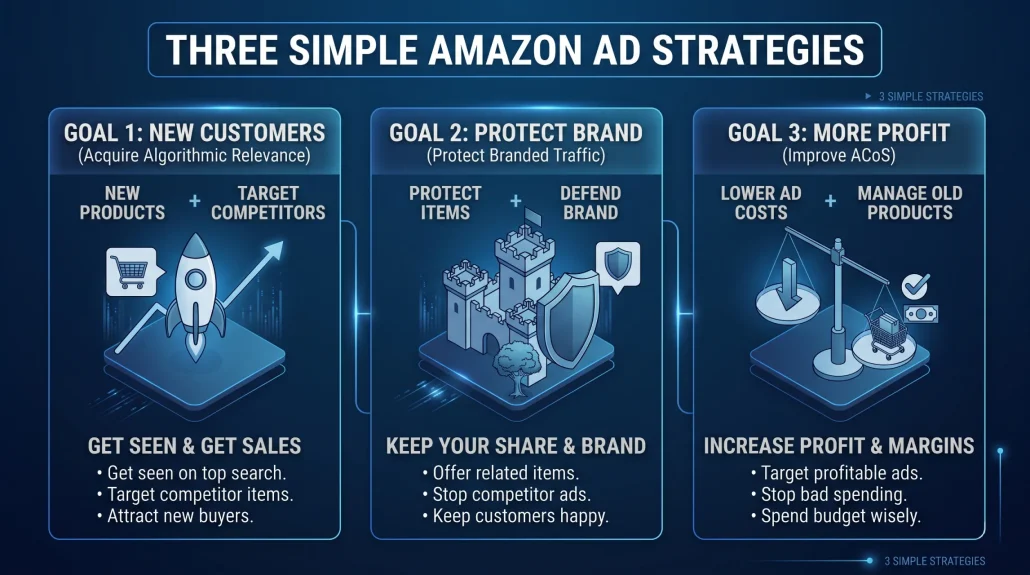
Understanding the mechanical function of these ad formats is only the first step. The true mark of a seasoned Amazon advertiser is knowing precisely when to deploy each format based on the immediate strategic context of the business. You should not treat these formats as interchangeable. Each format serves a different goal.
The New Product Launch vs. Supporting Existing Listings
When you are launching a completely new product with zero reviews and zero organic ranking, your strategy should focus mainly on Sponsored Products. In this phase, your primary objective is not profitability; it is the acquisition of algorithmic relevance. You need sales velocity to show Amazon’s ranking system that your product can convert for relevant searches. You should deploy highly targeted Sponsored Products exact-match campaigns, focusing on long-tail keywords that perfectly describe your item. During an early product launch, Sponsored Brands or Streaming TV may be less efficient if the listing has few reviews and limited proof. The goal is to place the product in front of shoppers who are already searching for a similar item.
Conversely, if your brand is already well-known and you possess a stable portfolio of highly reviewed products, your strategic posture must shift toward defense and expansion. If you have an established listing, you should utilize Sponsored Display to cross-sell to existing customers. For example, if a shopper recently purchased your premium espresso machine, you should serve them a Sponsored Display retargeting ad featuring your proprietary espresso cleaning tablets.
RANK LIKE THE PROS
Discover a better way to rank products from external traffic, like Facebook, Google and TikTok, with LandingCube promo pages.
Try it free for 21 days.
Growing Sales vs. Improving ACoS
The decision between prioritizing top-line sales growth versus improving your Advertising Cost of Sales (ACoS) dictates your format allocation. If your strict mandate is to lower ACoS and drive immediate profitability, you must constrain your budget entirely around your highest-converting Sponsored Products exact-match keywords and your Sponsored Display views-remarketing campaigns. These formats usually capture shoppers who are closest to purchase.
However, if your mandate is to grow top-line sales and aggressively capture market share, you must accept a higher blended ACoS and heavily fund Sponsored Brands and Streaming TV. You are effectively buying future customers, educating them about your product line so that when they are eventually ready to buy, they specifically search for your brand name rather than a generic category term. You are trading short-term efficiency for long-term volume.
Competitive Environment & Brand Defense
If a competitor begins aggressively bidding on your brand name, you can use Sponsored Brands to protect more space near the top of search results. By utilizing a Sponsored Brands custom image or video ad, you push the competitor’s Sponsored Products ad further down the page, protecting your branded search traffic. On the offensive side, if a massive competitor is dominating organic search, you can use Sponsored Display product targeting to place your ads directly on their listings, reaching comparison shoppers by highlighting your pricing or feature set.
Venturing into Mid-Funnel Formats: The Mathematical Tipping Point
A pivotal moment in the lifecycle of every Amazon brand occurs when the executive team asks: “Should we continue pouring our entire budget into Sponsored Products, or is it time to venture into Sponsored Brands and Sponsored Display?”
This decision should not come from guesswork or from interest in a new feature. It should come from market saturation, marginal return, and profit data.
Every keyword on Amazon possesses a finite search volume ceiling. If the keyword “organic dog treats” is searched fifty thousand times a month, you cannot artificially force consumers to search for it more often simply by increasing your advertising budget. When you dominate the top-of-search placement for your primary keywords, you will inevitably hit an inflection point. At this point, increasing your Sponsored Products daily budget does not result in a proportionate increase in sales. Instead, Amazon’s algorithm simply begins entering your ad into increasingly irrelevant, low-converting secondary auctions just to spend your budget. Your Cost-Per-Click inflates drastically while your conversion rate plummets.
The shift into mid-funnel formats should start when your core search campaigns show saturation. You must monitor your “Top of Search Impression Share” metric. If your impression share for your core converting keywords exceeds 70% or 80%, and your incremental cost to acquire the next marginal sale begins to skyrocket, you have maxed out your bottom-of-funnel potential. It is mathematically inefficient to spend another dollar fighting for the last remaining scraps of search traffic.
This is the precise moment you must pivot capital into Sponsored Brands and Sponsored Display. By investing in these mid-funnel formats, you are no longer fighting for the existing fifty thousand searches; you are actively educating new consumers to expand the total addressable market. While the direct ACoS of a Sponsored Brands campaign may look worse on paper than your historical Sponsored Products performance, it is fulfilling a completely different function. It is filling the top of the funnel, generating brand awareness that will eventually trickle down and convert through your highly efficient organic listings or retargeting campaigns.
The Illusion of Averages: Understanding Incremental ROAS (iROAS)
This leads to one of the most useful budget metrics in Amazon advertising: Incremental Return on Ad Spend, commonly referred to as iROAS. If you base every budget decision on average Return on Ad Spend (ROAS) alone, you may miss where the next dollar will produce the best return.
Average ROAS is a historical, aggregate metric. It takes your total revenue generated by an ad format and divides it by your total spend. Let us assume your Sponsored Products campaigns show an average ROAS of 4.0 (for every dollar spent, you make four dollars), while your newly launched Sponsored Brands campaigns show an average ROAS of 2.0.
If you have an extra $10,000 to invest next month, the simplistic, flawed logic of average ROAS dictates that you should put all $10,000 into Sponsored Products because 4.0 is greater than 2.0. This logic is dangerously misleading because it ignores the law of diminishing returns. The average ROAS of 4.0 represents the efficiency of the money you have already spent; it does not predict the efficiency of the next dollar you are going to spend.
Because your Sponsored Products campaigns may already be heavily saturated, forcing an additional $10,000 into that format might require bidding on highly inefficient, tertiary keywords, or paying exorbitant CPCs just to win a few extra impressions against aggressive competitors.
This is where Incremental ROAS becomes useful. Incremental ROAS measures the expected return of the next marginal dollar spent.
Let us revisit the mathematical scenario:
You push that extra $10,000 into Sponsored Products. Because of market saturation, that specific $10,000 only generates $12,000 in new sales. Your incremental ROAS for that specific allocation is an abysmal 1.2. The massive influx of inefficient spend drags your overall average ROAS down from 4.0 to 3.5, but you might not realize just how terrible the marginal efficiency was because it is hidden within the aggregate average.
Now, imagine you took that same $10,000 and invested it into expanding your Sponsored Brands campaigns, which currently have plenty of untapped audience headroom. That $10,000 generates $25,000 in new sales. The incremental ROAS of that decision is 2.5.
The point is simple: even though Sponsored Products has a vastly superior historical average ROAS (4.0) compared to Sponsored Brands (2.0), the incremental ROAS of adding budget to Sponsored Brands (2.5) is mathematically superior to adding it to Sponsored Products (1.2).
A strong media buyer allocates the next dollar to the channel with the highest incremental return, regardless of what the historical averages look like on the dashboard.
Understanding and calculating iROAS requires sophisticated data analysis. Amazon’s standard ad console often shows blended performance, so it may not show true incrementality by default. To truly measure incrementality, elite sellers utilize tools like the Amazon Marketing Cloud (AMC) or conduct geographic and temporal holdout tests. A holdout test involves intentionally turning off a specific ad format, like Sponsored Display, in a specific region or for a specific time period, and measuring the total drop in aggregate retail sales compared to a control group. This isolates the true causal impact of the advertising, completely separating the revenue generated by the ad from the revenue that would have occurred organically regardless.
When you manage your budget using incremental ROAS as your North Star, your entire perspective on mid-funnel and top-of-funnel advertising transforms. You stop viewing Streaming TV and Sponsored Brands as inefficient vanity projects, and you start recognizing them as highly scalable growth engines. You realize that pushing a saturated Sponsored Products campaign from $50,000 to $60,000 a month might yield almost zero incremental profit, whereas opening a new Sponsored Display retargeting funnel with that same $10,000 could dramatically lift the entire baseline of your business.
Conclusion
Amazon advertising in 2026 requires more than one campaign type. The sellers who treat it like a simple search engine, stubbornly dumping all their capital into exact-match keyword bids, will eventually find themselves squeezed out by rising costs and stagnant volume. To scale, brands need to use the right ad format for the right stage of growth.
Use Sponsored Products to capture high-intent shoppers. Use Sponsored Brands to support discovery and product-line visibility. Use Sponsored Display to retarget shoppers and reach competitor audiences. Use Streaming TV when the brand is ready to create demand beyond search.
Average metrics can make budget decisions look simpler than they are. Brands should review saturation, marginal return, and Incremental ROAS before moving more spend into any format. This helps advertisers choose the next campaign based on expected profit, not just past performance.
FAQ: All About Amazon Ad Types & Formatting
Sponsored Products are cost-per-click ads that promote individual product listings and appear within the standard search results, looking very similar to organic listings. Sponsored Brands are highly customizable banner ads that typically appear at the very top of the search page. They require Brand Registry and feature your brand logo, a custom headline, and a collection of up to three products (or a video) designed to drive shoppers to your Amazon Storefront.
Sponsored Products should be your primary tool when launching a new product, as they are the fastest way to generate sales velocity and improve organic ranking for specific keywords. They are also best utilized when you want to aggressively capture high-intent shoppers who are already searching for the exact item you sell.
No, you do not need Brand Registry to run Sponsored Products. However, Brand Registry is required for Sponsored Brands and Stores. Sponsored Display eligibility can vary by advertiser type, so sellers should confirm access inside their Amazon Ads account.
While Sponsored Products target specific keywords that shoppers type into the search bar, Sponsored Display targets audiences based on their shopping behavior. Sponsored Display allows you to retarget users who have viewed your product but didn’t buy, or target shoppers based on their broader lifestyle interests, both on the Amazon marketplace and across third-party websites.
Streaming TV refers to video advertisements that run on connected television devices across premium, ad-supported streaming services like Prime Video and Freevee. Managed through the Amazon DSP, these top-of-funnel ads are designed to build massive brand awareness and increasingly feature interactive elements that allow viewers to add products directly to their Amazon carts via their remotes.
Saturation occurs when your ad is already winning the vast majority of available top-of-search impressions for a specific search term. At this point, the keyword has a fixed search volume ceiling; no matter how much more money you pump into the campaign, you cannot force more people to search for that term, leading to skyrocketing costs with rapidly diminishing returns.
Average ROAS looks backward at how efficiently all your money was spent historically. It fails to predict what will happen when you increase your budget. As you scale a campaign, the cost to acquire the next customer typically increases. Relying on average ROAS blinds you to the fact that your newest, marginal ad spend might actually be highly unprofitable.
Incremental ROAS measures the true, causal impact of your advertising. It calculates the specific return on the very next dollar you spend, isolating the sales that happened purely because of the advertisement, separate from the sales that would have occurred organically regardless. It helps determine exactly where additional budget is best deployed.
You should shift budget into mid-funnel formats like Sponsored Brands when your top Sponsored Products campaigns begin showing severe diminishing returns. If you are consistently maxing out your top-of-search impression share and your incremental cost to acquire a sale through Sponsored Products is eroding your profit margin, it is time to invest in mid-funnel awareness to expand your total audience.
Yes, this is one of its most powerful features. Using the “Product Targeting” option within Sponsored Display, you can explicitly choose to display your advertisements directly under the buy box on the product detail pages of your direct competitors, allowing you to reach shoppers while they compare similar products.
RANK LIKE THE PROS
Discover a better way to rank products from external traffic, like Facebook, Google and TikTok, with LandingCube promo pages.
Try it free for 21 days.
RANK LIKE THE PROS
Discover a better way to rank products from external traffic, like Facebook, Google and TikTok, with LandingCube promo pages.
Try it free for 21 days.